Visiting the In-Laws: A Survival Guide for South African Couples

Visiting the In-Laws: A Survival Guide for South African Couples

When December Means More Than Just Holidays

You’ve survived the year together. You’ve navigated whose family gets Christmas and who gets New Year’s. You’ve agreed on the gift budget, packed the car, and mentally prepared for the seven-hour drive to Gauteng. But nothing – absolutely nothing – prepares you for the moment you walk through that front door and realize: you’re not just visiting family. You’re entering a complex social ecosystem with invisible rules, unspoken hierarchies, and someone’s Tannie who will definitely comment on your weight before you’ve even put your bag down.

Welcome to the South African in-law experience, where “just be yourself” is terrible advice and “we’re so relaxed” means there are actually 47 unwritten rules you’re about to break.

You’re not visiting a family – you’re entering a family system with rules you never agreed to.

The Cast of Characters You’ll Meet

Every South African family gathering has its predictable cast. There’s the self-appointed Minister of Opinions – usually an uncle or aunt who has somehow been granted the authority to comment on everyone’s life choices. They’ll ask about your job prospects, your house-buying timeline, and yes, your reproductive plans, all before the first round of drinks is poured.

Then there’s the Braai Master – the person (usually male, let’s be honest) who treats the fire like it’s a sacred ritual that only he understands. God help anyone who suggests the coals are ready or tries to flip something without permission. The braai isn’t just about cooking meat; it’s about territorial claims and masculine identity wrapped up in smoke and sosaties.

Don’t forget the Seating Police – the family member who knows exactly where everyone must sit and will physically move you if you dare choose the “wrong” chair. And finally, there’s the Weight Commentator, usually an auntie with remarkable X-ray vision who can detect a 2kg weight gain from across the garden and feels it’s her duty to announce it to everyone within earshot.

The Invisible Rules Nobody Told You About

Here’s the thing about family systems: they operate on decades of unspoken agreements that everyone “just knows.” Except you don’t know them. You married into them. And the first time you break one, you’ll know by the sudden silence or the look your partner shoots you across the room.

The rules might include: whose opinion matters most in family decisions, who gets served first at the table, whether shoes stay on or off in the house, when it’s appropriate to leave the gathering, how you should address the elders, and about 42 other protocols that would take an anthropology degree to decode.

Family rules operate on decades of unspoken agreements that everyone “just knows – except you don’t.

The challenge? These rules feel absolutely sacred to those who grew up with them. To you, they might feel arbitrary, outdated, or just plain weird. And that’s where the real tension begins.

The Question That Ruins Everything: “So, When Are You Having Kids?”

Ah yes, the question that can turn a perfectly pleasant lunch into an interrogation. It usually comes after the second helping of potato salad, delivered with that special combination of genuine interest and complete boundary violation that only family can achieve.

Maybe you’ve been trying for years. Maybe you’re dealing with fertility challenges. Maybe you’ve decided not to have children. Maybe you’re not ready. Maybe it’s none of their business. But here’s Tannie Susan, asking in front of 23 relatives, and everyone’s suddenly very interested in your uterus or your partner’s swimmers.

Your body tenses. Your partner’s hand finds yours under the table – whether to comfort you or stop you from launching into a speech about personal boundaries, you’re not entirely sure. How do you respond without either crying, exploding, or causing World War III before dessert?

Enter the Imago Approach: Mirroring Without Losing Your Mind

Imago Relationship Therapy teaches couples a simple but profound skill called mirroring – the practice of reflecting back what you hear before reacting. It’s designed to create safety, reduce defensiveness, and help partners feel genuinely heard. But here’s the question: can you actually use this when Tannie Susan asks about your family planning in front of the entire extended family?

The answer is yes – but not quite the way you might think. You’re not going to launch into, “So what I hear you saying, Tannie Susan, is that you’re curious about our reproductive timeline. Did I get that right? Is there more?” That would be weird, even for therapy people.

Mirroring isn’t about being a therapy robot – it’s about creating enough space between trigger and reaction to respond consciously.

Instead, think of mirroring as the internal pause button you press before responding. When someone asks an invasive question, your old-brain reaction is immediate: defend, attack, shut down, or flee to the bathroom for 20 minutes. Mirroring – even done silently in your own head – ”creates a split-second of space where you can think: “Okay, what are they really asking? What’s underneath this question?”

Maybe Tannie Susan is genuinely concerned about your happiness. Maybe she’s following the only script she knows for showing interest in young couples. Maybe she’s projecting her own anxieties about family legacy. Maybe she’s just nosy. The point isn’t to psychoanalyze her – it’s to create enough internal space that you don’t lose your mind or say something you’ll regret at every future family gathering.

Validation: The Superpower You Didn’t Know You Had

Here’s where it gets interesting. Validation in Imago terms means acknowledging that someone’s perspective makes sense from their point of view – even if you completely disagree with it. This doesn’t mean surrendering your boundaries or pretending everything is fine. It means recognizing that other people’s realities are valid for them, even when they clash with yours.

So when Uncle Pieter lectures you about “kids these days” not understanding hard work, or when your mother-in-law “helpfully” suggests you could improve your appearance, or when someone criticizes your career choices – validation doesn’t mean agreeing. It means understanding that they genuinely see the world this way. Their criticism isn’t random; it comes from their own wounds, their own fears, their own unexamined assumptions.

This understanding doesn’t magically make the comments okay. But it does something crucial: it helps you not take everything personally. When you realize that Uncle Pieter’s rant isn’t really about you – it’s about his own unprocessed feelings about aging and relevanceyou can respond (or not respond) with less reactivity.

Practical Strategies for In-Law Survival

Strategy 1: The Pre-Game Agreement

Before you even arrive, have an honest conversation with your partner about potential landmines. What questions trigger you most? What topics feel unsafe? Agree on some signals – a hand squeeze, a certain lookthat means “I need backup” or “Can we change the subject?” You’re a team. Act like one.

Strategy 2: The Diplomatic Deflection

You don’t owe anyone complete transparency about your personal life. When faced with invasive questions, try: “We’re taking things one step at a time,” or “We’ll definitely keep you posted when there’s news to share,” or even the classic, “That’s something we’re still figuring out together.” Then change the subject. Ask them about their garden, their recent trip, anything to redirect the attention.

Strategy 3: The Time-Out Protocol

Decide in advance how you’ll create space when things get overwhelming. Maybe it’s offering to run to the shop for ice. Maybe it’s taking a walk around the block. Maybe it’s hiding in the car for five minutes. You’re not abandoning your partner – you’re regulating your nervous system so you can actually be present and pleasant.

Your relationship with your partner matters infinitely more than maintaining the illusion of perfect family harmony.

Strategy 4: The Post-Visit Debrief

After you leave, create a ritual for processing what happened. Maybe it’s during the drive home. Maybe it’s over wine once you’re back in your own space. Talk about what was hard, what surprised you, what you both handled well, and what you’d do differently next time. Use this as a connecting opportunity, not a blame session.

When Your Partner Doesn’t See the Problem

This is where things get complicated. Your partner grew up in this system. To them, Tannie Susan’s comments might just be “how she is” or Uncle Pieter’s lectures might be “harmless.” They’ve developed immunity to things that feel shocking to you. Or worse, they’ve normalized dysfunction.

This is where Imago’s third principleempathybecomes critical, but in both directions. Your partner needs to empathize with how uncomfortable you feel in their family system. And you need to empathize with the fact that criticizing someone’s family can feel like an attack on them personally.

The conversation might sound like: “I know you love your family, and I respect that. And I need you to understand that some of their comments genuinely hurt me. Can we talk about how we handle this together?” The key is framing it as a shared problem to solve, not you versus their family.

Finding the Humor (Because Otherwise You’ll Cry)

Look, if you can’t laugh about the absurdity of family dynamics, you’re going to have a miserable December. Yes, it’s ridiculous that grown adults are having passive-aggressive debates about mayonnaise brands. Yes, it’s strange that the seating arrangement at a casual lunch requires a flow chart. Yes, someone will definitely get offended about something completely unpredictable.

But here’s the thing: every family is bizarre in its own way. Including yours. The family your partner married into has its own quirks and unspoken rules and characters who would make a reality TV producer weep with joy. Perspective helps.

The Bottom Line

Visiting in-laws during the holidays isn’t about achieving perfection or winning everyone’s approval. It’s about navigating differences with as much grace, humor, and consciousness as you can muster. It’s about protecting your relationship while respecting (or at least tolerating) the family systems you’ve each come from.

Use the tools Imago offers: pause before reacting (mirroring), try to see things from their perspective even when it’s hard (validation), and genuinely try to understand the feelings underneath the surface behaviors (empathy). These aren’t magic solutions that will make your in-laws suddenly enlightened. But they will help you stay grounded, connected to your partner, and reasonably sane.

And remember: you get to leave. Eventually, you’ll pack up the car, drive away, and return to your own space where the only rules that matter are the ones you and your partner create together. That’s not nothing.

So hang in there. Smile when appropriate. Set boundaries when necessary. Support your partner. And keep reminding yourself: this too shall pass. Usually around January 3rd.
How to Survive a December Holiday Without Breaking Up

How to Survive a December Holiday Without Breaking Up

A Survival Guide for Couples Who Still Like Each Other… Mostly

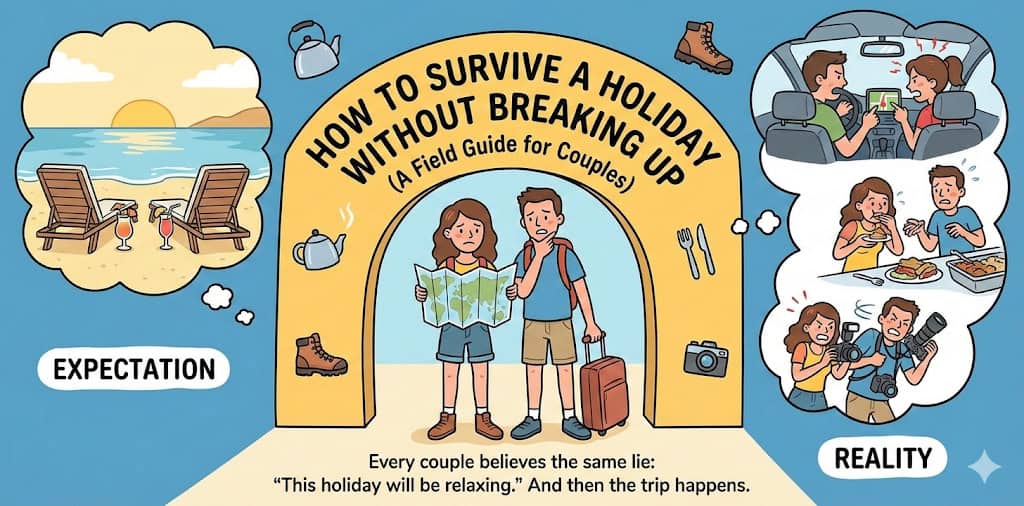
Every couple tells themselves the same beautiful lie as they pack for December: “This holiday is going to be so relaxing.”

Then you hit the N1 northbound during peak holiday traffic, the aircon packs up somewhere near Polokwane, and one of you ate the last Liqui-Fruit.

Welcome to the South African Summer Holiday Experience™.

Here’s your field guide to surviving it without ending up in separate chalets.

Day One: The Great Unpacking Standoff

You arrive at your self-catering unit in Plett (or your timeshare in Umhlanga, or that Airbnb near Clarens that looked bigger in the photos).

One of you immediately starts unpacking. Methodically. With a system. Toiletries arranged by size. Sunscreen in the bathroom. Biltong in a Tupperware.

The other one drops the bags and announces: “I’m going to the pool.”

What follows is a silence so loud it could drown out the Hadedas.

You’re not fighting about suitcases—you’re fighting because one needs order to relax, and the other needs freedom.

The Fix: Sit down for two actual minutes and say out loud: “Here’s what I need to feel settled.” Then—and this is the tricky bit—repeat back what your partner just said. Not with an eye-roll. With actual words.

You’ll discover you’re not fighting about suitcases. You’re fighting because one of you needs order to relax, and the other needs freedom. Neither is wrong. Both are just… very committed to their method.

The Daily Activity Wars (Or: “Why Are We Even Here?”)

December 26th, 6:47am.

One of you springs out of bed like a meerkat on Savanna Dry, ready to hike Robberg, hit the craft markets, photograph penguins, and possibly squeeze in a wine tasting before lunch.

The other groans from under a pillow: “But we’re on holiday.”

Cue the passive-aggressive breakfast where one person aggressively butters toast while the other scrolls through TripAdvisor with increasing hostility.

Each person gets one non-negotiable for the day—say them out loud, repeat them back, find the overlap.

The Fix: Before you leave the room, each person gets one non-negotiable for the day. Your partner gets to want their thing. You get to want yours. Say them out loud. Repeat them back. Find the overlap.

Example: “I need one morning to sleep past 8.” / “I need to see at least one thing that’s not this couch.”

Suddenly you’ve got a plan: Sleep in tomorrow. Explore today. Everyone lives.

The GPS Incident (It’s Always an Incident)

You’re driving to that restaurant everyone raved about. The one “only 15 minutes from town.”

Except Google Maps has decided you’re somehow in the ocean, your partner is reading directions from a screenshot they took three days ago, and you’ve just missed the turnoff for the third time.

Someone says, very quietly: “I told you it was back there.”

The other person grips the steering wheel like it owes them money.

It’s not about the turn—it’s about feeling competent and heard.

The Fix: Stop. Breathe. Say the actual fear out loud: “I’m worried we’ll waste the whole evening lost.” / “I’m scared you think I’m useless at navigating.”

Suddenly it’s not about the turn. It’s about feeling competent and heard. Pull over. Regroup. Maybe laugh at how ridiculous this is. (Spoiler: it’s very ridiculous.)

The Hunger Games

It’s 2pm. You’ve been walking around some charming village for three hours. The sun is aggressive. You’re both claiming you’re “fine,” but one of you is chewing the inside of their cheek and the other is dangerously silent.

This is the danger zone. Hanger + heat + holiday crowds = a fight about something completely unrelated that you’ll both regret.

The Fix: Adopt this as your holiday constitution: “We do not make decisions while hungry.”

Find the nearest Wimpy. Sit down. Order a toasted cheese. Rehydrate. Then discuss where you’re going next.

You’ll be amazed how reasonable your partner becomes after carbs.

The Photo Shoot That Never Ends

One of you is living their best influencer life, capturing every sunset, every latte, every pair of sunglasses artfully placed on a beach towel.

The other is wondering how many times a human being can be asked to “just stand there naturally” before they snap.

By day three, the photographer says: “Why are you pulling that face?” The subject replies: “This is my face.”

One wants to capture the holiday; the other wants to experience it—both are valid.

The Fix: Recognize what’s actually happening: One of you wants to capture the holiday. The other wants to experience it. Both are valid.

Say it: “I need to take photos to remember this.” Or: “I need some time to just be here without posing.”

Set a boundary: Ten minutes of photos. Then phones down for an hour. Everyone wins. Nobody murders anybody over a sunset selfie.

The Silent Scoreboard of Resentment

By Day Four, nobody’s saying what they’re actually thinking. You’re both just quietly tallying up your contributions like you’re auditing a marriage.

“I organized this entire trip.” / “I packed the car.” / “I drove for six hours.” / “I smiled politely at your family on Christmas Day.”

The Fix: Every evening, spend five minutes doing this:

  • One thing you enjoyed today
  • One thing that annoyed you (said kindly, not weaponized)
  • One thing you’d like tomorrow

Keep it short. No lectures. No TED Talks on “the emotional labor of holiday planning.”

Just: “I loved swimming with you today. The 45-minute stop at that farm stall was rough. Tomorrow I’d like to sleep in.” Done.

The Truth About December Holidays

It’s not the holiday that breaks you. It’s the heat. The traffic. The unspoken expectations. The assumption that your partner should just know what you need without you saying it.

Here’s the thing: If you stay curious about what the other person actually needs (instead of what you think they should need), if you repeat back what they say so they feel heard, and if you treat frustration as information instead of warfare…

You might actually come home still liking each other.

And maybe—just maybe—laughing about the time you almost broke up over a bunny chow in Durban.

The Real Secret

You’re on the same team. Even when it doesn’t feel like it. Even in traffic. Even when the Airbnb has no WiFi and someone forgot to pack the adapter.

Happy holidays, South Africa. May your cool drinks stay cold and your tempers stay cool. 🍻☀️🇿🇦

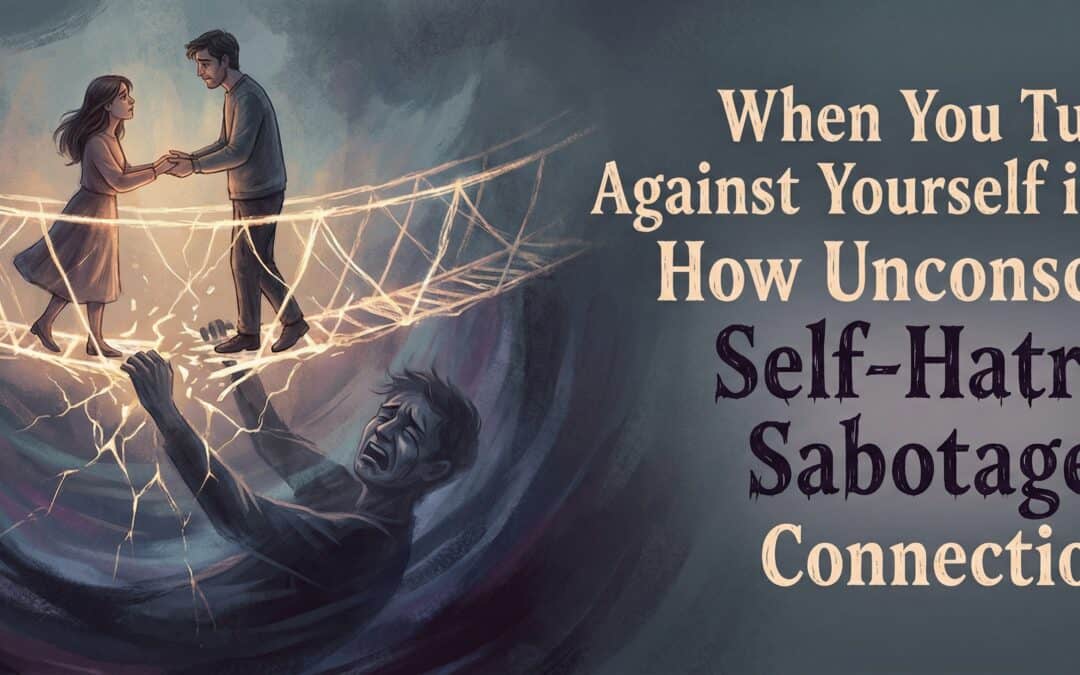
When You Turn Against Yourself in Love: How Unconscious Self-Hatred Sabotages Connection

When You Turn Against Yourself in Love: How Unconscious Self-Hatred Sabotages Connection

The Hidden Enemy Within

You’re lying in bed next to your partner, but you might as well be oceans apart. They reached for your hand earlier, and you pulled away—not because you don’t love them, but because some voice inside whispered, “You don’t deserve this.” Or perhaps you’ve spent the entire evening criticizing the way they loaded the dishwasher, knowing even as the words leave your mouth that this isn’t really about the dishes at all.

What if the most painful patterns in your relationship aren’t really about your partner? They’re about a quiet war you’re waging with yourself—one you often don’t even know you’re fighting.

Self-hatred rarely announces itself with clarity. It doesn’t wake you up declaring, “You’re worthless!” Instead, it operates in the shadows, disguised as perfectionism, self-sacrifice, or protective withdrawal. It’s the voice that says you need to earn love through constant giving, or that you should keep your needs small so you won’t be a burden, or that if your partner really knew you, they’d leave.

This unconscious self-rejection becomes the invisible third party in your relationship—the one calling the shots while you wonder why connection feels so difficult.

How Self-Hatred Sabotages Love

The Over-Giver’s Exhaustion

Sarah works full-time, manages most of the household, and always says yes when her partner asks for help with his projects. She prides herself on being supportive. But underneath, there’s a quiet belief: “If I stop giving, I’ll have nothing to offer. I’m only valuable for what I do.”

She resents her partner for not noticing her exhaustion, but she’s trained him not to see it. Every time she swallows her needs and pushes through, she reinforces her own unworthiness. The relationship becomes transactional—her service in exchange for the right to stay.

Over-giving isn’t generosity when it springs from the belief that you’re not enough as you are.

Over-giving isn’t generosity when it springs from the belief that you’re not enough as you are. It’s a form of self-abandonment, and eventually, it breeds resentment that corrodes intimacy from the inside out.

The Critic’s Shield

Marcus finds fault constantly. His partner leaves a towel on the floor, and he delivers a lecture on respect. She mentions feeling tired, and he points out that he’s tired too—why does she always need sympathy? The relationship has become a courtroom where he’s both judge and prosecutor.

But beneath the criticism lives terror. If he focuses on his partner’s flaws, he doesn’t have to face his own. If he stays vigilant about her imperfections, maybe she won’t notice his. Criticism becomes a wall against intimacy—because intimacy means being truly seen, and being seen feels dangerous when you believe that your true self is fundamentally unacceptable.

The Withdrawer’s Prison

Elena goes quiet when conflict arises. Her partner tries to talk about feeling disconnected, and she retreats into her phone or suddenly remembers urgent work. She tells herself she’s keeping the peace, avoiding drama. Really, she’s avoiding exposure.

The distance you create to protect yourself becomes the very thing that starves the relationship of oxygen.

Deep down, she believes that her feelings are too much, her needs are burdensome, her very presence might be unwelcome if she asks for anything real. So she makes herself small. She withdraws not just physically but emotionally, creating a buffer zone between her vulnerable self and the risk of rejection.

But this protective strategy backfires. The distance she creates to protect herself becomes the very thing that starves the relationship of oxygen. Her partner feels shut out, and Elena feels more alone than ever—trapped in a prison of her own making.


The Roots Beneath the Surface

These patterns don’t emerge from nowhere. They’re adaptations, learned long before your current relationship began.

Perhaps you grew up in a home where love felt conditional—available when you performed well, withdrawn when you didn’t. Maybe a parent was depressed or overwhelmed, and you learned that your needs were a burden. Or perhaps you faced criticism or neglect that taught you that something about you was fundamentally wrong.

Children are meaning-making creatures. When we experience pain or rejection, we rarely blame the limitations of the adults around us. Instead, we conclude: “There must be something wrong with me.” This belief gets wired into our nervous system, our sense of self, our understanding of how love works.

Then we grow up and bring these invisible contracts into our intimate relationships, unconsciously recreating familiar dynamics even as we consciously long for something different.

The Path Back to Yourself—and Each Other

Healing self-hatred isn’t about positive thinking or affirmations plastered over deep wounds. It requires something more honest: the willingness to turn toward yourself with curiosity instead of judgment, and to let your partner witness this journey.

Practice 1: Notice the Inner Narrative

Start by simply paying attention to the voice in your head, especially in moments of conflict or disconnection with your partner.

When you feel yourself pulling away, criticizing, or over-functioning, pause and ask: “What am I telling myself right now about who I am?” You might hear things like:

  • “I’m too needy.”
  • “I’m not doing enough.”
  • “If they knew the real me, they’d leave.”
  • “I always mess things up.”

Don’t try to change these thoughts yet. Just notice them. Write them down. The act of witnessing begins to loosen their grip.

Practice 2: Share the Discovery

This is where courage comes in. The next time you catch yourself in one of your protective patterns, try naming it out loud to your partner—not as confession but as invitation.

It might sound like:

  • “I notice I’m criticizing how you’re cooking dinner, but I think what’s really happening is I’m anxious about something at work and I don’t know how to ask for comfort.”
  • “I’m pulling away right now, and I realize it’s because I’m afraid that if I tell you what I really need, you’ll think I’m too much.”
  • “I keep saying yes to everything, but underneath I’m terrified that if I don’t keep giving, you won’t want me anymore.”
Real intimacy emerges when two people can see their wounds clearly and choose connection anyway.

This kind of vulnerability transforms the dynamic. Instead of your partner experiencing only the defensive behavior—the criticism, withdrawal, or exhausting over-functioning—they get to see the frightened, human part of you underneath. This creates space for connection instead of reaction.

Practice 3: The Dialogue of Self-Acceptance

This exercise helps partners witness and validate each other’s journey toward self-acceptance.

Step One: The Speaker Shares

Choose who will speak first. The speaker completes these sentences:

  • “One way I’ve been turning against myself in our relationship is…”
  • “The old message I’m carrying is…”
  • “What I’m really longing for is…”

For example: “One way I’ve been turning against myself is by withdrawing when I feel hurt instead of telling you. The old message I’m carrying is that my feelings are too much and will drive people away. What I’m really longing for is to feel safe being honest about what’s happening inside me.”

Step Two: The Listener Mirrors

The listener reflects back what they heard, word for word if possible: “So what I’m hearing you say is…” This isn’t about agreeing or fixing—just accurate listening.

Step Three: The Listener Validates

The listener says: “You make sense. I can understand how you might feel that way because…” This acknowledges the logic of the speaker’s experience, even if it’s based on old wounds rather than current reality.

Step Four: The Listener Empathizes

The listener imagines what this might feel like: “I imagine that when you carry this belief, you might feel…” (lonely, scared, exhausted, etc.)

Step Five: Switch Roles

Now the listener becomes the speaker and shares their own pattern of self-rejection.

This practice does something profound: it externalizes the internal conflict. The self-hatred that operated in isolation now has to reveal itself in the light of your partner’s compassionate witness. That changes everything.

Practice 4: Catch the Repetition

Once you’ve identified your pattern, you can begin catching it in real time—ideally before it fully unfolds.

Create a gentle signal with your partner. When you notice yourself starting to over-give, withdraw, or criticize from that defended place, you might say something like: “There it is—that’s the pattern we talked about. Can we pause?”

Then take a moment to reconnect with what you actually need or feel. Try completing this sentence: “What’s really true for me right now is…”

Maybe what’s really true is: “I’m scared. I need reassurance.” Or “I feel overwhelmed and I need help, but I’m afraid to ask.” Or “I’m judging myself harshly right now and I’m deflecting that onto you.”

Practice 5: Practice Receiving

For many people struggling with self-hatred, the hardest thing isn’t giving—it’s receiving. Compliments, help, affection, reassurance—all bounce off the armor of unworthiness.

You can be imperfect, needy, angry, scared—fully human—and still be loved.

Deliberately practice letting love in. When your partner expresses appreciation, affection, or offers support, pause. Notice the urge to deflect, minimize, or immediately reciprocate to balance the scales.

Instead, simply say: “Thank you. I’m going to let that in.” Then take a breath and actually feel it. You might feel vulnerable, uncomfortable, even tearful. That’s okay. You’re retraining your nervous system to recognize that you’re worthy of receiving, not just giving.

A Different Kind of Commitment

Healing self-hatred within a relationship requires something radical: the willingness to disappoint the inner critic that has been running the show. That critic promised to keep you safe by making you perfect, invisible, or indispensable. But safety purchased at the cost of authenticity isn’t safety—it’s a comfortable prison.

Real intimacy emerges when two people can stand before each other, see their own and each other’s wounds clearly, and choose connection anyway. Not because you’ve fixed yourself into lovability, but because you’ve recognized that you were always lovable—you just forgot.

Your partner can’t heal your self-hatred. But in the spaciousness of a relationship where both people are willing to bring their hidden rejections into the light, something remarkable becomes possible: you begin to internalize a different experience. You discover that you can be imperfect, needy, angry, scared—fully human—and still be loved. Not despite these qualities, but inclusive of them.

This is the deeper commitment underneath the commitment to stay together: the commitment to stop abandoning yourself in the name of love, and instead to bring your whole, complicated, beautiful self to the shared space between you.

The war you’ve been waging against yourself doesn’t have to continue. You can lay down your weapons—the criticism, the withdrawal, the exhausting over-giving. You can turn toward yourself with the same kindness you’d offer a frightened child.

And your relationship can become not just a place where two people coexist, but a sanctuary where two people practice, together, the revolutionary act of coming home to themselves and each other.

The journey from self-rejection to self-acceptance isn’t linear, and it’s rarely easy. But every moment you choose curiosity over criticism, vulnerability over withdrawal, and honest need over compulsive giving, you’re rewiring decades of conditioning. You’re teaching your nervous system that it’s safe to be real. And you’re creating the conditions for the kind of love you’ve always longed for—the kind that sees you completely and says, “Yes. You belong here. You always have.”

The Space Between Us Is Alive

The Space Between Us Is Alive

The Space Between Us Is Alive

Have you ever walked into a room where two people just had a fight? You can feel it hanging in the air—thick, tense, uncomfortable. Or think about those moments when you and your partner are perfectly in sync: you catch each other’s eyes across a crowded room and just know what the other is thinking. That invisible something you’re sensing isn’t just your imagination. According to Imago Relationship Therapy, it’s real. It’s alive. And it’s called the Space-Between.

Your Relationship Is a Third Entity

We typically think about relationships in terms of “you” and “me”—two separate people trying to get along, compromise, and hopefully stay in love. But what if that’s not the whole picture? What if the relationship itself is something more than the sum of its parts?

Imago Relationship Therapy introduces a revolutionary idea: the Space-Between. This is the invisible but tangible field that exists between you and your partner. It’s not inside you, and it’s not inside them—it exists in the relational space you share. And here’s the remarkable part: you’re both constantly creating and recreating this field with every interaction, every word, every look, every tone of voice.

The Space-Between is real and alive—you’re both constantly creating it with every interaction.

Think of it like the air in your home. You both breathe it. You both affect its quality. When one person “pollutes” it with criticism, defensiveness, or contempt, you both end up breathing that toxic air. When one person purifies it with kindness, curiosity, or appreciation, you both benefit from that nourishment.

This isn’t just a poetic metaphor. The Space-Between has actual properties that can be felt and even measured. It has temperature (warm or cold), texture (smooth or jagged), and most importantly, it has qualities like safety, curiosity, and empathy—or their opposites: danger, judgment, and indifference.

Every Gesture Matters

Once you understand that the Space-Between is real and alive, everything changes. That eye roll during dinner? You’re not just expressing your frustration—you’re injecting poison into the field you both inhabit. That gentle touch on your partner’s shoulder when they’re stressed? You’re not just being nice—you’re actively healing and strengthening the relational space you share.

Every tone carries energy. Every glance transmits information. Every gesture is a brick you’re either building with or throwing. And because this field exists between you rather than within you, your partner can’t help but be affected by what you put into it, just as you can’t help but be affected by what they contribute.

Every tone carries energy. Every gesture is a brick you’re either building with or throwing.

This is why couples often report feeling like they’re “walking on eggshells” or like “everything I say is wrong.” They’re not imagining it. The Space-Between has become contaminated with accumulated hurt, defensiveness, and fear. Both partners are now living in a toxic relational atmosphere that they co-created, often without even realizing what they were doing.

But here’s the hopeful flip side: if you can pollute the Space-Between, you can also purify it. If you can wound it, you can also heal it. And unlike trying to change your partner (which never works), changing what you contribute to the Space-Between is entirely within your control.

The Reactivity Trap

Most relationship damage happens not in the big blowout fights, but in the thousands of small moments of reactivity we barely notice. Your partner makes a comment. You feel a twinge of irritation. You let it show in your voice. They sense your irritation and get defensive. You notice their defensiveness and escalate slightly. Round and round it goes, each of you reacting to the other’s reaction, until the Space-Between is so charged with negativity that even neutral comments feel like attacks.

The insidious thing about reactivity is that it feels justified in the moment. Your partner did say that annoying thing. You are responding to something real. But what we don’t see is that our reaction creates the very atmosphere we’re complaining about. We breathe out frustration, and then we’re surprised when we breathe in tension.

Your reaction creates the very atmosphere you’re complaining about.

Quantum physics tells us that the observer affects what’s being observed. In relationships, the Space-Between works similarly: you can’t step outside of it to analyze it objectively. You’re always part of the field you’re trying to understand. Your very attempt to examine what’s wrong can either heal the space or contaminate it further, depending on how you approach it.

This is why blaming never works. When you point at your partner and say “You’re the problem,” you’re polluting the Space-Between with judgment and defensiveness. Even if your partner is doing something problematic, your blame ensures that the relational field becomes too toxic for them to acknowledge it or change.

The Nightly Practice: Becoming Conscious Gardeners

So how do you begin to take responsibility for the invisible-but-real field you’re co-creating? Start with a simple practice that takes less than five minutes but can transform your relationship over time.

Before bed each night, sit together (or if you’re apart, do this on a call) and ask yourselves: “What did we feed the Space-Between today—safety or fear?”

This isn’t about keeping score or cataloging everything your partner did wrong. It’s about becoming conscious of your joint creation. Maybe you both stayed calm during a stressful conversation about money—that fed safety. Maybe you snapped at each other during the morning rush—that fed fear. Maybe you laughed together over dinner—that fed connection. Maybe you scrolled on your phones instead of talking—that fed disconnection.

Just notice. Be honest. Hold the awareness together that you’re both breathing the same relational air, that you’re both living inside this field you’re creating.

Then, make a small commitment: name one small act that could clear or nourish the Space-Between tomorrow. Not a grand gesture or complete transformation—just one small thing. Maybe it’s greeting each other with a hug when you get home from work. Maybe it’s taking three deep breaths before responding when you feel triggered. Maybe it’s saying one specific thing you appreciated about your partner that day.

The key word is small. You’re not trying to fix everything. You’re trying to become conscious co-creators instead of unconscious polluters.

Living in the Field You’re Creating

The Space-Between concept changes everything about how we approach relationship difficulties. Instead of “What’s wrong with you?” or even “What’s wrong with me?”, the question becomes: “What’s happening in the field we’re co-creating, and how can we both take responsibility for healing it?”

You’re not opponents; you’re partners working together to create a relational environment where you both can thrive.

This shift moves you from an adversarial stance to a collaborative one. You’re not opponents; you’re partners working together to create a relational environment where you both can thrive. When the Space-Between is contaminated with reactivity, you’re both suffering—even the person who “started it.” When the Space-Between is filled with safety, curiosity, and empathy, you’re both nourished—even if one person is going through a difficult time.

The relationship isn’t something that happens to you. It’s not something your partner is responsible for. It’s a living field that you’re both breathing, both inhabiting, both creating with every moment of every day. The question isn’t whether you’re affecting it—you are, constantly. The question is whether you’re doing so consciously or unconsciously.

Tonight, before you sleep, take a moment to sense the Space-Between. What does it feel like right now? What did you both contribute to it today? And what one small act could begin to clear it tomorrow?

The Space-Between is alive. And so is your power to heal it.

The Fight That Brought Us Closer

The Fight That Brought Us Closer

The Fight That Brought Us Closer

Rain tapped the windows as she checked the clock—9:27 PM. He walked in, damp and weary, bracing for impact. Instead of a lecture, she asked, “Are you okay?” He blinked, surprised. “I’m sorry I’m late,” he said. “I got stuck at work. I should have called.”

They moved to the couch. She shared her feelings without blame: “I get scared and unimportant when it’s this late.” He listened without defense: “It makes sense you’d feel that way.” Then he added truth without excuse: “I get tunnel vision. But you matter more than any job.”

Speak-and-listen replaced attack-and-defend.

The room shifted from tension to tenderness. No one won; they won together. Gratitude crept in where suspicion lived. He offered a concrete step: a reminder to check in if he’s stuck late. She offered trust: to ask and not assume the worst. They inched closer on the couch, both relieved.

This wasn’t the absence of conflict; it was the transformation of it. They practiced a new loop: speak-and-listen, validate-and-repair. They added evening appreciations and quick cleanups of small hurts. These simple moves built a sturdier kind of closeness, one evening at a time.

By bedtime they felt the difference. They fell asleep tangled together, not on opposite edges of the bed. Tomorrow would bring new challenges, but they now had a path: small moments of repair, repeated, that grow trust strong enough to hold their differences.

No one won the argument; they won together.

Difference isn’t a threat—it’s an invitation.

Small moments of repair build a love that lasts.
Beneath the Anger, a Shared Pain

Beneath the Anger, a Shared Pain

Beneath the Anger, a Shared Pain

They sat on opposite ends of a loveseat, unsure what would happen next. The room was quiet and warm. With gentle guidance, she spoke first: “When you stay late without telling me, I feel like I don’t matter.” He wanted to defend himself, but chose to listen. He mirrored back what he heard, softly, and let her feelings land.

Her tone wasn’t sharp now; it was aching. For the first time, he felt the depth of her loneliness. Something in his chest softened. He said, “It makes sense you’d feel that way.” A small knot loosened inside her. Validation—the honest acknowledgment that her experience was real—lightened years of tension.

Beneath every outburst was the same plea: Do you see my pain?

Then came his turn. He spoke haltingly: “I work late to be a good provider. But sometimes… I hide at work because I feel like I can’t make you happy.” He swallowed. “When you’re upset, I hear that I’m failing—just like when I was a kid.” He described a childhood of never being enough: 98 wasn’t 100, effort was always almost.

Through tears she mirrored his words: “When I criticize, you feel like that little boy again—bracing for impact.” She had mistaken his shutdown for indifference; it was actually hurt. Compassion began to replace resentment. He covered his face and nodded. The room felt suddenly softer, safer.

They had argued for years over who was right. In this moment they discovered something better: both were real. Her hurt did not negate his; his pain did not diminish hers. By honoring each reality side by side, they found a way forward they had never seen before.

Her hurt did not negate his, and his pain did not diminish hers.

The breakthrough was simple, not easy: listening without defense. It didn’t erase their differences, but it turned blame into understanding. They left the room emotionally spent, hands intertwined, aware that real change would take practice—yet hopeful in a way they hadn’t felt in years.

Listening without defense turned blame into understanding.

Two truths can stand side by side and deepen love.