

Every December, churches fill up. Candles are lit, carols echo, nativity scenes go up.
We celebrate the birth of Christ. We speak about Holy Love. God’s Love. We sing, “Love came down at Christmas.”
But here’s the hard question:
If you say you believe in God’s love, but the people closest to you experience you as distant, harsh, critical, or checked out… what is that belief worth in real life?
Knowing about love and living love are two different things.
This article is about that gap.
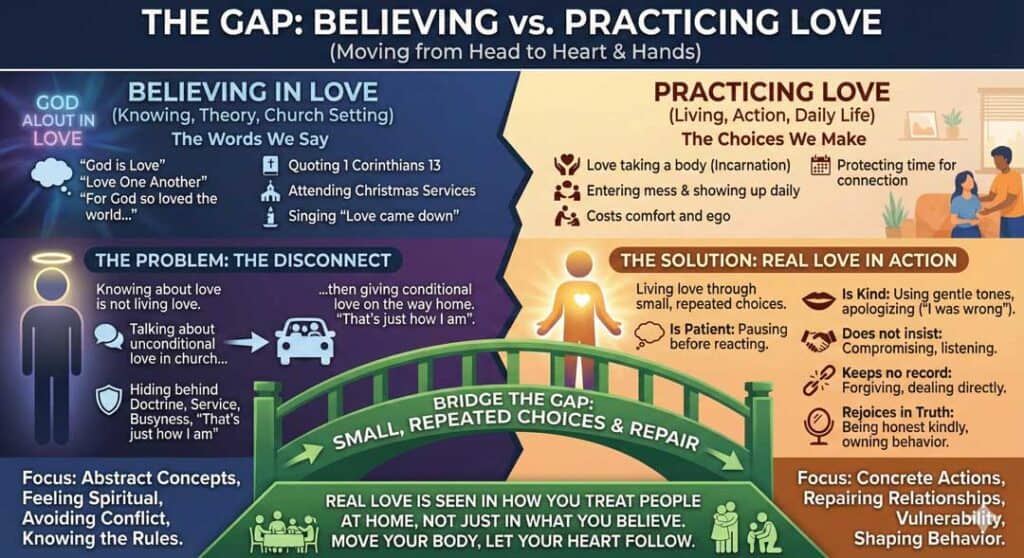
The Problem: We “Believe” in Love but Don’t Practice It
You know the words:
- “God is love.”
- “Love one another.”
- “For God so loved the world…”
You might even be able to quote 1 Corinthians 13 from memory.
But:
- You snap at your partner when you’re stressed.
- You shut down when someone needs a real conversation.
- You keep score instead of forgiving.
- You stay silent when you should apologise.
You can sit in a Christmas service talking about unconditional love, then give your family very conditional love in the car on the way home.
The issue is not that you don’t know enough. The issue is that you don’t practice what you already know.
Christmas: Love That Took a Body
The central Christian claim at Christmas is simple: Love did not stay an idea. Love took a body.
- God didn’t send a concept.
- God didn’t send a rulebook.
- God didn’t send “thoughts and prayers” from a distance.
God’s love moved into human life – with crying, feeding, waiting, growing, listening, walking, touching, healing.
If you say you honour that, but your love stays in your head or in your church building, you’ve missed the point.
Real love:
- Enters mess.
- Shows up in small daily moments.
- Costs you comfort and ego.
Holy Love is not sentimental. It is concrete.
From Knowing God’s Love to Living God’s Love
Think of it like this:
- Knowing God’s love = “I’ve heard the story, I agree with it.”
- Trusting God’s love = “I let it matter for me personally.”
- Living God’s love = “I let it shape how I treat people.”
You move from “knowing” to “living” through small, repeated choices, not through one emotional church service.
Ask yourself:
If someone filmed you at home for a week, would they conclude: “This person believes in a God of love” based only on how you treat others?
If the answer is no, don’t defend yourself. Let it be a wake-up call.
What Real Love Looks Like in Daily Life
You don’t need to guess. Scripture already gives a clear picture (1 Corinthians 13). Translate that into daily behaviour:
Real love:
Is patient
- You pause before reacting.
- You give people time to finish their sentence.
Is kind
- You use a gentle tone, especially with those closest to you.
- You look for one small way to lighten someone’s load today.
Does not insist on its own way
- You can say, “Let’s do it your way this time.”
- You can compromise on plans, even when you’re convinced you’re right.
Keeps no record of wrongs
- You stop bringing up that old mistake in every argument.
- You deal with issues directly instead of storing them as ammunition.
Rejoices with the truth
- You tell the truth kindly, instead of lying to keep the peace.
- You face your own behaviour honestly, without excuses.
None of this is mystical. It is hard. It is simple. It is concrete.
How We Dodge Real Love (Even While Talking About God)
Here are some common ways you avoid living love while pretending you’re still being “spiritual”:
Hiding behind doctrine
- You debate theology but won’t apologise.
Hiding behind service
- You help everyone at church, but your family gets your leftovers.
Hiding behind busyness
- “I’m doing important things for God,” becomes an excuse for emotional absence.
Hiding behind “that’s just how I am”
- You use personality as a shield against growth.
Every time you do this, you disconnect your faith from your relationships. You are “celebrating” God’s love while withholding your own.
Bringing Holy Love Into Your Relationships
If Christmas is about love taking on flesh, then your task is to let love take flesh in your body:
In your face
- Softening your expression when your partner talks.
- Really looking at your child when they show you something.
In your mouth
- “I was wrong. I’m sorry.”
- “I’m listening. Tell me more.”
- “I appreciate you, even though we’re struggling.”
In your hands
- Helping with the work nobody sees.
- A gentle touch on the arm when someone is upset.
In your calendar
- Protecting time for the people who matter.
- Saying no to some “good things” so you can say yes to real connection.
You don’t need to fix everything at once. Choose one concrete way to let God’s love move through you today.
When You Fail (Because You Will)
You will lose your temper. You will withdraw. You will say something sharp and regret it.
Living love is not about perfection. It’s about repair.
When you fail:
- Notice it – “I spoke harshly just now.”
- Own it – “I’m sorry, that was unfair.” No excuses. No blaming.
- Ask what the other person needs – “How did that land for you?” “What do you need from me now?”
- Try again – Show, with your next action, that you’re serious.
This is how grace and Holy Love become visible in a relationship: not in never hurting each other, but in how you repair when you do.
A Christmas Prayer You Live, Not Just Say
If you want one simple way to realign this season, try this short daily prayer and back it up with action:
“God of Love, Show me one person I can love well today, and one concrete way to do it.”
Then:
- Send the message.
- Make the call.
- Listen without defending.
- Offer the hug.
- Start the repair conversation.
Don’t wait to “feel spiritual”. Move your body in the direction of love, and let your heart follow.
Closing: If Love Doesn’t Change How You Treat People, It’s Still Theory
Celebrating the birth of Christ without changing how you treat people at home is like celebrating bread while never eating.
- If God is love, your faith should make you more patient, not more arrogant.
- More humble, not more defensive.
- More present, not more absent.
Real love is not mainly seen in church services, candles, or carols. It is seen in the way you speak to your partner in the kitchen, your kids in the car, your family at the table.
Holy Love isn’t only something you sing about. It is something you practice, one relationship, one conversation, one awkward apology at a time.
This was just what I needed today. I love your beautiful challenges. Thank you for writing this.