Why You Married Someone So Different From You

Why You Married Someone So Different From You

Why You Married Someone So Different From You

You didn’t pick the wrong person. The differences between you and your partner are not the problem — they are the point.


You didn’t pick the wrong person. You picked the right one for the wrong reason.

Sit with that for a moment. The partner you sometimes want to throttle — the one who loads the dishwasher wrong, who feels too much or not enough, who wants to talk when you want silence and wants silence when you finally want to talk — you didn’t choose them by accident. Something in you picked them on purpose. And that something knew what it was doing.

Most couples arrive at a point where the difference between them stops feeling romantic and starts feeling like a problem that needs solving. One of you is early, the other is late. One of you saves, the other spends. One of you wants connection through words, the other through touch, the other through just being in the same room without anyone saying anything. At first you found it charming. Now you find it infuriating. And you start to wonder, quietly: did I marry the wrong person?

You didn’t. But you are asking the wrong question. The real question is: what is all this difference for?

Difference is not a mistake in your relationship. It is the design of it.

The fantasy of the matching pair

Somewhere along the way we got sold the idea that a good relationship is one where two people agree about everything. Same values, same rhythms, same love languages, same emotional temperature. If you are in conflict, the logic goes, something has gone wrong. Either you picked badly, or one of you needs to change to match the other.

This is nonsense, and it ruins relationships.

Look at any couple that has actually lasted — not survived, but grown — and you will not find two identical people. You will find two people who figured out how to let their differences rub against each other without tearing each other apart. The spark that drew you to your partner in the first place was never sameness. It was the thing in them that you didn’t have. The calm to your intensity. The playfulness to your seriousness. The steadiness to your spontaneity. You didn’t fall in love with a mirror. You fell in love with a missing piece.

And then, somewhere between the honeymoon and the laundry pile, the missing piece became the sore spot. The calm started to feel like indifference. The playfulness started to feel like avoidance. The steadiness started to feel like a wall you couldn’t get through. The very thing that drew you in became the thing you now argue about.

Why the power struggle shows up (and why it’s not a disaster)

There is a predictable pattern in every long-term relationship. It goes something like this: bliss, disappointment, war. You meet. It feels like home. Then the cracks show. Then you start fighting about the cracks. Then you start fighting about whose fault the cracks are. Then you start wondering if maybe this whole thing was a mistake.

That third stage — the war stage — has a name in our work. We call it the power struggle. And here is the surprising thing about it: the power struggle is not a sign that your relationship is broken. It is a sign that your relationship is working exactly the way it was designed to.

The thing you find hardest about your partner is usually the thing you most need to learn.

The differences between you are touching something old. Something from long before you met. Your partner didn’t create those tender places in you — but they are standing right on top of them. When they do the thing they do (pull away, come on too strong, get silent, get loud), it lands in a place that was already sore. And you react not just to what they did, but to everything that old soreness remembers.

That is why the fights feel so big. That is why you can’t let it go. That is why the same argument keeps coming back wearing different clothes. The difference between you is not the problem. The difference between you is the doorway.

From opposition to creation

Here is the shift that changes everything. Stop treating your differences like obstacles to overcome. Start treating them like ingredients.

Two people who see the world the same way can only make one kind of life together. Two people who see the world differently can make something neither of them could have imagined alone. But only if they stop fighting about whose way is right.

The couple who figures this out is not the couple who argues less. They are the couple who has learned how to argue differently. Instead of trying to win, they try to understand. Instead of trying to change each other, they let themselves be changed by each other. Instead of treating difference as a threat, they treat it as information — something important that their partner is trying to tell them about how the world looks from where they are standing.

This is not soft. It is not weakness. It is one of the hardest things two human beings can do. But it is also where every real creative force in your relationship comes from.

What this looks like in a real kitchen

Let’s get concrete. You are tired. Your partner has left their stuff on the counter for the third time this week. You feel the old thing rising — the tightness, the voice in your head that says they don’t care, they never listen, this is who they are and it’s never going to change.

The old way: snap, criticise, roll your eyes, slam a cupboard, give them the silent treatment, or deliver the speech you’ve been rehearsing in your head.

You and your partner are not two separate people sharing a house. You are a system.

The new way: pause. Notice that the size of your reaction is bigger than the size of the mess. Notice that something old is touching something present. Then — and this is the hard part — get curious instead of hostile. Maybe the counter is not really about the counter. Maybe there is a conversation underneath the conversation that neither of you has ever had.

In the workshop we teach couples how to have that conversation. Not a fight dressed up as a talk. A real conversation, structured in a way that makes it safe for both of you to say the true thing — the thing under the thing — without one of you shutting down and the other attacking.

What your relationship is trying to teach you

Every difference between you and your partner is pointing at something. The place where you clash is the place where you are both being invited to grow. Not to become like each other. To become more fully yourselves, with the help of someone who sees the world differently enough to stretch you into new shape.

Your partner’s way of loving, of working, of fighting, of resting — it is not wrong. It is not better than yours. It is different. And that difference is a teacher, if you will let it be.

The goal is not to turn your partner into a version of you. The goal is to build a relationship big enough to hold both of you, with your differences intact, and to let that container become the place where you both become more than you could have been apart.

The Getting the Love You Want workshop

This is the heart of the Getting the Love You Want workshop — two days in Pretoria, on 5 and 6 June 2026, where we help couples stop fighting their differences and start using them. You will learn a way of talking that turns opposition into understanding. You will see the pattern you and your partner have been caught in, probably for years, and you will experience — in the room, with your partner, in real time — what it feels like to step out of it.

You didn’t pick the wrong person. You picked the one who can help you grow.

This is not therapy. It is not couples counselling. It is a structured, hands-on workshop built for couples who want to do the work together, without cameras on them or strangers interpreting their marriage. You and your partner do the work. We teach you how.

If you and your partner have been stuck in the same argument for months or years, and you are ready to try something that actually teaches you a different way, this is your invitation. Spaces are limited — the group stays small so that every couple is properly held.

Your differences are not the enemy. They are the doorway. Come and learn how to walk through it together.

Getting the Love You Want · Couples Workshop

Pretoria · 5–6 June 2026

Two days with your partner. A method you take home. Small group, limited places.

Register for the workshop →
The Science Is Clear: Love Is the Best Medicine

The Science Is Clear: Love Is the Best Medicine

The Most Important Health Decision You’ll Ever Make

This Valentine’s month, forget the gym membership. Forget the diet plan. Forget the supplements lining your bathroom cabinet.

If you want to live longer, healthier, and happier, the science is unambiguous: invest in your relationship.

This isn’t romantic sentimentality. It’s what 87 years of research has been telling us – and what we’ve been slow to hear.

Relationship satisfaction at age 50 is a better predictor of physical health than your cholesterol levels.

The Harvard Study That Changed Everything

In 1938, Harvard researchers began tracking the lives of 724 men – some from Harvard, some from Boston’s poorest neighbourhoods. They followed them through careers, marriages, divorces, children, grandchildren, illness, and death. The study is still running, now tracking the original participants’ children.

After 87 years and multiple generations, what did they find?

Robert Waldinger, the study’s current director, summarised it simply: “The key to healthy aging is relationships, relationships, relationships.”

The data was striking. Relationship satisfaction at age 50 predicted physical health better than cholesterol levels. People in warm, supportive relationships lived significantly longer than isolated individuals. And loneliness? Waldinger was blunt: “Loneliness kills. It’s as powerful as smoking or alcoholism.”

This wasn’t about having lots of friends or being socially busy. It was specifically about the quality of close relationships – and for most people, that means their intimate partnership.

The Numbers Don’t Lie

The Harvard study isn’t alone. A landmark 2010 meta-analysis of 308,000 participants found that strong social relationships confer a 50% increased likelihood of survival. To put that in perspective, social isolation carries a mortality risk equivalent to smoking 15 cigarettes daily – exceeding even the health impact of obesity.

How does this work biologically?

When you feel securely connected to your partner, your body responds. Cortisol – the stress hormone – drops. Blood pressure stabilises. Inflammation decreases. Even wound healing accelerates (couples in high-conflict relationships heal more slowly than connected couples).

Research from Kiecolt-Glaser’s lab at Ohio State demonstrated that partner touch literally changes your stress physiology. When partners hold hands during stressful situations, the brain’s threat response diminishes. We are neurobiologically wired to co-regulate – to calm each other’s nervous systems.

Social isolation carries a mortality risk equivalent to smoking 15 cigarettes daily.

Why We Need Each Other to Feel Calm

Stephen Porges’ Polyvagal Theory explains why connection is so central to our wellbeing. Our nervous systems evolved not just for individual survival, but for social engagement. The same neural pathways that keep us alive – regulating heart rate, breathing, and arousal – are the ones that detect safety or danger in our relationships.

When we feel safe with our partner, our vagal system activates rest-and-digest mode. We can think clearly, feel empathy, and engage creatively. When we feel threatened – whether by a predator or by disconnection from our partner – the same system triggers fight, flight, or freeze.

Sue Johnson, founder of Emotionally Focused Therapy, puts it plainly: “Our nervous systems are wired for connection. Emotional isolation is more disastrous for health than smoking, obesity, or lack of exercise.”

This is why relationship stress doesn’t just feel bad – it’s genuinely bad for you. And why relationship safety doesn’t just feel good – it’s genuinely good for you.

The Relational Paradigm: A Different Way of Seeing

Traditional psychology asked: “What’s wrong with you?” It located problems inside individuals – diagnosing, treating, fixing separate selves.

Imago Relationship Therapy operates from a different premise: the relational paradigm. Since connection is the defining feature of human nature, disconnection is the source of our deepest pain. And reconnection is the path to healing.

Daniel Siegel’s interpersonal neurobiology confirms this: the mind is “fully embodied AND fully relational.” We are not isolated brains; we are relational beings whose inner experience is shaped by our outer connections.

What does this mean practically?

It means that your relationship isn’t a nice-to-have addition to your wellbeing. It IS your wellbeing. The quality of the space between you and your partner directly shapes your physical health, emotional stability, and capacity for joy.

Your relationship isn’t a nice-to-have addition to your wellbeing. It IS your wellbeing.

Love as Biological Infrastructure

In South Africa, we face enormous daily stressors – economic pressure, crime concerns, traffic, load shedding, political uncertainty. In this context, it’s tempting to see relationship work as a luxury, something to attend to once the “real” problems are sorted.

The research says the opposite.

Your relationship is your primary stress buffer. A secure partnership doesn’t eliminate external stressors, but it changes how your body processes them. Couples who feel emotionally safe together show lower cortisol responses to stress, faster recovery from conflict, and greater resilience in the face of life’s challenges.

Barbara Fredrickson’s research on “positivity resonance” shows that love isn’t just a feeling – it’s a biological event. When partners share moments of genuine connection, their cardiovascular and immune systems synchronise. They literally come into rhythm with each other.

This is why investing in your relationship isn’t selfish or indulgent. It’s the foundation of everything else.

The Couples Who Thrive

Here’s what the research shows about couples who maintain health-giving relationships over time:

They prioritise safety. Not the absence of conflict, but the presence of emotional security. They know their partner will be there, will respond, will care.

They repair quickly. John Gottman’s research shows that it’s not whether couples fight that predicts longevity – it’s how quickly they reconnect after rupture. Thriving couples don’t let emotional debt accumulate.

They maintain a 5:1 ratio. Stable, happy couples have at least five positive interactions for every negative one. They’re generous with appreciation, affection, and attention.

They turn toward each other. Gottman found that couples who stayed together responded to each other’s “bids for connection” 86% of the time. Divorced couples? Only 33%.

They keep investing. They don’t assume love maintains itself. They treat their relationship as their most important asset – one that deserves ongoing attention and care.

The couples who thrive aren’t the ones who avoid challenges – they’re the ones who invest in becoming relationship masters.

What This Means for You

If the science is clear that your relationship is the most powerful predictor of your health and happiness, what does that call for?

Not passive hope that things will work out.

Not waiting until crisis forces your hand.

It calls for intentional investment – the same kind of focused attention you’d give to any critical area of your life.

This Valentine’s month, consider what it would mean to treat your relationship as the priority the research says it is. What if, instead of another dinner out or another gift that gets forgotten, you gave each other the gift of mastering love?

The Intensive Path

Our three-day Imago Couples Intensive offers something rare: concentrated time to focus exclusively on your relationship. Not crisis intervention – though it serves that too – but celebration, deepening, and mastery.

In three days, couples accomplish what often takes months of weekly sessions. They learn to dialogue differently, understand each other’s worlds, and build the safety that makes lasting love possible.

The couples who thrive aren’t the ones who avoid challenges. They’re the ones who invest in becoming relationship masters.

Your relationship is your best medicine. What would it mean to treat it that way?

Book your Imago Couples Intensive and give each other the gift of a thriving partnership – not just this Valentine’s, but for all the years to come.
Connection Isn’t Something You Get—It’s What You Are

Connection Isn’t Something You Get—It’s What You Are

Connection Isn’t Something You Get—It’s What You Are

Many couples think connection is something you get when you get married. Others think connection comes from “better communication.” Both ideas miss something important.

Marriage gives you proximity, not connection; you still have to practise being reachable and responsive.

Marriage gives you a legal bond and daily contact. Communication gives you words. But connection is deeper than a ring or a conversation. Connection is part of being human. You exist because you are connected. You became “you” in relationship with other people. From the first day of life, your nervous system learned: Am I safe? Am I seen? Does someone come back for me?

Connection Isn’t Something You Get—It’s What You Are

Connection is not a quality you acquire. It is an existential essence of who you are. The real question is not “How do we get connection?” The real question is: “How do we protect it, and how do we restore it when it gets ruptured?”

What “the space-between” means for couples

In Doing Imago Relationship Therapy in the Space-Between, Harville Hendrix and Helen LaKelly Hunt describe the relationship as a real “between” that you both influence. Think of it like the emotional atmosphere between you. It is not only inside you or inside your partner. It is in the space-between.

When the space-between feels safe, you relax. You talk, you laugh, you touch, you solve problems. When the space-between feels unsafe, you defend. You criticise, you shut down, you control, you avoid, or you act “fine” while feeling far away.

Connection is not a skill you earn; it is the human starting point, and disconnection is the wound.

Here is the key point: you are always connecting. Even silence is a form of connecting. Even sarcasm is a form of connecting. The question is whether your connecting creates closeness or distance.

Why connection gets ruptured (and why it feels so intense)

If disconnection did not matter, you could shrug it off. But disconnection hits your body like danger. That is not weakness. That is biology.

As children, all of us had moments where connection with a caregiver broke down. Sometimes it was big: anger, neglect, separation, chaos. Sometimes it was small but repeated: a parent who was busy, distracted, or emotionally unavailable. In the book, the authors describe rupture in connecting as a universal human experience. Those early ruptures shape your reflexes in adult love.

So when your partner rolls their eyes, forgets something, turns away, or says “whatever,” it can feel like more than a moment. It can feel like: I do not matter. I am alone. I am unsafe. That is when you go into protection mode.

Protection mode often looks like:

  • Attack: criticism, blame, raised voice, “always/never.”
  • Withdraw: silence, shutdown, leaving the room, distraction.
  • Control: lecturing, policing, fixing, insisting.
  • Pleasing: agreeing on the surface while resentment builds.

These are not “bad personality traits.” They are attempts to survive disconnection. The tragedy is that they usually create more disconnection.

The space between you becomes safe when you stop winning and start repairing.

Communication is not the same as connection

You can communicate and still feel alone. You can talk for hours and not feel met. Why? Because connection is not mainly about information. It is about experience: do I feel heard, valued, and emotionally held?

Here is a simple test:

  • If your “communication” ends with one of you feeling small, guilty, or unsafe, you shared words but lost connection.
  • If your “communication” ends with both of you feeling calmer, clearer, and closer, you built connection.

Connection requires a specific kind of communication: slow enough to be accurate, respectful enough to feel safe, and structured enough to stop the usual spiral.

A simple way to think about connection in daily life

Connection is built through small moments, not grand gestures. Each day, you make “bids” for connection: a comment, a question, a touch, a look, a sigh. Your partner responds in one of three ways:

  • Turning toward: “Tell me more.” Eye contact. A touch. Interest.
  • Turning away: distraction, short answers, phone, “later.”
  • Turning against: irritation, sarcasm, criticism.

Over time, turning toward builds trust. Turning away and turning against build loneliness, even if you share a home.

How to restore rupture in the space-between

Repair is not a speech. It is an action that reopens connection. In Imago, repair becomes easier when you use a structure. Structure lowers threat. It stops interruptions and defensiveness. It helps both of you stay present.

Try this 10-minute “repair” practice once this week:

  1. Set the intention: “I want to reconnect. I am not here to win.”
  2. One speaks, one listens: The speaker says one short sentence about their feeling and need (not a complaint). Example: “I felt alone earlier and I need a few minutes of attention.”
  3. Mirror: The listener repeats back what they heard. “What I hear you saying is…” (No arguing.)
  4. Validate: “That makes sense because…” (You do not have to agree. You make it understandable.)
  5. Empathise: “I imagine you might feel…”
  6. Small action: One concrete step. “Can I sit with you for 10 minutes now?” or “Can we plan a time tonight?”
  7. Close with appreciation: Each shares one appreciation for the other.

This is not magic. It is practice. The more you repair, the safer the space-between becomes.

Imago Dialogue gives you a repeatable way to repair ruptures before they become resentment.

The skill you need most is not “talking.” It is repairing.

Every couple ruptures connection. The difference between thriving couples and struggling couples is not whether they rupture. It is whether they repair.

If you want a practical path, read Doing Imago Relationship Therapy in the Space-Between. It explains why disconnection hurts so much, and it teaches a clear method for restoring the space-between. Then take the next step: book Imago Relationship Therapy or join an Imago workshop so you can learn the dialogue skills with support.

Do not wait until distance becomes normal. If you feel a rupture, treat it like a signal, not a verdict. Come back. Slow down. Use a structure. Repair the connection. That is how you build a relationship that feels alive.

Why a Clear Relationship Vision Matters in 2026

Why a Clear Relationship Vision Matters in 2026

Why a Clear Relationship Vision Matters in 2026

Many couples plan their careers, finances, and holidays. Yet they never plan their relationship with the same care. When there is no shared vision, daily pressure sets the agenda. You react to problems, you argue about symptoms, and you drift into routines you did not choose.

If you do not choose a direction for your relationship, your stress will choose one for you.

A vision is not a slogan. It is a practical description of what you want to build together and how you want to treat each other while you build it. It gives you a reference point when you feel disconnected. It also helps you stop turning your partner into the problem. Instead, you and your partner become the team facing the issue.

What a relationship vision actually does

A clear vision does three things:

  • It reduces confusion. You stop guessing what “a good relationship” means to each of you.
  • It creates alignment. You can say yes to what fits and no to what pulls you apart.
  • It builds safety. When you know the direction, small setbacks feel manageable.

Without a vision, you will still have goals. They just stay hidden and unspoken. Hidden goals usually come out as criticism, shutdown, control, or “fine, do what you want.” A vision brings those needs into the open so you can negotiate them with respect.

The 2026 question: are you planning from fear or from potential?

Most couples do not think they are fear-driven. Fear is often quiet. It shows up as “we must not end up like my parents,” “we cannot afford another fight,” or “I do not want to feel rejected again.” These are understandable. But when fear leads, the vision shrinks.

A fear-based vision tends to sound like this:

  • “We just want fewer fights.”
  • “We want things to be normal again.”
  • “We want to stop talking about hard topics.”

These goals are not wrong. They are incomplete. They focus on avoiding pain, not creating connection. Avoidance can calm things down for a while, but it rarely builds closeness.

A shared vision turns conflict into data: it shows you what needs attention, not who is to blame.

A potential-based vision is different. It asks: “What could this relationship become if we did the work?” It does not deny problems. It refuses to let problems define the future.

A potential-based vision tends to sound like this:

  • “We want a home where we speak with respect, even when we disagree.”
  • “We want to repair quickly after conflict and learn from what happened.”
  • “We want a strong friendship, a satisfying sex life, and reliable emotional support.”
  • “We want to parent as allies and protect our couple bond.”

Potential-based does not mean unrealistic. It means you plan for growth, not for survival.

What should your 2026 relationship vision include?

A good 2026 vision has clear areas. If you skip an area, it usually becomes the next argument.

1) Emotional climate

Describe the felt sense you want at home. Examples: calm, playful, warm, honest, supportive. Then define what that looks like in behaviour: tone of voice, how you greet each other, how you handle stress after work.

2) Conflict and repair

Conflict is normal. The vision is not “never fight.” The vision is “we know how to come back.” Decide how you will repair: time-out rules, a structured dialogue, apologies that include ownership and a next step.

3) Appreciation and admiration

Most couples under-dose appreciation. In 2026, make it measurable. For example: each of you shares two appreciations per day, or you do a weekly appreciation check-in.

A fear-based plan avoids pain; a potential-based plan builds the relationship you actually want to live in.

4) Time, attention, and rituals

Love needs contact. Decide on rituals that protect connection: a weekly date, a Sunday planning chat, a daily 10-minute reconnect, or a technology boundary after 20:30.

5) Intimacy and sexuality

Do not leave this to chance. Write what you want to feel: desired, safe, playful, connected, free to say yes and no. Add practices: honest conversations, slow touch, planned intimacy, or a shared learning goal.

6) Money and workload

Stress comes from uneven load more than from the amount of work. Your vision should include fairness: who carries what, how you decide, and how you revisit the agreement.

How to create your 2026 vision together

Do this as a 60–90 minute meeting. Put phones away. Keep it structured. Use a timer if you tend to interrupt.

  1. Start with the “why.” Each of you answers: “Why do I want a better relationship in 2026?” Keep it personal. No blaming.
  2. Name the fear. Each of you names one fear that could drive your planning. Example: “I fear being alone in the relationship.” Then add: “What I want instead is…”
  3. Name the potential. Each of you completes: “If we do this well, our relationship in December 2026 will feel like…”
  4. Choose 3 priorities. Pick three areas for the first 90 days. If you choose ten, you will do none.
  5. Write 3 weekly actions. Small, repeatable actions beat big promises. Examples: a 20-minute weekly dialogue, two appreciations a day, one date a week.

Keep your vision short enough to remember. A good format is one paragraph plus a bullet list of practices.

Your 2026 vision works when it becomes a weekly practice, not a once-a-year conversation.

How to know if your vision is working

Use simple markers you can track:

  • Repair speed: How long do you stay disconnected after a conflict?
  • Emotional bids: Do you respond when your partner reaches for you?
  • Appreciation ratio: Do positives clearly outnumber critiques?
  • Ritual consistency: Do you keep the weekly practices most weeks?

If the markers drift, do not panic. Adjust. A vision is a living agreement. It is not a test you pass or fail.

A simple 2026 vision statement you can adapt

“In 2026, we choose to act like a team. We speak with respect, even when we are stressed. We repair quickly after conflict and stay curious about each other’s inner world. We protect time for connection, we share the load fairly, and we build a relationship that supports both of us to grow.”

When you plan from potential, you still face hard days. The difference is that hard days do not define the relationship. They become moments where you practise the vision.

Dear 2025 Relationship: You Were a Lot… and We Appreciate You Anyway

Dear 2025 Relationship: You Were a Lot… and We Appreciate You Anyway

2025, The Year Your Relationship Did… Something

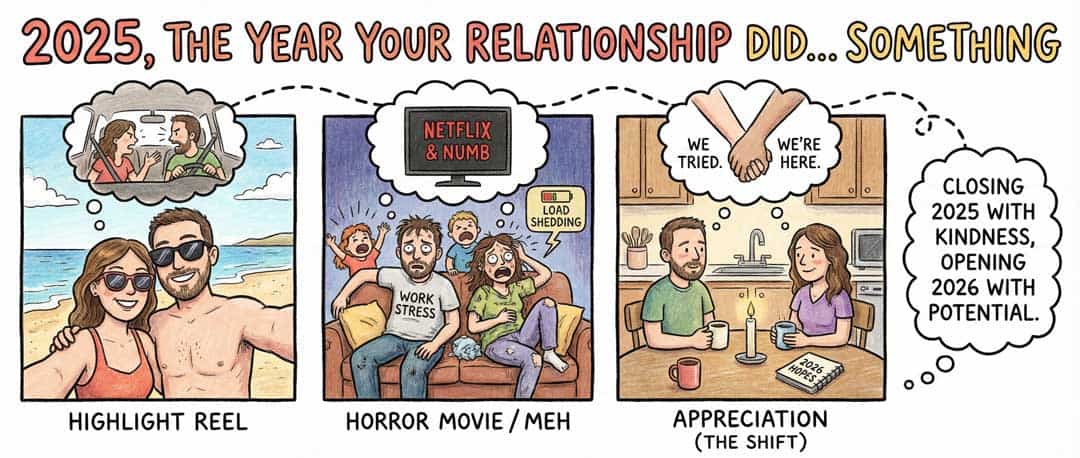
Maybe 2025 was romantic. Long walks, sunset selfies, those rare moments when you both laughed so hard you cried.

Maybe it was a soapie. Drama, tears, “we need to talk” on repeat, plot twists you didn’t see coming.

Maybe it was a crime scene (emotionally). Arguments that escalated, things said that can’t be unsaid, silences that lasted days.

Or maybe it was just… flat. Netflix and numb. Going through the motions. Not terrible, not wonderful, just there.

Here’s the truth: however it looked, you both did the best you could with what you knew.

This article isn’t about fixing everything before midnight on December 31st. It’s about laughing a bit, wincing a bit, then ending with appreciation instead of judgement. Because how you close off 2025 will determine how you open 2026.

2025 Relationship Status: Highlight, Horror Movie, or “Meh”?

Let’s be honest about the three main relationship profiles of 2025:

The Highlight Reel Couple

You posted the photos. The beach days, the braai sunsets, the matching takkies. From the outside, you looked like relationship goals. But you know the truth: half those smiles were staged after arguments in the car. You’re not fake, you’re just selective about what you share. And that’s okay.

The Disaster-but-Still-Here Couple

Fights. Tears. “We need to talk” became your most-used phrase. You threatened to leave (or thought about it) at least once. Money stress, family drama, work pressure—it all landed in your relationship like a bomb. But here’s the thing: you’re still here. That counts for something.

The Numb-and-Netflix Couple

Nothing dramatic happened. That’s the problem. You’re roommates who occasionally have sex. Conversations dried up to logistics: “What’s for supper?” “Did you pay the wifi?” You’re not fighting, but you’re not really connecting either. Just… existing side by side.

None of these profiles make you a failed couple—they show what you were up against.

Here’s what matters: none of these profiles make you a failed couple. They show what you were up against this year. And that’s worth acknowledging.

You Weren’t Lazy, You Were Overloaded

Let’s name the real enemies of your relationship in 2025:

  • Work stress that followed you home every single night
  • Kids who needed everything, all the time
  • Financial pressure that kept you both awake at 3am
  • Load shedding that ruined plans and frayed nerves
  • WhatsApp groups that never stopped pinging
  • Family obligations that drained your weekends
  • Unresolved childhood stuff that kept showing up in your arguments
  • Exhaustion. Just bone-deep, relentless exhaustion.

Your nervous systems were running on fumes. Fight-or-flight became your default setting. You weren’t choosing to be irritable or distant or defensive—you were surviving.

So let’s reframe the narrative: Instead of “we sucked at this relationship,” try “we were stretched thin and still showed up in imperfect ways.”

You weren’t choosing to be difficult—you were surviving.

That’s closer to the truth.

“We Tried Our Best” – What That Actually Looked Like

Your “best effort” in 2025 probably didn’t look like the therapy books said it should. But it was real. Here’s what imperfect trying looked like:

  • Sending a peace-offering meme instead of starting another fight
  • Going to bed angry but still making tea in the morning
  • Agreeing to talk… then both chickening out… but at least not ghosting each other in the same house
  • Apologising three days late instead of never
  • Staying home together even when you wanted to run away
  • Holding hands during the worst of it, even when you couldn’t find words
  • Not saying the cruelest thing you thought of (even though you wanted to)
  • Showing up for boring domestic tasks when romance was dead
  • Choosing to stay instead of choosing to leave

Effort doesn’t always look wise or polished. Sometimes it’s clumsy survival. Sometimes it’s just not making things worse. And sometimes, that’s actually heroic.

Judgement: The Fastest Way to Ruin 2026 Before It Starts

Here’s how judgement sounds in relationships:

  • “You never change.”
  • “You’re impossible.”
  • “This relationship is a joke.”
  • “I can’t believe I’m still dealing with this.”
  • “You always do this.”

When your partner hears that tone—the one that says “you’re fundamentally flawed and I’ve given up”—something shuts down inside them.

The effects of feeling judged:

  • You stop trying (because why bother if you’re already a failure?)
  • You hide your real feelings (because vulnerability gets punished)
  • You play it safe and repeat the same patterns (because risk feels too dangerous)
  • You defend yourself instead of being honest
  • You return the judgement (because hurt people hurt people)
Feeling judged in 2025 trains you to fail again in 2026.

Here’s the clear line: Feeling judged in 2025 trains you to fail again in 2026.

If you want different results next year, you need a different approach. And that approach is appreciation.

Appreciation: Not Flattery, Just Honest Recognition

Appreciation is not the same as fake positivity. It’s not pretending everything was fine when it wasn’t.

It’s not saying: “You’re perfect.” “We’re amazing.” “This year was great.”

It’s more like: “You really did keep trying, even when it was messy.” “I see the effort you made, even when it didn’t work out perfectly.”

Here’s what real appreciation sounds like:

“Thank you for sticking it out when things were rough this year. I know you wanted to leave sometimes. I’m glad you stayed.”

“I noticed you tried to listen more, even when you were tired and overwhelmed. That didn’t go unnoticed.”

“We had some horrible fights this year, but we always came back to talk. That matters more than the fights themselves.”

“You showed up for me when I was falling apart, even though you were barely holding it together yourself.”

“We didn’t get it right most of the time, but we kept trying. That’s actually pretty brave.”

Appreciation does something powerful: it calms the nervous system. It signals safety. It says “you’re not on trial here.” And when people feel safe, they can actually change.

A Simple 2025 Relationship Debrief (Without Blaming Each Other)

Want to actually process this year together? Try this guided structure for a year-end chat. Set aside 30-45 minutes, put phones away, and work through these questions:

1. What was hard this year for us?

Stay on “we”, not “you”. Example: “It was hard for us when work took over and we stopped having real conversations.” Not: “You never made time for me.”

2. Where did we actually show effort?

Name small wins: conversations you forced yourselves to have, repairs you attempted, moments of humour that broke the tension, showing up even when you wanted to hide.

Example: “We showed effort when we agreed to stop arguing in front of the kids, even though it meant biting our tongues.” “We showed effort that time we both apologised the same day instead of dragging it out for a week.”

3. What did we learn about ourselves?

This is about self-awareness, not blame. Example: “I realised I shut down when I feel criticised.” “I realised I get loud when I feel ignored.” “I learned I need more sleep before I can handle difficult conversations.”

4. What do we want more of in 2026?

Be specific. Not “more happiness” (too vague). Try: “More honesty, even when it’s uncomfortable.” “More laughter—we used to be funny together.” “More date nights, even if they’re just pizza and a drive.” “More sleep so we’re not always running on empty.”

Sample sentences to help you start:

  • “One thing that was hard for us this year was…”
  • “I noticed we showed effort when…”
  • “Something I learned about myself in our relationship this year is…”
  • “In 2026, I’d like us to have more…”

Swapping Judgement for Appreciation in One Sentence

Sometimes all you need is a translation guide. Here’s how to turn judgement into appreciation:

From: “You’re so dramatic.”
To: “You feel things deeply, and I can see it matters to you.”

From: “You never talk.”
To: “I know talking is hard for you. I appreciate the times you push yourself to share with me.”

From: “We’re a mess.”
To: “We’re messy and still here. That counts for something.”

From: “You always shut down.”
To: “I can see you withdraw when things get intense. I’m learning that’s how you protect yourself.”

From: “This year was terrible for us.”
To: “This year was hard, and we survived it together. That’s not nothing.”

Appreciation says: it’s safe to try again.

Notice the shift? You’re not denying reality. You’re just choosing to see effort alongside struggle.

How Appreciation Sets You Up for New Potential in 2026

Here’s the basic logic of why this matters:

Appreciation says: “It’s safe to try again.”

Safety leads to: More openness. More willingness to take risks. More honest conversations.

That’s where: New patterns can actually form.

Think about it this way:

  • Feeling judged = “I’m doomed to repeat 2025 because I’m fundamentally broken.”
  • Feeling appreciated = “I can grow. I can experiment. I can repair in new ways. There’s room here for me to be different.”

You don’t change when you feel attacked. You change when you feel seen, accepted, and given space to evolve.

So if you want 2026 to be different, stop punishing each other for 2025. Start appreciating the humans who did their messy best.

A Short Ritual to Close Off 2025 Together

Want to mark the end of this year in a meaningful way? Try this simple ritual:

The 2025 Relationship Close-Out

Sit together somewhere comfortable. Phones away. Maybe with a glass of wine or a cup of tea. Set aside 20-30 minutes.

Each person shares:

  1. One thing that was hard for me this year in our relationship.
    Example: “It was hard for me when we stopped touching each other.”
  2. One thing I appreciate about your effort this year.
    Example: “I appreciate that you kept coming back to talk, even after our worst fights.”
  3. One thing I appreciate about us as a team.
    Example: “I appreciate that we still make each other laugh when we’re not fighting.”
  4. One hope I have for us in 2026.
    Example: “I hope we can be more gentle with each other when we’re stressed.”

Optional humorous addition:

Light a candle and call it “The Drama of 2025.” Say thank you for the lessons it taught you. Acknowledge what was hard. Then blow it out together and say “Done.”

It’s silly, but it’s also symbolic. You’re marking a transition. You’re choosing to put 2025 behind you without carrying all its judgement into the new year.

Closing: You Don’t Need a Perfect Relationship, You Need an Honest One

2025 doesn’t need to be rewritten or denied. It needs to be acknowledged.

You don’t upgrade 2026 by punishing yourselves for 2025. You upgrade it by saying: “We were doing the best we could with what we knew… and now we’re ready to learn more.”

Perfect relationships don’t exist. But honest relationships—where two people can look at their mess and say “we’re still here, and we still choose this”—those are worth everything.

You made it through 2025. That matters. Maybe you fought too much. Maybe you disconnected for stretches. Maybe you hurt each other in ways you’re still repairing. But you showed up. You tried. And even when trying looked clumsy and desperate and inadequate, it was still something.

So here’s to appreciating the two imperfect humans who made it through 2025 together—and giving them a kinder, braver chance in 2026.

You deserve that. Both of you.

If God Is Love, Why Are We So Bad At It?

If God Is Love, Why Are We So Bad At It?

Every December, churches fill up. Candles are lit, carols echo, nativity scenes go up.

We celebrate the birth of Christ. We speak about Holy Love. God’s Love. We sing, “Love came down at Christmas.”

But here’s the hard question:

If you say you believe in God’s love, but the people closest to you experience you as distant, harsh, critical, or checked out… what is that belief worth in real life?

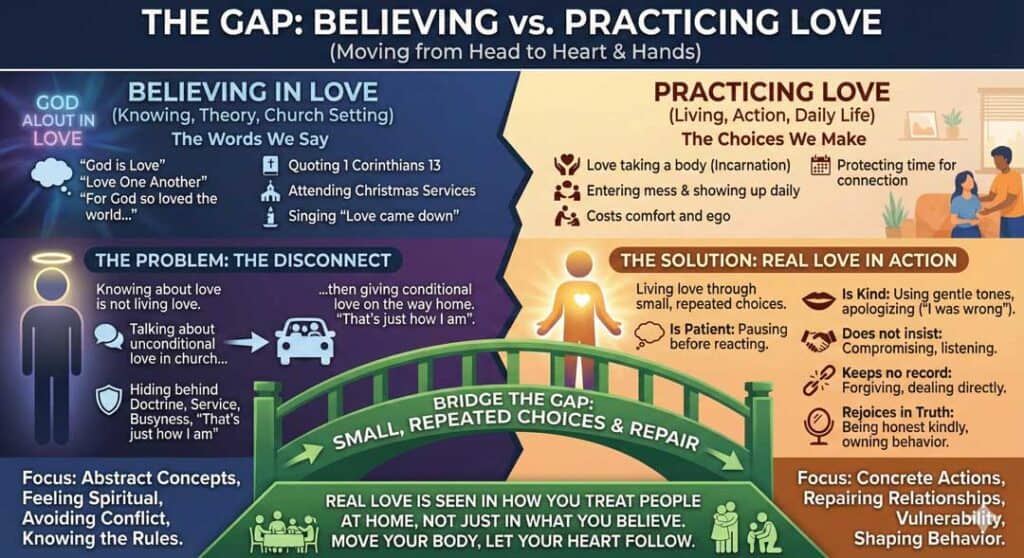
Knowing about love and living love are two different things.

This article is about that gap.

The Problem: We “Believe” in Love but Don’t Practice It

You know the words:

  • “God is love.”
  • “Love one another.”
  • “For God so loved the world…”

You might even be able to quote 1 Corinthians 13 from memory.

But:

  • You snap at your partner when you’re stressed.
  • You shut down when someone needs a real conversation.
  • You keep score instead of forgiving.
  • You stay silent when you should apologise.
You can sit in a Christmas service talking about unconditional love, then give your family very conditional love in the car on the way home.

You can sit in a Christmas service talking about unconditional love, then give your family very conditional love in the car on the way home.

The issue is not that you don’t know enough. The issue is that you don’t practice what you already know.

Christmas: Love That Took a Body

The central Christian claim at Christmas is simple: Love did not stay an idea. Love took a body.

  • God didn’t send a concept.
  • God didn’t send a rulebook.
  • God didn’t send “thoughts and prayers” from a distance.

God’s love moved into human life – with crying, feeding, waiting, growing, listening, walking, touching, healing.

If you say you honour that, but your love stays in your head or in your church building, you’ve missed the point.

Real love:

  • Enters mess.
  • Shows up in small daily moments.
  • Costs you comfort and ego.
Holy Love is not sentimental. It is concrete.

Holy Love is not sentimental. It is concrete.

From Knowing God’s Love to Living God’s Love

Think of it like this:

  • Knowing God’s love = “I’ve heard the story, I agree with it.”
  • Trusting God’s love = “I let it matter for me personally.”
  • Living God’s love = “I let it shape how I treat people.”

You move from “knowing” to “living” through small, repeated choices, not through one emotional church service.

Ask yourself:

If someone filmed you at home for a week, would they conclude: “This person believes in a God of love” based only on how you treat others?

If the answer is no, don’t defend yourself. Let it be a wake-up call.

What Real Love Looks Like in Daily Life

You don’t need to guess. Scripture already gives a clear picture (1 Corinthians 13). Translate that into daily behaviour:

Real love:

Is patient

  • You pause before reacting.
  • You give people time to finish their sentence.

Is kind

  • You use a gentle tone, especially with those closest to you.
  • You look for one small way to lighten someone’s load today.

Does not insist on its own way

  • You can say, “Let’s do it your way this time.”
  • You can compromise on plans, even when you’re convinced you’re right.

Keeps no record of wrongs

  • You stop bringing up that old mistake in every argument.
  • You deal with issues directly instead of storing them as ammunition.

Rejoices with the truth

  • You tell the truth kindly, instead of lying to keep the peace.
  • You face your own behaviour honestly, without excuses.
None of this is mystical. It is hard. It is simple. It is concrete.

None of this is mystical. It is hard. It is simple. It is concrete.

How We Dodge Real Love (Even While Talking About God)

Here are some common ways you avoid living love while pretending you’re still being “spiritual”:

Hiding behind doctrine

  • You debate theology but won’t apologise.

Hiding behind service

  • You help everyone at church, but your family gets your leftovers.

Hiding behind busyness

  • “I’m doing important things for God,” becomes an excuse for emotional absence.

Hiding behind “that’s just how I am”

  • You use personality as a shield against growth.

Every time you do this, you disconnect your faith from your relationships. You are “celebrating” God’s love while withholding your own.

Bringing Holy Love Into Your Relationships

If Christmas is about love taking on flesh, then your task is to let love take flesh in your body:

In your face

  • Softening your expression when your partner talks.
  • Really looking at your child when they show you something.

In your mouth

  • “I was wrong. I’m sorry.”
  • “I’m listening. Tell me more.”
  • “I appreciate you, even though we’re struggling.”

In your hands

  • Helping with the work nobody sees.
  • A gentle touch on the arm when someone is upset.

In your calendar

  • Protecting time for the people who matter.
  • Saying no to some “good things” so you can say yes to real connection.

You don’t need to fix everything at once. Choose one concrete way to let God’s love move through you today.

When You Fail (Because You Will)

You will lose your temper. You will withdraw. You will say something sharp and regret it.

Living love is not about perfection. It’s about repair.

When you fail:

  1. Notice it – “I spoke harshly just now.”
  2. Own it – “I’m sorry, that was unfair.” No excuses. No blaming.
  3. Ask what the other person needs – “How did that land for you?” “What do you need from me now?”
  4. Try again – Show, with your next action, that you’re serious.

This is how grace and Holy Love become visible in a relationship: not in never hurting each other, but in how you repair when you do.

A Christmas Prayer You Live, Not Just Say

If you want one simple way to realign this season, try this short daily prayer and back it up with action:

“God of Love, Show me one person I can love well today, and one concrete way to do it.”

Then:

  • Send the message.
  • Make the call.
  • Listen without defending.
  • Offer the hug.
  • Start the repair conversation.
Don’t wait to “feel spiritual”. Move your body in the direction of love, and let your heart follow.

Don’t wait to “feel spiritual”. Move your body in the direction of love, and let your heart follow.

Closing: If Love Doesn’t Change How You Treat People, It’s Still Theory

Celebrating the birth of Christ without changing how you treat people at home is like celebrating bread while never eating.

  • If God is love, your faith should make you more patient, not more arrogant.
  • More humble, not more defensive.
  • More present, not more absent.

Real love is not mainly seen in church services, candles, or carols. It is seen in the way you speak to your partner in the kitchen, your kids in the car, your family at the table.

Holy Love isn’t only something you sing about. It is something you practice, one relationship, one conversation, one awkward apology at a time.