The Five Differences That Drive Every Couple Mad

The Five Differences That Drive Every Couple Mad

The Five Differences That Drive Every Couple Mad

Money, mess, time, feelings, sex. Every couple fights about them. None of these fights are actually about what they seem to be about.


You know your version of this list already.

You are tidy. Your partner lives inside what looks to you like a low-grade explosion. Or you are the feeler, and your partner handles emotion the way other people handle a hot pan — quickly, from a distance, and with a firm grip on something else. Or you are the saver, and your partner treats money like it was printed for the purpose of being spent. Or you are the one who wants sex, and your partner is the one who wants to talk. Or the reverse.

Every couple has their version. And every couple, sooner or later, comes to believe that their version is the real problem. If only we could agree about money, about tidiness, about sex, about time, about the children — then things would be fine.

Here is the bad news and the good news in one sentence: you will never agree about those things the way you imagine. And that was never going to be what saved your relationship anyway.

Your partner is not wrong. They are different. Those are not the same thing, even when it feels like they are.

The five differences that drive every couple mad

Couples argue about thousands of things, but underneath the thousands there are five big categories where the differences tend to show up. Almost every couple will recognise themselves in most of them.

1. Tidiness and order

One of you walks into a room and notices what’s out of place. The other walks into the same room and notices who is in it. You experience a messy kitchen as a source of low-grade stress. Your partner experiences your cleaning-up as a low-grade judgement. You think they don’t see. They think you don’t stop.

This is rarely about the dishes. Underneath, the tidier one is usually managing anxiety through order. The less-tidy one is usually protecting spontaneity and presence from being choked by rules. Both are responses to something older — how each of you learned, as children, to be safe in the spaces you grew up in.

2. Money

The saver and the spender is the oldest story in couples’ therapy, but the story underneath it is not really about rands and cents. It is about what money means. For one of you, money might be freedom, or enjoyment, or generosity. For the other, money might be safety, or future security, or dignity. When you fight about a purchase, you are not arguing about a number. You are arguing about what it feels like to be secure in the world.

Until you understand what money actually means to the other person, you will negotiate numbers forever and never get anywhere.

3. Time and presence

One of you wants to spend a whole Saturday together, in the same room, moving slowly. The other wants their Saturday structured, productive, with time for solo work and a run and then maybe dinner. You experience your partner’s need for time apart as rejection. They experience your desire for constant togetherness as suffocation.

If you solve the surface fight but nothing changes underneath, you haven’t solved anything.

Both of you are trying to do the same thing — protect your sense of self inside the relationship. One of you does it by staying close. The other does it by stepping away. Neither is wrong. Neither is the problem. The pattern between you is the problem.

4. Emotional expression

One of you feels big, out loud, in colour. The other processes emotion quietly, often after the fact, and doesn’t want to be pushed. You want to talk about it right now. They want to go for a walk. You experience their quiet as coldness or withdrawal. They experience your urgency as overwhelm and intrusion.

This is probably the single most common and most painful difference in long-term relationships, because it usually gets labelled as the bigger one being “too much” and the quieter one being “emotionally unavailable.” Both labels are wrong. Both of you have nervous systems that learned, long ago, how to survive emotional weather. You just learned opposite strategies.

5. Sex and affection

One of you wants more physical connection than the other. Or you want different kinds. Or you want it at different times of day, different points in the week, different phases of the month, different chapters of your life. Whatever the specific mismatch, the script is similar. The one who wants more feels unwanted. The one who wants less feels pressured. Both feel ashamed, for different reasons. Neither one can easily talk about it, because every attempt has already gone wrong.

This is rarely about libido. It is almost always about how each of you learned to experience desire, vulnerability, and being wanted — and those lessons started long before you met.

Why the usual advice doesn’t help

The usual advice on all five of these is some version of: compromise. Meet in the middle. Find a solution that works for both of you. It sounds reasonable. It mostly doesn’t work.

The reason it doesn’t work is that compromise treats the difference as a problem to be minimised. You each give up something so the disagreement becomes smaller. But the difference was never the real issue. The real issue was what the difference was touching in each of you — what it was telling you about safety, worth, love, and belonging.

Compromise without understanding is just two people agreeing to be equally unhappy in a slightly smaller way. And the old pain doesn’t go anywhere. It just waits for the next argument to come up the stairs.

Every difference in your relationship is pointing at a part of you that has room to stretch.

What actually works

What actually works is slower, harder, and ultimately much more satisfying. It goes something like this.

First, you stop trying to solve the difference. You get curious about it instead. What does tidiness mean to you? Where did that come from? What does spending feel like to your partner? Where did they learn that? What happens in your body when your partner wants more time together than you do? What happens in theirs when you want more?

Second, you take turns talking and listening — really listening, not preparing your comeback. You cross the bridge into your partner’s world. You try to feel, for a moment, what they feel. You don’t have to agree. You don’t have to match. You just have to understand, deeply, that their experience is as real and valid as yours, even when it makes no sense to you.

Third — and this is where the creative force shows up — you start building something new together. Not a compromise. A third way. Something that could only exist because the two of you are different, and because you have taken the time to understand what each of you actually needs.

A couple where one person loves order and the other loves spontaneity doesn’t have to live in perpetual war. They can build a life that has both — zones of tidiness and zones of mess, rhythms of structure and rhythms of spacious time — once they stop trying to prove whose way is right.

A couple where one person wants constant togetherness and the other needs solo time doesn’t have to end up with the clingy one feeling rejected and the independent one feeling smothered. They can build a rhythm of closeness and space that neither of them would have found alone.

This is not a compromise. This is creation. And it is only possible when both of you have stopped fighting your differences and started using them.

A relationship big enough to hold both of you is not built by compromise. It is built by understanding.

What you’ll learn at the workshop

The Getting the Love You Want workshop is designed precisely for this. Over three hands-on days in Pretoria, on 5 to 7 June 2026, we help couples do three things. We help you see the specific pattern your differences have been caught in, probably for years. We teach you a way of talking that lets you actually understand each other — not just hear each other’s words. And we give you the tools to start building something new together, out of the differences you have.

You bring the difficult thing. Maybe it’s the money conversation you’ve been avoiding. Maybe it’s the sex conversation. Maybe it’s the one about your children, or your in-laws, or the way one of you shows up on Sunday evenings. Whatever it is — bring it. You’ll watch the skills demonstrated, then practise them yourselves, and we’ll show you how to hold it differently.

It’s a small group, hands-on, built for couples who want to do real work together. If the two of you have spent too many years on the same five arguments, come and learn how to make those arguments into something else. Not smaller. Bigger — and more useful. The differences between you don’t need to be resolved. They need to be understood. And once they are, they become one of the most creative forces in your life together.

Getting the Love You Want · Couples Workshop

Pretoria · 5–7 June 2026

Three hands-on days with your partner. Live demos, real practice, a method you take home. Small group, limited places.

Register for the workshop →
From Shutdown to Safety: How Imago Dialogue Helps Couples Repair Rupture

From Shutdown to Safety: How Imago Dialogue Helps Couples Repair Rupture

From Shutdown to Safety: How Imago Dialogue Helps Couples Repair Rupture

This article is based on real couple work, with all identifying details removed. The pattern will feel familiar to many couples: one partner escalates because they feel alone and unheard; the other withdraws because conflict feels unsafe. Both are trying to protect themselves. Both end up more disconnected.

They live busy lives. Work pressure stays high. Parenting decisions take energy. A serious health scare in the wider family adds fear and fatigue. Under that weight, their relationship starts to feel like a place of tension rather than support.

Most conflict is a protest against disconnection, not a debate about facts.

The struggle: the pursue–withdraw cycle

At home, their conflict does not start with “big issues.” It starts with small moments: tone, timing, a comment that lands as criticism, or a request that feels like pressure. One partner experiences the other as distant and emotionally unavailable. They try harder—talk more, push for answers, raise intensity, and demand change.

The other partner experiences that intensity as attack. Their body goes into protection mode. They shut down, go quiet, defend themselves, or leave the room. Sometimes they try to fix things with logic. Sometimes they stop engaging completely. The message they are trying to send is: “This is too much. I’m not safe.” The message the other partner receives is: “You don’t care.”

That is the trap. The more one pursues, the more the other withdraws. The more one withdraws, the more the other pursues. Both feel rejected. Both feel misunderstood. Both start keeping score.

When one partner pursues and the other withdraws, both are trying to feel safe.

Why it gets worse under stress

Stress changes how your nervous system works. When you feel overwhelmed, you become less patient, less curious, and more reactive. You interpret your partner through threat: “They are against me,” “They don’t see me,” “I’m on my own.”

This couple’s stress did not only come from the relationship. Work demands and family pressure reduced their capacity. They had less energy for kindness and more sensitivity to tone. The relationship then became the place where unprocessed stress leaked out.

Intimacy added another layer. One partner associated closeness with emotional presence and tenderness. The other associated closeness with physical intimacy and feeling desired. When either kind of closeness was missing, both felt rejected. They spoke about sex from pain, not from safety. That made the topic even harder.

What changed in the room: structure created safety

In Imago work, you do not start by solving the argument. You start by making the space between you safe enough for the truth to be shared. Safety does not mean “no feelings.” Safety means: no interruptions, no defending, no counter-attacks, and no shaming.

The couple learned a key shift: connection comes before solutions. When they were connected, they could talk about anything. When they were disconnected, even small topics became battles.

Mirroring slows the fight down so both of you can finally hear what is really being said.

How Imago Dialogue helped them repair rupture

Imago Dialogue is a structured conversation with three core steps: mirroring, validation, and empathy. The structure slows reactivity down and increases accuracy. It stops the “I know what you mean” shortcut and replaces it with: “Let me show you I heard you.”

1) Mirroring

One partner speaks in short sentences. The other mirrors: “What I hear you saying is…” Then they check: “Did I get that?” This was huge for the couple. The partner who escalated finally felt received. The partner who withdrew finally had a clear job: listen and reflect, not defend.

2) Validation

Validation does not mean agreement. It means: “Your experience makes sense.” In this couple, validation reduced shame and defensiveness. The withdrawing partner could say, “It makes sense you feel alone when I go quiet.” The pursuing partner could say, “It makes sense you shut down when my tone gets sharp.”

3) Empathy

Empathy is where the nervous system calms. It sounds like: “I imagine you might feel scared,” “I can see how painful that is,” or “That must be heavy.” Once empathy appeared, the conflict stopped being a courtroom. It became a place to meet.

As the sessions progressed, they practised repairing small ruptures in real time. Instead of escalating or disappearing, they could say:

  • “I feel myself getting defensive. Can we slow down?”
  • “I want to stay here. I need 10 minutes, then I will come back.”
  • “That landed badly. Can I try again?”

What they practised at home

The couple did not rely on insight alone. They relied on practice. Three habits made the biggest difference:

  • Daily appreciation: one clean appreciation each day, with no critique attached.
  • Short structured dialogues: 10–20 minutes, once or twice a week, not only when things explode.
  • Return after time-outs: if one needed space, they named a return time so silence did not become punishment.

They also learned a simple rule: repair first, solve later. When they repaired the emotional tone, problem-solving became easier. When they skipped repair, solutions became weapons.

Repair early and often—because connection is not a feeling you wait for, it’s a practice you choose.

What changed

They did not become a conflict-free couple. But they became a repair-capable couple. They noticed these shifts:

  • Less escalation: arguments shortened because both could slow down.
  • Less shutdown: the withdrawing partner could stay present for longer.
  • More teamwork: the problem became “our pattern,” not “your personality.”
  • More tenderness: appreciation and empathy softened the tone at home.
  • Better intimacy conversations: they could talk about sex without pressure, blame, or shame.

If you recognise this cycle in your relationship, do not wait until distance feels normal. Learn a structure that makes repair possible.

Book Imago Relationship Therapy (or join an Imago workshop) to learn the dialogue skills with guidance and turn repair into a habit.

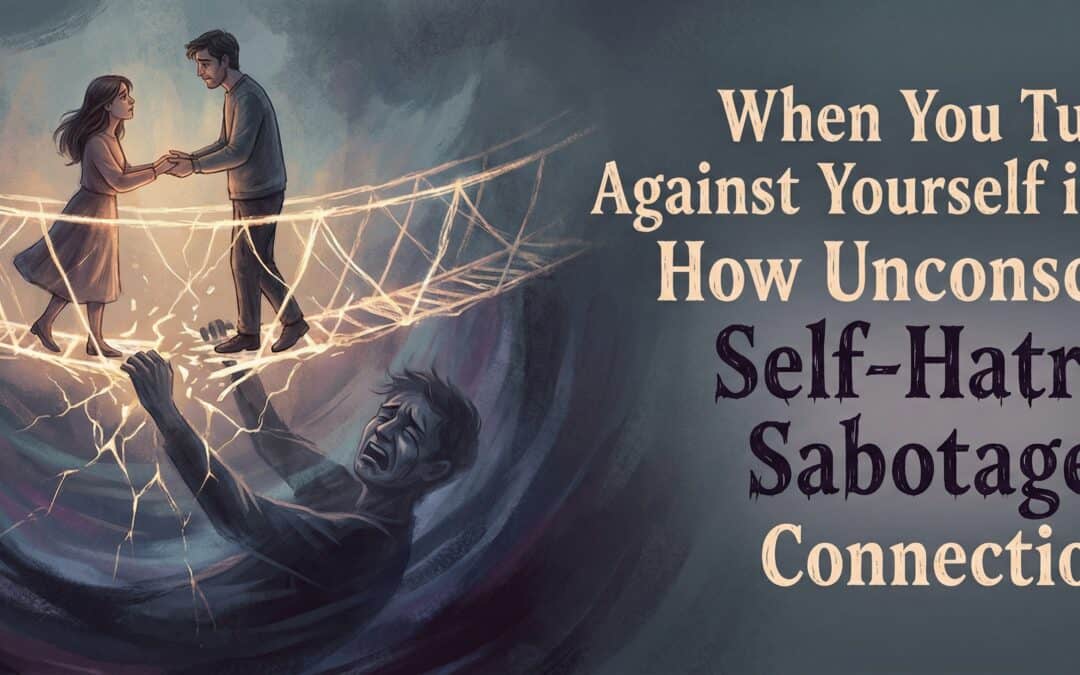
When You Turn Against Yourself in Love: How Unconscious Self-Hatred Sabotages Connection

When You Turn Against Yourself in Love: How Unconscious Self-Hatred Sabotages Connection

The Hidden Enemy Within

You’re lying in bed next to your partner, but you might as well be oceans apart. They reached for your hand earlier, and you pulled away—not because you don’t love them, but because some voice inside whispered, “You don’t deserve this.” Or perhaps you’ve spent the entire evening criticizing the way they loaded the dishwasher, knowing even as the words leave your mouth that this isn’t really about the dishes at all.

What if the most painful patterns in your relationship aren’t really about your partner? They’re about a quiet war you’re waging with yourself—one you often don’t even know you’re fighting.

Self-hatred rarely announces itself with clarity. It doesn’t wake you up declaring, “You’re worthless!” Instead, it operates in the shadows, disguised as perfectionism, self-sacrifice, or protective withdrawal. It’s the voice that says you need to earn love through constant giving, or that you should keep your needs small so you won’t be a burden, or that if your partner really knew you, they’d leave.

This unconscious self-rejection becomes the invisible third party in your relationship—the one calling the shots while you wonder why connection feels so difficult.

How Self-Hatred Sabotages Love

The Over-Giver’s Exhaustion

Sarah works full-time, manages most of the household, and always says yes when her partner asks for help with his projects. She prides herself on being supportive. But underneath, there’s a quiet belief: “If I stop giving, I’ll have nothing to offer. I’m only valuable for what I do.”

She resents her partner for not noticing her exhaustion, but she’s trained him not to see it. Every time she swallows her needs and pushes through, she reinforces her own unworthiness. The relationship becomes transactional—her service in exchange for the right to stay.

Over-giving isn’t generosity when it springs from the belief that you’re not enough as you are.

Over-giving isn’t generosity when it springs from the belief that you’re not enough as you are. It’s a form of self-abandonment, and eventually, it breeds resentment that corrodes intimacy from the inside out.

The Critic’s Shield

Marcus finds fault constantly. His partner leaves a towel on the floor, and he delivers a lecture on respect. She mentions feeling tired, and he points out that he’s tired too—why does she always need sympathy? The relationship has become a courtroom where he’s both judge and prosecutor.

But beneath the criticism lives terror. If he focuses on his partner’s flaws, he doesn’t have to face his own. If he stays vigilant about her imperfections, maybe she won’t notice his. Criticism becomes a wall against intimacy—because intimacy means being truly seen, and being seen feels dangerous when you believe that your true self is fundamentally unacceptable.

The Withdrawer’s Prison

Elena goes quiet when conflict arises. Her partner tries to talk about feeling disconnected, and she retreats into her phone or suddenly remembers urgent work. She tells herself she’s keeping the peace, avoiding drama. Really, she’s avoiding exposure.

The distance you create to protect yourself becomes the very thing that starves the relationship of oxygen.

Deep down, she believes that her feelings are too much, her needs are burdensome, her very presence might be unwelcome if she asks for anything real. So she makes herself small. She withdraws not just physically but emotionally, creating a buffer zone between her vulnerable self and the risk of rejection.

But this protective strategy backfires. The distance she creates to protect herself becomes the very thing that starves the relationship of oxygen. Her partner feels shut out, and Elena feels more alone than ever—trapped in a prison of her own making.


The Roots Beneath the Surface

These patterns don’t emerge from nowhere. They’re adaptations, learned long before your current relationship began.

Perhaps you grew up in a home where love felt conditional—available when you performed well, withdrawn when you didn’t. Maybe a parent was depressed or overwhelmed, and you learned that your needs were a burden. Or perhaps you faced criticism or neglect that taught you that something about you was fundamentally wrong.

Children are meaning-making creatures. When we experience pain or rejection, we rarely blame the limitations of the adults around us. Instead, we conclude: “There must be something wrong with me.” This belief gets wired into our nervous system, our sense of self, our understanding of how love works.

Then we grow up and bring these invisible contracts into our intimate relationships, unconsciously recreating familiar dynamics even as we consciously long for something different.

The Path Back to Yourself—and Each Other

Healing self-hatred isn’t about positive thinking or affirmations plastered over deep wounds. It requires something more honest: the willingness to turn toward yourself with curiosity instead of judgment, and to let your partner witness this journey.

Practice 1: Notice the Inner Narrative

Start by simply paying attention to the voice in your head, especially in moments of conflict or disconnection with your partner.

When you feel yourself pulling away, criticizing, or over-functioning, pause and ask: “What am I telling myself right now about who I am?” You might hear things like:

  • “I’m too needy.”
  • “I’m not doing enough.”
  • “If they knew the real me, they’d leave.”
  • “I always mess things up.”

Don’t try to change these thoughts yet. Just notice them. Write them down. The act of witnessing begins to loosen their grip.

Practice 2: Share the Discovery

This is where courage comes in. The next time you catch yourself in one of your protective patterns, try naming it out loud to your partner—not as confession but as invitation.

It might sound like:

  • “I notice I’m criticizing how you’re cooking dinner, but I think what’s really happening is I’m anxious about something at work and I don’t know how to ask for comfort.”
  • “I’m pulling away right now, and I realize it’s because I’m afraid that if I tell you what I really need, you’ll think I’m too much.”
  • “I keep saying yes to everything, but underneath I’m terrified that if I don’t keep giving, you won’t want me anymore.”
Real intimacy emerges when two people can see their wounds clearly and choose connection anyway.

This kind of vulnerability transforms the dynamic. Instead of your partner experiencing only the defensive behavior—the criticism, withdrawal, or exhausting over-functioning—they get to see the frightened, human part of you underneath. This creates space for connection instead of reaction.

Practice 3: The Dialogue of Self-Acceptance

This exercise helps partners witness and validate each other’s journey toward self-acceptance.

Step One: The Speaker Shares

Choose who will speak first. The speaker completes these sentences:

  • “One way I’ve been turning against myself in our relationship is…”
  • “The old message I’m carrying is…”
  • “What I’m really longing for is…”

For example: “One way I’ve been turning against myself is by withdrawing when I feel hurt instead of telling you. The old message I’m carrying is that my feelings are too much and will drive people away. What I’m really longing for is to feel safe being honest about what’s happening inside me.”

Step Two: The Listener Mirrors

The listener reflects back what they heard, word for word if possible: “So what I’m hearing you say is…” This isn’t about agreeing or fixing—just accurate listening.

Step Three: The Listener Validates

The listener says: “You make sense. I can understand how you might feel that way because…” This acknowledges the logic of the speaker’s experience, even if it’s based on old wounds rather than current reality.

Step Four: The Listener Empathizes

The listener imagines what this might feel like: “I imagine that when you carry this belief, you might feel…” (lonely, scared, exhausted, etc.)

Step Five: Switch Roles

Now the listener becomes the speaker and shares their own pattern of self-rejection.

This practice does something profound: it externalizes the internal conflict. The self-hatred that operated in isolation now has to reveal itself in the light of your partner’s compassionate witness. That changes everything.

Practice 4: Catch the Repetition

Once you’ve identified your pattern, you can begin catching it in real time—ideally before it fully unfolds.

Create a gentle signal with your partner. When you notice yourself starting to over-give, withdraw, or criticize from that defended place, you might say something like: “There it is—that’s the pattern we talked about. Can we pause?”

Then take a moment to reconnect with what you actually need or feel. Try completing this sentence: “What’s really true for me right now is…”

Maybe what’s really true is: “I’m scared. I need reassurance.” Or “I feel overwhelmed and I need help, but I’m afraid to ask.” Or “I’m judging myself harshly right now and I’m deflecting that onto you.”

Practice 5: Practice Receiving

For many people struggling with self-hatred, the hardest thing isn’t giving—it’s receiving. Compliments, help, affection, reassurance—all bounce off the armor of unworthiness.

You can be imperfect, needy, angry, scared—fully human—and still be loved.

Deliberately practice letting love in. When your partner expresses appreciation, affection, or offers support, pause. Notice the urge to deflect, minimize, or immediately reciprocate to balance the scales.

Instead, simply say: “Thank you. I’m going to let that in.” Then take a breath and actually feel it. You might feel vulnerable, uncomfortable, even tearful. That’s okay. You’re retraining your nervous system to recognize that you’re worthy of receiving, not just giving.

A Different Kind of Commitment

Healing self-hatred within a relationship requires something radical: the willingness to disappoint the inner critic that has been running the show. That critic promised to keep you safe by making you perfect, invisible, or indispensable. But safety purchased at the cost of authenticity isn’t safety—it’s a comfortable prison.

Real intimacy emerges when two people can stand before each other, see their own and each other’s wounds clearly, and choose connection anyway. Not because you’ve fixed yourself into lovability, but because you’ve recognized that you were always lovable—you just forgot.

Your partner can’t heal your self-hatred. But in the spaciousness of a relationship where both people are willing to bring their hidden rejections into the light, something remarkable becomes possible: you begin to internalize a different experience. You discover that you can be imperfect, needy, angry, scared—fully human—and still be loved. Not despite these qualities, but inclusive of them.

This is the deeper commitment underneath the commitment to stay together: the commitment to stop abandoning yourself in the name of love, and instead to bring your whole, complicated, beautiful self to the shared space between you.

The war you’ve been waging against yourself doesn’t have to continue. You can lay down your weapons—the criticism, the withdrawal, the exhausting over-giving. You can turn toward yourself with the same kindness you’d offer a frightened child.

And your relationship can become not just a place where two people coexist, but a sanctuary where two people practice, together, the revolutionary act of coming home to themselves and each other.

The journey from self-rejection to self-acceptance isn’t linear, and it’s rarely easy. But every moment you choose curiosity over criticism, vulnerability over withdrawal, and honest need over compulsive giving, you’re rewiring decades of conditioning. You’re teaching your nervous system that it’s safe to be real. And you’re creating the conditions for the kind of love you’ve always longed for—the kind that sees you completely and says, “Yes. You belong here. You always have.”


The Space Between Us Is Alive

The Space Between Us Is Alive

The Space Between Us Is Alive

Have you ever walked into a room where two people just had a fight? You can feel it hanging in the air—thick, tense, uncomfortable. Or think about those moments when you and your partner are perfectly in sync: you catch each other’s eyes across a crowded room and just know what the other is thinking. That invisible something you’re sensing isn’t just your imagination. According to Imago Relationship Therapy, it’s real. It’s alive. And it’s called the Space-Between.

Your Relationship Is a Third Entity

We typically think about relationships in terms of “you” and “me”—two separate people trying to get along, compromise, and hopefully stay in love. But what if that’s not the whole picture? What if the relationship itself is something more than the sum of its parts?

Imago Relationship Therapy introduces a revolutionary idea: the Space-Between. This is the invisible but tangible field that exists between you and your partner. It’s not inside you, and it’s not inside them—it exists in the relational space you share. And here’s the remarkable part: you’re both constantly creating and recreating this field with every interaction, every word, every look, every tone of voice.

The Space-Between is real and alive—you’re both constantly creating it with every interaction.

Think of it like the air in your home. You both breathe it. You both affect its quality. When one person “pollutes” it with criticism, defensiveness, or contempt, you both end up breathing that toxic air. When one person purifies it with kindness, curiosity, or appreciation, you both benefit from that nourishment.

This isn’t just a poetic metaphor. The Space-Between has actual properties that can be felt and even measured. It has temperature (warm or cold), texture (smooth or jagged), and most importantly, it has qualities like safety, curiosity, and empathy—or their opposites: danger, judgment, and indifference.

Every Gesture Matters

Once you understand that the Space-Between is real and alive, everything changes. That eye roll during dinner? You’re not just expressing your frustration—you’re injecting poison into the field you both inhabit. That gentle touch on your partner’s shoulder when they’re stressed? You’re not just being nice—you’re actively healing and strengthening the relational space you share.

Every tone carries energy. Every glance transmits information. Every gesture is a brick you’re either building with or throwing. And because this field exists between you rather than within you, your partner can’t help but be affected by what you put into it, just as you can’t help but be affected by what they contribute.

Every tone carries energy. Every gesture is a brick you’re either building with or throwing.

This is why couples often report feeling like they’re “walking on eggshells” or like “everything I say is wrong.” They’re not imagining it. The Space-Between has become contaminated with accumulated hurt, defensiveness, and fear. Both partners are now living in a toxic relational atmosphere that they co-created, often without even realizing what they were doing.

But here’s the hopeful flip side: if you can pollute the Space-Between, you can also purify it. If you can wound it, you can also heal it. And unlike trying to change your partner (which never works), changing what you contribute to the Space-Between is entirely within your control.

The Reactivity Trap

Most relationship damage happens not in the big blowout fights, but in the thousands of small moments of reactivity we barely notice. Your partner makes a comment. You feel a twinge of irritation. You let it show in your voice. They sense your irritation and get defensive. You notice their defensiveness and escalate slightly. Round and round it goes, each of you reacting to the other’s reaction, until the Space-Between is so charged with negativity that even neutral comments feel like attacks.

The insidious thing about reactivity is that it feels justified in the moment. Your partner did say that annoying thing. You are responding to something real. But what we don’t see is that our reaction creates the very atmosphere we’re complaining about. We breathe out frustration, and then we’re surprised when we breathe in tension.

Your reaction creates the very atmosphere you’re complaining about.

Quantum physics tells us that the observer affects what’s being observed. In relationships, the Space-Between works similarly: you can’t step outside of it to analyze it objectively. You’re always part of the field you’re trying to understand. Your very attempt to examine what’s wrong can either heal the space or contaminate it further, depending on how you approach it.

This is why blaming never works. When you point at your partner and say “You’re the problem,” you’re polluting the Space-Between with judgment and defensiveness. Even if your partner is doing something problematic, your blame ensures that the relational field becomes too toxic for them to acknowledge it or change.

The Nightly Practice: Becoming Conscious Gardeners

So how do you begin to take responsibility for the invisible-but-real field you’re co-creating? Start with a simple practice that takes less than five minutes but can transform your relationship over time.

Before bed each night, sit together (or if you’re apart, do this on a call) and ask yourselves: “What did we feed the Space-Between today—safety or fear?”

This isn’t about keeping score or cataloging everything your partner did wrong. It’s about becoming conscious of your joint creation. Maybe you both stayed calm during a stressful conversation about money—that fed safety. Maybe you snapped at each other during the morning rush—that fed fear. Maybe you laughed together over dinner—that fed connection. Maybe you scrolled on your phones instead of talking—that fed disconnection.

Just notice. Be honest. Hold the awareness together that you’re both breathing the same relational air, that you’re both living inside this field you’re creating.

Then, make a small commitment: name one small act that could clear or nourish the Space-Between tomorrow. Not a grand gesture or complete transformation—just one small thing. Maybe it’s greeting each other with a hug when you get home from work. Maybe it’s taking three deep breaths before responding when you feel triggered. Maybe it’s saying one specific thing you appreciated about your partner that day.

The key word is small. You’re not trying to fix everything. You’re trying to become conscious co-creators instead of unconscious polluters.

Living in the Field You’re Creating

The Space-Between concept changes everything about how we approach relationship difficulties. Instead of “What’s wrong with you?” or even “What’s wrong with me?”, the question becomes: “What’s happening in the field we’re co-creating, and how can we both take responsibility for healing it?”

You’re not opponents; you’re partners working together to create a relational environment where you both can thrive.

This shift moves you from an adversarial stance to a collaborative one. You’re not opponents; you’re partners working together to create a relational environment where you both can thrive. When the Space-Between is contaminated with reactivity, you’re both suffering—even the person who “started it.” When the Space-Between is filled with safety, curiosity, and empathy, you’re both nourished—even if one person is going through a difficult time.

The relationship isn’t something that happens to you. It’s not something your partner is responsible for. It’s a living field that you’re both breathing, both inhabiting, both creating with every moment of every day. The question isn’t whether you’re affecting it—you are, constantly. The question is whether you’re doing so consciously or unconsciously.

Tonight, before you sleep, take a moment to sense the Space-Between. What does it feel like right now? What did you both contribute to it today? And what one small act could begin to clear it tomorrow?

The Space-Between is alive. And so is your power to heal it.

When Two Truths Collide

When Two Truths Collide

When Two Truths Collide

She didn’t even remember how the argument began. One minute they were discussing something as trivial as weekend plans, and the next she was in tears, her voice shaking with frustration. Across the kitchen, her husband’s face was flushed with anger and hurt. In that charged moment, it felt like they were living in two different worlds. Each was utterly convinced of their own point of view, and each felt painfully misunderstood by the other.

This wasn’t the first time a simple conversation had spiraled into a storm. It was becoming alarmingly routine. Last week, a casual decision about what to cook for dinner somehow exploded into an accusation that he never helped out. A month before, their anniversary night ended in icy silence. Tonight followed the same script: she voiced a need; he heard criticism. He defended himself; she raised her voice, desperate to be heard. Both ended up feeling attacked, unappreciated, and alone.

Two different truths lived under the same roof, and each truth was entirely real.

On this night, the pattern reached a breaking point. “I can’t do this anymore,” she cried. “You don’t even care how I feel!” His eyes flashed as he threw up his hands. “How can you say that? Nothing I do is ever enough for you!” The words hung in the air, heavy with years of resentment and guilt. He bit his lip to hold back tears. She stood frozen, heart pounding, aching at the sight of his back turned to her.

In the dark of their bedroom, neither could sleep. Each replayed the fight in their mind, feeling both justified and ashamed. She longed to be understood. In her reality, if he truly loved her, he would be more present. He, staring at the ceiling, felt guilty and not enough. In his reality, he worked hard because he cared—and braced for criticism because nothing seemed to satisfy.

Sometime past midnight she whispered, “I don’t want to fight like this anymore.” He exhaled, “Neither do I.” She took a breath and said, “I’m afraid I matter less to you than everything else.” He turned toward her, tears gathering. “You matter more than anything,” he said. “I just feel like I’m failing you.”

We might need help—there has to be a new way to hear each other.

In that fragile exchange, something shifted. For the first time in a long time, they were hearing each other’s pain instead of the echo of their own. They held hands in the dark and cried softly. It wasn’t a magic fix, but it was a turning point—their first real alignment in months.

By morning, nothing external had changed, but the posture of their hearts had. Over coffee he said, “We might need help.” She nodded. The idea of a guided process—somewhere safe to practice hearing each other—felt less threatening than another year of the same loop. They promised to fight for the relationship, not against each other.

That promise became their North Star. They were still two different people with two different truths, but they discovered that both could be honored. The goal was no longer winning; it was understanding. And that single shift began to change the feel of their home—warmer, steadier, more connected.

Fight for your relationship, not against each other.

Honoring both realities is the first brave step toward healing.

When Two Truths Collide

When Two Truths Collide

She didn’t even remember how the argument began. One minute they were discussing something as trivial as weekend plans, and the next she was in tears, her voice shaking with frustration. Across the kitchen, her husband’s face was flushed with anger and hurt. In that charged moment, it felt like they were living in two different worlds. Each was utterly convinced of their own point of view, and each felt painfully misunderstood by the other.

This wasn’t the first time a simple conversation had spiraled into a storm. It was becoming alarmingly routine. Last week, a casual decision about what to cook for dinner somehow exploded into an accusation that he never helped out. A month before, their anniversary night ended in icy silence. Tonight followed the same script: she voiced a need; he heard criticism. He defended himself; she raised her voice, desperate to be heard. Both ended up feeling attacked, unappreciated, and alone.

Two different truths lived under the same roof, and each truth was entirely real.

On this night, the pattern reached a breaking point. “I can’t do this anymore,” she cried. “You don’t even care how I feel!” His eyes flashed as he threw up his hands. “How can you say that? Nothing I do is ever enough for you!” The words hung in the air, heavy with years of resentment and guilt. He bit his lip to hold back tears. She stood frozen, heart pounding, aching at the sight of his back turned to her.

In the dark of their bedroom, neither could sleep. Each replayed the fight in their mind, feeling both justified and ashamed. She longed to be understood. In her reality, if he truly loved her, he would be more present. He, staring at the ceiling, felt guilty and not enough. In his reality, he worked hard because he cared—and braced for criticism because nothing seemed to satisfy.

Sometime past midnight she whispered, “I don’t want to fight like this anymore.” He exhaled, “Neither do I.” She took a breath and said, “I’m afraid I matter less to you than everything else.” He turned toward her, tears gathering. “You matter more than anything,” he said. “I just feel like I’m failing you.”

We might need help—there has to be a new way to hear each other.

In that fragile exchange, something shifted. For the first time in a long time, they were hearing each other’s pain instead of the echo of their own. They held hands in the dark and cried softly. It wasn’t a magic fix, but it was a turning point—their first real alignment in months.

By morning, nothing external had changed, but the posture of their hearts had. Over coffee he said, “We might need help.” She nodded. The idea of a guided process—somewhere safe to practice hearing each other—felt less threatening than another year of the same loop. They promised to fight for the relationship, not against each other.

That promise became their North Star. They were still two different people with two different truths, but they discovered that both could be honored. The goal was no longer winning; it was understanding. And that single shift began to change the feel of their home—warmer, steadier, more connected.

Fight for your relationship, not against each other.

Honoring both realities is the first brave step toward healing.