by Kobus van der Merwe | Dec 9, 2025 | Blog, Couples, Struggles
December hits and suddenly everyone’s “together.”
You’re in the same house, maybe the same room, sometimes even the same car for hours on the N1 or N2. Yet half the time the only thing really connecting you is the Wi-Fi password.
You sit on the couch while your partner scrolls. The kids game in their rooms. Conversations shrink to logistics: “What’s for supper?” “Did you pack the towels?”
This festive season can go by like that: bodies close, hearts far.
Real time with your loved ones is not about sharing a roof or a car seat. It’s about showing up with your attention. Looking up from the screen. Hearing the small sigh. Asking one more curious question. Laughing at the same silly thing at the braai.
This holiday can be the year you don’t only “survive” the family time. It can be the year you actually feel close again.
The Illusion of “Being Together”
Picture this: It’s 8pm on a Tuesday evening in December. The whole family is in the lounge. Dad’s on the recliner checking his work emails even though he’s officially on leave. Mom’s scrolling through TikTok recipes she’ll never make. The teenager is watching YouTube with earbuds in. The younger one is playing Roblox.
Everyone’s home. Everyone’s “together.”
And everyone is completely alone.
We tell ourselves, “At least we’re in the same room.” We convince ourselves that proximity equals connection. That as long as we’re under the same roof, in the same space, breathing the same air, we’re doing family time. We’re doing couple time.
Physical proximity without presence is a very fancy way of being alone.
But here’s the uncomfortable truth: Physical proximity without presence is a very fancy way of being alone.
You can sit next to your partner for three hours and never actually meet them. You can drive to Durban with your kids in the backseat and arrive having had zero meaningful conversations. You can spend the entire festive season “together” and feel more disconnected than ever.
The illusion is dangerous because it looks right from the outside. The Christmas card shows everyone smiling together. But the real experience? It’s a collection of separate people happening to occupy the same coordinates on Google Maps.
Why Your Presence Matters More Than Your Plans
Every December, we obsess over the plans. The perfect beach house booking. The right gifts. The Instagram-worthy festive spread. We spend hours comparing prices on Takealot and days stuck in Sandton City traffic.
But here’s what nobody tells you: Your loved ones won’t remember the thread count of the holiday accommodation sheets. They’ll remember how it felt to sit across from you at breakfast.
Connection isn’t built in grand gestures or expensive trips. It’s built in moments of focused attention. When you look up from your phone and really see your partner. When you ask your child about their day and actually listen to the answer instead of planning your response. When you’re fully there—mind, body, and heart—for the ordinary moments.
Research in neuroscience shows that when someone feels truly seen and heard, their nervous system regulates. Stress hormones decrease. The feeling of safety increases. This is why your presence is so powerful—it literally changes your loved one’s physiology.
Your loved one will forget what was on the table; they remember how they felt sitting across from you.
Couples and families don’t remember perfect itineraries. They remember moments of attention. The time you both laughed so hard at something ridiculous during load shedding. The conversation in the car where your teenager actually opened up. The morning your partner brought you coffee and sat down to drink theirs with you instead of rushing off.
These moments cost nothing. But they require everything—your full, undivided presence.
Sharing Space vs Sharing Attention
Let’s get clear on the difference, because it matters.
Sharing space looks like this:
- Same house, but minds elsewhere
- Same car trip, everyone on separate devices with headphones
- Same braai, but half the people are on their phones photographing the food instead of enjoying the company
- Same bed, scrolling through separate social media feeds before sleep
Sharing attention looks like this:
- Eye contact when your partner speaks
- Phones face-down and out of reach
- Listening without immediately trying to fix or give advice
- Responding to small bids for connection: “Come look at this sunset,” “Listen to this song,” “Taste this and tell me what you think”
Here’s a real example: Two families drive from Joburg to the coast for the holidays.
Family A: Everyone has headphones in. Dad’s listening to a podcast about crypto. Mom’s on a work call (yes, during leave). The kids are watching YouTube. They stop for petrol, grab a pie, and continue. Six hours pass. They arrive having barely spoken.
Family B: They make a playlist together before leaving. They play car games. They stop at a farm stall and actually walk around together, tasting things, laughing at the overpriced rusks. Someone starts a debate about which is better—Durban or Cape Town beaches. It gets heated and hilarious. Six hours pass. They arrive feeling like they’ve already had a holiday.
Same distance. Same amount of time. Completely different experience.
The Festive Trap: Busy, Full… and Emotionally Empty
The South African December is its own special brand of chaos, isn’t it?
There’s the last-minute shopping in overcrowded malls where parking is a contact sport. The bumper-to-bumper traffic leaving the cities. The work emails that keep coming even though you’re “officially off.” The family obligations—this side on Christmas, that side on New Year’s, somehow fitting in friends and neighbours too.
The kids are over-stimulated from too much screen time and too much sugar. The adults are exhausted from trying to create the “perfect” holiday experience while secretly counting down until January when normal life resumes.
Busyness gives you an excuse not to connect.
And here’s the trap: all this busyness gives you a convenient excuse not to actually connect. You can blame the chaos. “We’ll have proper time together after the holidays settle down.” “Once we get to the beach house, then we’ll relax.” “When things calm down in January, then we’ll talk.”
But what if they never really calm down? What if you keep postponing connection until “later,” and later never comes?
The cost shows up in small ways at first. Little irritabilities. Snapping at each other over nothing. Small fights about whose family to visit or how much to spend. That feeling of being “over” the holidays by the 26th of December.
But underneath, something more serious is happening: you’re drifting. You’re becoming strangers who share a surname and a bond payment. You’re losing the felt sense of “us.”
Small Daily Rituals That Turn Time into Connection
Okay, enough with the problem. Let’s talk solutions. The good news is that creating real connection doesn’t require a complete life overhaul. It requires small, consistent rituals that become your relationship’s anchors.
For Couples
The Evening Check-In (10-15 minutes)
Every evening, preferably after the immediate dinner chaos, sit down together and ask three questions:
- “What drained you today?”
- “What fed you today?”
- “What do you need from me tomorrow?”
That’s it. No problem-solving. No debate. Just listening and being heard.
Morning Coffee or Evening Walk
Pick one. Make it sacred. Phones stay inside. Just you two and whatever conversation emerges. Some days it’ll be deep. Some days you’ll just complain about municipal potholes. Both are connection.
The No-Admin Conversation
Once a day, have one conversation that isn’t about logistics. Don’t discuss who’s fetching the kids or what’s for supper or whether the rates and taxes got paid. Talk about feelings, memories, dreams, observations. Remember when you used to just… talk?
For Parents and Kids
One-on-One Time
Each child gets 10-20 minutes of undivided attention. Not while you’re cooking or checking emails. Sit down, get on their level, and be fully there. Play what they want to play. Listen to what they want to tell you.
Simple Traditions
- Pancake morning where everyone helps
- Family TikTok dance (yes, even if you feel ridiculous)
- Board game night where phones stay in another room
- Sunset beach walk before dinner
- Making silly videos together
The content matters less than the full presence.
For Extended Family
Story Circle
At a family gathering, go around and have each person share one favourite memory from the year. No interrupting. No phones. Just listening to each other’s stories.
Shared Activities
Instead of everyone splitting off to separate screens, do something together: cooking, beach walk, card games, even washing dishes while chatting. The activity provides an excuse to be together; the conversation is what actually matters.
Simple Presence Skills (So You Don’t Drift Back to Auto-Pilot)
Real presence requires practice. Here are concrete micro-skills you can use:
1. Phone Face-Down, Out of Reach
Not just on silent. Not just flipped over on the table in front of you. Actually put it somewhere else. Your brain can’t fully relax if the phone is within sight.
2. Look at the Person While They Speak
This sounds obvious, but when was the last time you maintained eye contact during an entire conversation with your partner? Try it. It’s more intimate than you remember.
3. Reflect Back What You Heard
“So you felt frustrated when…” This simple Imago Dialogue technique shows you’re actually listening, not just waiting for your turn to talk.
4. Ask One Follow-Up Question
Instead of immediately changing the topic to your own story, ask one more curious question about what they just shared. “Tell me more about that.” “What was that like for you?” “How did you handle it?”
These aren’t therapy techniques you need special training for. They’re basic presence skills we’ve all forgotten in the age of constant distraction.
Handling Awkwardness When You Try Something New
Let’s be honest: the first time you suggest, “Let’s put our phones away and actually talk,” your partner or kids might look at you like you’ve grown a second head.
That’s normal. Change feels weird. Especially when the change is toward more intimacy and vulnerability.
Here are some phrases that can help:
“I realized I don’t want this holiday to vanish in a blur. Can we try something different tonight?”
“I actually want to hear how you really are, not only what we still need to buy at Makro.”
“I miss us. Can we try something?”
What to do if they roll their eyes:
Don’t punish it. Don’t lecture. Don’t make a big deal. Just say something like, “Fair enough, no pressure. But I’m going to keep my phone away for a bit if you want to join me.”
Then do it yourself. Be present whether they join immediately or not. Often, once people experience real presence, they start craving it. But you can’t force it. You can only offer it.
A Simple Holiday Agreement for Your Household
Want to actually make this happen? Don’t just hope for the best. Make a simple agreement.
Sit down with your partner, your family, whoever you’re spending this festive season with, and propose a short “connection agreement.” Write it down. Put it on the fridge.
Here’s an example:
Our December Connection Agreement
- One phone-free meal together every day (supper)
- One slow activity per week with full attention (beach walk, board game, braai without devices)
- A closing “gratitude moment” each night where each person shares one thing they appreciated about the day
Years from now, nobody will talk about the traffic or the specials; they’ll remember how it felt to be with you.
That’s it. Simple. Doable. Specific.
You’re not committing to becoming completely different people. You’re just committing to showing up a bit more fully for the people you love.
Don’t Let This Holiday Blur Past You
Years from now, nobody will talk about the Black Friday deals you scored or the traffic on the N3 or whether you got the right specials at Woolworths.
They’ll remember how it felt to be with you this December.
They’ll remember the conversation in the car. The laughter at the braai. The morning you sat together drinking coffee without rushing anywhere. The way you looked at them—really looked at them—and they felt seen.
The real gift you give your loved ones is your focused presence.
Not your exhausted, distracted, looking-at-your-phone-while-half-listening presence. Your full, eyes-up, heart-open, I’m-actually-here-with-you presence.
You can be at the most beautiful beach house in Plett, surrounded by your favourite people, with a cold drink in your hand and not a single work email demanding attention—and still be completely absent from your relationships.
Or you can be stuck in Joburg traffic on the way back from Checkers, holding hands in the car, really talking to each other, and be more connected than you’ve been all year.
The festive season will pass. The holidays will end. The decorations will come down. Work will start again.
But the habit of presence you build this December? That can change everything.
So put down your phone. Look at your partner. Really see your child. Notice the person sitting across from you.
And show up—fully, completely, courageously.
That’s the gift that keeps on giving long after the wrapping paper is binned and the new year has begun.
This December, don’t just be there. Be here.
by Kobus van der Merwe | Nov 25, 2025 | Blog, Couples, Life, Struggles
“
A Survival Guide for Couples Who Still Like Each Other… Mostly
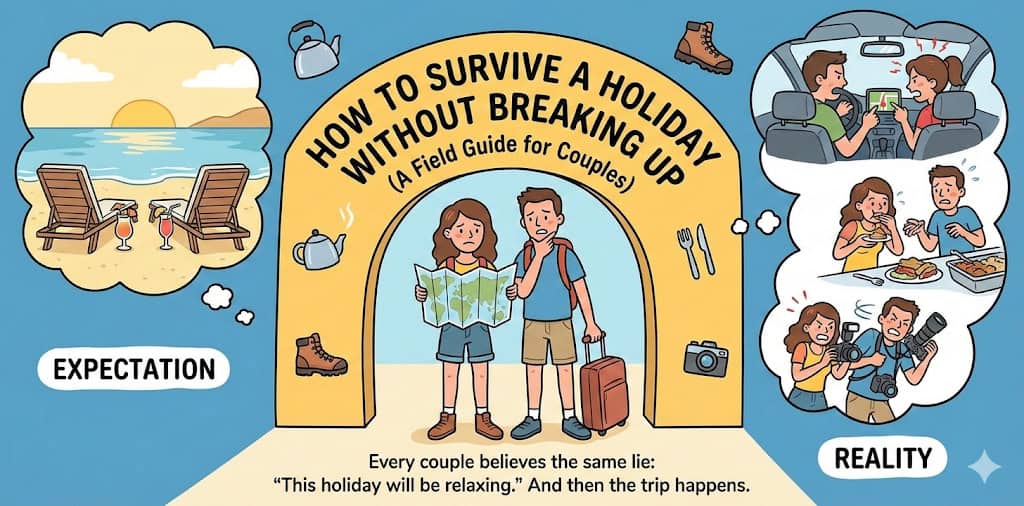
Every couple tells themselves the same beautiful lie as they pack for December: “This holiday is going to be so relaxing.”
Then you hit the N1 northbound during peak holiday traffic, the aircon packs up somewhere near Polokwane, and one of you ate the last Liqui-Fruit.
Welcome to the South African Summer Holiday Experience™.
Here’s your field guide to surviving it without ending up in separate chalets.
Day One: The Great Unpacking Standoff
You arrive at your self-catering unit in Plett (or your timeshare in Umhlanga, or that Airbnb near Clarens that looked bigger in the photos).
One of you immediately starts unpacking. Methodically. With a system. Toiletries arranged by size. Sunscreen in the bathroom. Biltong in a Tupperware.
The other one drops the bags and announces: “I’m going to the pool.”
What follows is a silence so loud it could drown out the Hadedas.
You’re not fighting about suitcases—you’re fighting because one needs order to relax, and the other needs freedom.
The Fix: Sit down for two actual minutes and say out loud: “Here’s what I need to feel settled.” Then—and this is the tricky bit—repeat back what your partner just said. Not with an eye-roll. With actual words.
You’ll discover you’re not fighting about suitcases. You’re fighting because one of you needs order to relax, and the other needs freedom. Neither is wrong. Both are just… very committed to their method.
The Daily Activity Wars (Or: “Why Are We Even Here?”)
December 26th, 6:47am.
One of you springs out of bed like a meerkat on Savanna Dry, ready to hike Robberg, hit the craft markets, photograph penguins, and possibly squeeze in a wine tasting before lunch.
The other groans from under a pillow: “But we’re on holiday.”
Cue the passive-aggressive breakfast where one person aggressively butters toast while the other scrolls through TripAdvisor with increasing hostility.
Each person gets one non-negotiable for the day—say them out loud, repeat them back, find the overlap.
The Fix: Before you leave the room, each person gets one non-negotiable for the day. Your partner gets to want their thing. You get to want yours. Say them out loud. Repeat them back. Find the overlap.
Example: “I need one morning to sleep past 8.” / “I need to see at least one thing that’s not this couch.”
Suddenly you’ve got a plan: Sleep in tomorrow. Explore today. Everyone lives.
The GPS Incident (It’s Always an Incident)
You’re driving to that restaurant everyone raved about. The one “only 15 minutes from town.”
Except Google Maps has decided you’re somehow in the ocean, your partner is reading directions from a screenshot they took three days ago, and you’ve just missed the turnoff for the third time.
Someone says, very quietly: “I told you it was back there.”
The other person grips the steering wheel like it owes them money.
It’s not about the turn—it’s about feeling competent and heard.
The Fix: Stop. Breathe. Say the actual fear out loud: “I’m worried we’ll waste the whole evening lost.” / “I’m scared you think I’m useless at navigating.”
Suddenly it’s not about the turn. It’s about feeling competent and heard. Pull over. Regroup. Maybe laugh at how ridiculous this is. (Spoiler: it’s very ridiculous.)
The Hunger Games
It’s 2pm. You’ve been walking around some charming village for three hours. The sun is aggressive. You’re both claiming you’re “fine,” but one of you is chewing the inside of their cheek and the other is dangerously silent.
This is the danger zone. Hanger + heat + holiday crowds = a fight about something completely unrelated that you’ll both regret.
The Fix: Adopt this as your holiday constitution: “We do not make decisions while hungry.”
Find the nearest Wimpy. Sit down. Order a toasted cheese. Rehydrate. Then discuss where you’re going next.
You’ll be amazed how reasonable your partner becomes after carbs.
The Photo Shoot That Never Ends
One of you is living their best influencer life, capturing every sunset, every latte, every pair of sunglasses artfully placed on a beach towel.
The other is wondering how many times a human being can be asked to “just stand there naturally” before they snap.
By day three, the photographer says: “Why are you pulling that face?” The subject replies: “This is my face.”
One wants to capture the holiday; the other wants to experience it—both are valid.
The Fix: Recognize what’s actually happening: One of you wants to capture the holiday. The other wants to experience it. Both are valid.
Say it: “I need to take photos to remember this.” Or: “I need some time to just be here without posing.”
Set a boundary: Ten minutes of photos. Then phones down for an hour. Everyone wins. Nobody murders anybody over a sunset selfie.
The Silent Scoreboard of Resentment
By Day Four, nobody’s saying what they’re actually thinking. You’re both just quietly tallying up your contributions like you’re auditing a marriage.
“I organized this entire trip.” / “I packed the car.” / “I drove for six hours.” / “I smiled politely at your family on Christmas Day.”
The Fix: Every evening, spend five minutes doing this:
- One thing you enjoyed today
- One thing that annoyed you (said kindly, not weaponized)
- One thing you’d like tomorrow
Keep it short. No lectures. No TED Talks on “the emotional labor of holiday planning.”
Just: “I loved swimming with you today. The 45-minute stop at that farm stall was rough. Tomorrow I’d like to sleep in.” Done.
The Truth About December Holidays
It’s not the holiday that breaks you. It’s the heat. The traffic. The unspoken expectations. The assumption that your partner should just know what you need without you saying it.
Here’s the thing: If you stay curious about what the other person actually needs (instead of what you think they should need), if you repeat back what they say so they feel heard, and if you treat frustration as information instead of warfare…
You might actually come home still liking each other.
And maybe—just maybe—laughing about the time you almost broke up over a bunny chow in Durban.
The Real Secret
You’re on the same team. Even when it doesn’t feel like it. Even in traffic. Even when the Airbnb has no WiFi and someone forgot to pack the adapter.
Happy holidays, South Africa. May your cool drinks stay cold and your tempers stay cool. 🍻☀️🇿🇦
“

by Kobus van der Merwe | Nov 13, 2025 | Blog, Couples, Dialogue, Struggles
The Space Between Us Is Alive
Have you ever walked into a room where two people just had a fight? You can feel it hanging in the air—thick, tense, uncomfortable. Or think about those moments when you and your partner are perfectly in sync: you catch each other’s eyes across a crowded room and just know what the other is thinking. That invisible something you’re sensing isn’t just your imagination. According to Imago Relationship Therapy, it’s real. It’s alive. And it’s called the Space-Between.
Your Relationship Is a Third Entity
We typically think about relationships in terms of “you” and “me”—two separate people trying to get along, compromise, and hopefully stay in love. But what if that’s not the whole picture? What if the relationship itself is something more than the sum of its parts?
Imago Relationship Therapy introduces a revolutionary idea: the Space-Between. This is the invisible but tangible field that exists between you and your partner. It’s not inside you, and it’s not inside them—it exists in the relational space you share. And here’s the remarkable part: you’re both constantly creating and recreating this field with every interaction, every word, every look, every tone of voice.
The Space-Between is real and alive—you’re both constantly creating it with every interaction.
Think of it like the air in your home. You both breathe it. You both affect its quality. When one person “pollutes” it with criticism, defensiveness, or contempt, you both end up breathing that toxic air. When one person purifies it with kindness, curiosity, or appreciation, you both benefit from that nourishment.
This isn’t just a poetic metaphor. The Space-Between has actual properties that can be felt and even measured. It has temperature (warm or cold), texture (smooth or jagged), and most importantly, it has qualities like safety, curiosity, and empathy—or their opposites: danger, judgment, and indifference.
Every Gesture Matters
Once you understand that the Space-Between is real and alive, everything changes. That eye roll during dinner? You’re not just expressing your frustration—you’re injecting poison into the field you both inhabit. That gentle touch on your partner’s shoulder when they’re stressed? You’re not just being nice—you’re actively healing and strengthening the relational space you share.
Every tone carries energy. Every glance transmits information. Every gesture is a brick you’re either building with or throwing. And because this field exists between you rather than within you, your partner can’t help but be affected by what you put into it, just as you can’t help but be affected by what they contribute.
Every tone carries energy. Every gesture is a brick you’re either building with or throwing.
This is why couples often report feeling like they’re “walking on eggshells” or like “everything I say is wrong.” They’re not imagining it. The Space-Between has become contaminated with accumulated hurt, defensiveness, and fear. Both partners are now living in a toxic relational atmosphere that they co-created, often without even realizing what they were doing.
But here’s the hopeful flip side: if you can pollute the Space-Between, you can also purify it. If you can wound it, you can also heal it. And unlike trying to change your partner (which never works), changing what you contribute to the Space-Between is entirely within your control.
The Reactivity Trap
Most relationship damage happens not in the big blowout fights, but in the thousands of small moments of reactivity we barely notice. Your partner makes a comment. You feel a twinge of irritation. You let it show in your voice. They sense your irritation and get defensive. You notice their defensiveness and escalate slightly. Round and round it goes, each of you reacting to the other’s reaction, until the Space-Between is so charged with negativity that even neutral comments feel like attacks.
The insidious thing about reactivity is that it feels justified in the moment. Your partner did say that annoying thing. You are responding to something real. But what we don’t see is that our reaction creates the very atmosphere we’re complaining about. We breathe out frustration, and then we’re surprised when we breathe in tension.
Your reaction creates the very atmosphere you’re complaining about.
Quantum physics tells us that the observer affects what’s being observed. In relationships, the Space-Between works similarly: you can’t step outside of it to analyze it objectively. You’re always part of the field you’re trying to understand. Your very attempt to examine what’s wrong can either heal the space or contaminate it further, depending on how you approach it.
This is why blaming never works. When you point at your partner and say “You’re the problem,” you’re polluting the Space-Between with judgment and defensiveness. Even if your partner is doing something problematic, your blame ensures that the relational field becomes too toxic for them to acknowledge it or change.
The Nightly Practice: Becoming Conscious Gardeners
So how do you begin to take responsibility for the invisible-but-real field you’re co-creating? Start with a simple practice that takes less than five minutes but can transform your relationship over time.
Before bed each night, sit together (or if you’re apart, do this on a call) and ask yourselves: “What did we feed the Space-Between today—safety or fear?”
This isn’t about keeping score or cataloging everything your partner did wrong. It’s about becoming conscious of your joint creation. Maybe you both stayed calm during a stressful conversation about money—that fed safety. Maybe you snapped at each other during the morning rush—that fed fear. Maybe you laughed together over dinner—that fed connection. Maybe you scrolled on your phones instead of talking—that fed disconnection.
Just notice. Be honest. Hold the awareness together that you’re both breathing the same relational air, that you’re both living inside this field you’re creating.
Then, make a small commitment: name one small act that could clear or nourish the Space-Between tomorrow. Not a grand gesture or complete transformation—just one small thing. Maybe it’s greeting each other with a hug when you get home from work. Maybe it’s taking three deep breaths before responding when you feel triggered. Maybe it’s saying one specific thing you appreciated about your partner that day.
The key word is small. You’re not trying to fix everything. You’re trying to become conscious co-creators instead of unconscious polluters.
Living in the Field You’re Creating
The Space-Between concept changes everything about how we approach relationship difficulties. Instead of “What’s wrong with you?” or even “What’s wrong with me?”, the question becomes: “What’s happening in the field we’re co-creating, and how can we both take responsibility for healing it?”
You’re not opponents; you’re partners working together to create a relational environment where you both can thrive.
This shift moves you from an adversarial stance to a collaborative one. You’re not opponents; you’re partners working together to create a relational environment where you both can thrive. When the Space-Between is contaminated with reactivity, you’re both suffering—even the person who “started it.” When the Space-Between is filled with safety, curiosity, and empathy, you’re both nourished—even if one person is going through a difficult time.
The relationship isn’t something that happens to you. It’s not something your partner is responsible for. It’s a living field that you’re both breathing, both inhabiting, both creating with every moment of every day. The question isn’t whether you’re affecting it—you are, constantly. The question is whether you’re doing so consciously or unconsciously.
Tonight, before you sleep, take a moment to sense the Space-Between. What does it feel like right now? What did you both contribute to it today? And what one small act could begin to clear it tomorrow?
The Space-Between is alive. And so is your power to heal it.