by Kobus van der Merwe | Dec 29, 2025 | Blog, Couples, Life
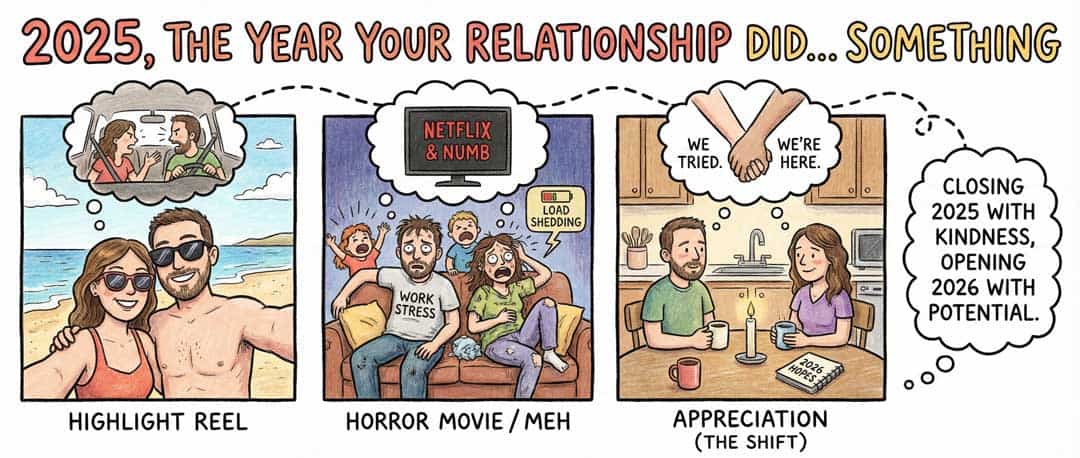
2025, The Year Your Relationship Did… Something
Maybe 2025 was romantic. Long walks, sunset selfies, those rare moments when you both laughed so hard you cried.
Maybe it was a soapie. Drama, tears, “we need to talk” on repeat, plot twists you didn’t see coming.
Maybe it was a crime scene (emotionally). Arguments that escalated, things said that can’t be unsaid, silences that lasted days.
Or maybe it was just… flat. Netflix and numb. Going through the motions. Not terrible, not wonderful, just there.
Here’s the truth: however it looked, you both did the best you could with what you knew.
This article isn’t about fixing everything before midnight on December 31st. It’s about laughing a bit, wincing a bit, then ending with appreciation instead of judgement. Because how you close off 2025 will determine how you open 2026.
2025 Relationship Status: Highlight, Horror Movie, or “Meh”?
Let’s be honest about the three main relationship profiles of 2025:
The Highlight Reel Couple
You posted the photos. The beach days, the braai sunsets, the matching takkies. From the outside, you looked like relationship goals. But you know the truth: half those smiles were staged after arguments in the car. You’re not fake, you’re just selective about what you share. And that’s okay.
The Disaster-but-Still-Here Couple
Fights. Tears. “We need to talk” became your most-used phrase. You threatened to leave (or thought about it) at least once. Money stress, family drama, work pressure—it all landed in your relationship like a bomb. But here’s the thing: you’re still here. That counts for something.
The Numb-and-Netflix Couple
Nothing dramatic happened. That’s the problem. You’re roommates who occasionally have sex. Conversations dried up to logistics: “What’s for supper?” “Did you pay the wifi?” You’re not fighting, but you’re not really connecting either. Just… existing side by side.
None of these profiles make you a failed couple—they show what you were up against.
Here’s what matters: none of these profiles make you a failed couple. They show what you were up against this year. And that’s worth acknowledging.
You Weren’t Lazy, You Were Overloaded
Let’s name the real enemies of your relationship in 2025:
- Work stress that followed you home every single night
- Kids who needed everything, all the time
- Financial pressure that kept you both awake at 3am
- Load shedding that ruined plans and frayed nerves
- WhatsApp groups that never stopped pinging
- Family obligations that drained your weekends
- Unresolved childhood stuff that kept showing up in your arguments
- Exhaustion. Just bone-deep, relentless exhaustion.
Your nervous systems were running on fumes. Fight-or-flight became your default setting. You weren’t choosing to be irritable or distant or defensive—you were surviving.
So let’s reframe the narrative: Instead of “we sucked at this relationship,” try “we were stretched thin and still showed up in imperfect ways.”
You weren’t choosing to be difficult—you were surviving.
That’s closer to the truth.
“We Tried Our Best” – What That Actually Looked Like
Your “best effort” in 2025 probably didn’t look like the therapy books said it should. But it was real. Here’s what imperfect trying looked like:
- Sending a peace-offering meme instead of starting another fight
- Going to bed angry but still making tea in the morning
- Agreeing to talk… then both chickening out… but at least not ghosting each other in the same house
- Apologising three days late instead of never
- Staying home together even when you wanted to run away
- Holding hands during the worst of it, even when you couldn’t find words
- Not saying the cruelest thing you thought of (even though you wanted to)
- Showing up for boring domestic tasks when romance was dead
- Choosing to stay instead of choosing to leave
Effort doesn’t always look wise or polished. Sometimes it’s clumsy survival. Sometimes it’s just not making things worse. And sometimes, that’s actually heroic.
Judgement: The Fastest Way to Ruin 2026 Before It Starts
Here’s how judgement sounds in relationships:
- “You never change.”
- “You’re impossible.”
- “This relationship is a joke.”
- “I can’t believe I’m still dealing with this.”
- “You always do this.”
When your partner hears that tone—the one that says “you’re fundamentally flawed and I’ve given up”—something shuts down inside them.
The effects of feeling judged:
- You stop trying (because why bother if you’re already a failure?)
- You hide your real feelings (because vulnerability gets punished)
- You play it safe and repeat the same patterns (because risk feels too dangerous)
- You defend yourself instead of being honest
- You return the judgement (because hurt people hurt people)
Feeling judged in 2025 trains you to fail again in 2026.
Here’s the clear line: Feeling judged in 2025 trains you to fail again in 2026.
If you want different results next year, you need a different approach. And that approach is appreciation.
Appreciation: Not Flattery, Just Honest Recognition
Appreciation is not the same as fake positivity. It’s not pretending everything was fine when it wasn’t.
It’s not saying: “You’re perfect.” “We’re amazing.” “This year was great.”
It’s more like: “You really did keep trying, even when it was messy.” “I see the effort you made, even when it didn’t work out perfectly.”
Here’s what real appreciation sounds like:
“Thank you for sticking it out when things were rough this year. I know you wanted to leave sometimes. I’m glad you stayed.”
“I noticed you tried to listen more, even when you were tired and overwhelmed. That didn’t go unnoticed.”
“We had some horrible fights this year, but we always came back to talk. That matters more than the fights themselves.”
“You showed up for me when I was falling apart, even though you were barely holding it together yourself.”
“We didn’t get it right most of the time, but we kept trying. That’s actually pretty brave.”
Appreciation does something powerful: it calms the nervous system. It signals safety. It says “you’re not on trial here.” And when people feel safe, they can actually change.
A Simple 2025 Relationship Debrief (Without Blaming Each Other)
Want to actually process this year together? Try this guided structure for a year-end chat. Set aside 30-45 minutes, put phones away, and work through these questions:
1. What was hard this year for us?
Stay on “we”, not “you”. Example: “It was hard for us when work took over and we stopped having real conversations.” Not: “You never made time for me.”
2. Where did we actually show effort?
Name small wins: conversations you forced yourselves to have, repairs you attempted, moments of humour that broke the tension, showing up even when you wanted to hide.
Example: “We showed effort when we agreed to stop arguing in front of the kids, even though it meant biting our tongues.” “We showed effort that time we both apologised the same day instead of dragging it out for a week.”
3. What did we learn about ourselves?
This is about self-awareness, not blame. Example: “I realised I shut down when I feel criticised.” “I realised I get loud when I feel ignored.” “I learned I need more sleep before I can handle difficult conversations.”
4. What do we want more of in 2026?
Be specific. Not “more happiness” (too vague). Try: “More honesty, even when it’s uncomfortable.” “More laughter—we used to be funny together.” “More date nights, even if they’re just pizza and a drive.” “More sleep so we’re not always running on empty.”
Sample sentences to help you start:
- “One thing that was hard for us this year was…”
- “I noticed we showed effort when…”
- “Something I learned about myself in our relationship this year is…”
- “In 2026, I’d like us to have more…”
Swapping Judgement for Appreciation in One Sentence
Sometimes all you need is a translation guide. Here’s how to turn judgement into appreciation:
From: “You’re so dramatic.”
To: “You feel things deeply, and I can see it matters to you.”
From: “You never talk.”
To: “I know talking is hard for you. I appreciate the times you push yourself to share with me.”
From: “We’re a mess.”
To: “We’re messy and still here. That counts for something.”
From: “You always shut down.”
To: “I can see you withdraw when things get intense. I’m learning that’s how you protect yourself.”
From: “This year was terrible for us.”
To: “This year was hard, and we survived it together. That’s not nothing.”
Appreciation says: it’s safe to try again.
Notice the shift? You’re not denying reality. You’re just choosing to see effort alongside struggle.
How Appreciation Sets You Up for New Potential in 2026
Here’s the basic logic of why this matters:
Appreciation says: “It’s safe to try again.”
Safety leads to: More openness. More willingness to take risks. More honest conversations.
That’s where: New patterns can actually form.
Think about it this way:
- Feeling judged = “I’m doomed to repeat 2025 because I’m fundamentally broken.”
- Feeling appreciated = “I can grow. I can experiment. I can repair in new ways. There’s room here for me to be different.”
You don’t change when you feel attacked. You change when you feel seen, accepted, and given space to evolve.
So if you want 2026 to be different, stop punishing each other for 2025. Start appreciating the humans who did their messy best.
A Short Ritual to Close Off 2025 Together
Want to mark the end of this year in a meaningful way? Try this simple ritual:
The 2025 Relationship Close-Out
Sit together somewhere comfortable. Phones away. Maybe with a glass of wine or a cup of tea. Set aside 20-30 minutes.
Each person shares:
- One thing that was hard for me this year in our relationship.
Example: “It was hard for me when we stopped touching each other.”
- One thing I appreciate about your effort this year.
Example: “I appreciate that you kept coming back to talk, even after our worst fights.”
- One thing I appreciate about us as a team.
Example: “I appreciate that we still make each other laugh when we’re not fighting.”
- One hope I have for us in 2026.
Example: “I hope we can be more gentle with each other when we’re stressed.”
Optional humorous addition:
Light a candle and call it “The Drama of 2025.” Say thank you for the lessons it taught you. Acknowledge what was hard. Then blow it out together and say “Done.”
It’s silly, but it’s also symbolic. You’re marking a transition. You’re choosing to put 2025 behind you without carrying all its judgement into the new year.
Closing: You Don’t Need a Perfect Relationship, You Need an Honest One
2025 doesn’t need to be rewritten or denied. It needs to be acknowledged.
You don’t upgrade 2026 by punishing yourselves for 2025. You upgrade it by saying: “We were doing the best we could with what we knew… and now we’re ready to learn more.”
Perfect relationships don’t exist. But honest relationships—where two people can look at their mess and say “we’re still here, and we still choose this”—those are worth everything.
You made it through 2025. That matters. Maybe you fought too much. Maybe you disconnected for stretches. Maybe you hurt each other in ways you’re still repairing. But you showed up. You tried. And even when trying looked clumsy and desperate and inadequate, it was still something.
So here’s to appreciating the two imperfect humans who made it through 2025 together—and giving them a kinder, braver chance in 2026.
You deserve that. Both of you.

by Kobus van der Merwe | Dec 17, 2025 | Blog, Couples, Life
When “I’m So Busy” Becomes Your Personality
Someone asks, “How are you?”
Before your brain even boots up, the word is already out: “Busy.”
Your calendar is full. Your inbox never empties. Your phone pings constantly. You’re doing, achieving, managing, responding—always moving, always on.
And somewhere underneath all that motion, your heart is running on low battery.
Here’s the uncomfortable truth: Quality relationships need time and focus. Not the leftover scraps after work, family obligations, WhatsApp groups, and that thing you promised to do six weeks ago. Real time. Real attention.
But busyness? Busyness can be a socially approved way to avoid uncomfortable feelings. It looks productive. It feels important. And nobody questions it because everyone else is doing it too.
This holiday break can be the time you stop hiding behind your to-do list and start filling the space between you and your partner with real connection again.
If you’re brave enough.
Are You Busy… Or Busy Addicted?
Let’s get honest. Here’s a light checklist to poke some fun and provoke some truth:
- You feel guilty if you sit down “for no reason” – Even watching TV requires justification: “I’m just unwinding after a long day.”
- You reach for your phone the second there’s silence – Quiet makes you uncomfortable, so you fill it immediately.
- Rest days make you edgy and irritable – When there’s nothing urgent to do, you don’t know who you are.
- You secretly feel more important when you’re overwhelmed – Being busy makes you feel needed, valuable, like you matter.
- “I’m so busy” has become your excuse for everything – Can’t call your mom, can’t see friends, can’t sit with your partner—you’re too busy.
Busyness isn’t just about getting things done—it’s a way of avoiding feelings.
If three or more of these sound familiar, you might not just be busy. You might be busy addicted.
And here’s the pattern: busyness isn’t just about “getting things done.” It’s a way of avoiding feelings. As long as you’re moving, you don’t have to feel. And that’s the real problem.
Childhood Messages: What Did You Learn About Rest and Fun?
Think back to your childhood. What were the spoken and unspoken rules about:
- Relaxing
- Having fun
- Belonging in your family
- Feeling wanted
Did you hear messages like:
- “You must always be useful.”
- “Fun is a reward, not a normal part of life.”
- “If you’re not achieving, you’re lazy.”
- “Don’t be a bother; fit in, keep quiet, don’t take up space.”
- “Idle hands are the devil’s workshop.”
- “Rest is for when you’re done—and you’re never really done.”
These messages didn’t disappear when you became an adult. They burrowed deep into your nervous system. Now:
- You feel safe when you’re productive.
- You feel anxious when you slow down.
- You believe your worth is tied to your output.
- You think resting means you’re weak, lazy, or selfish.
Your busyness isn’t a personality trait. It’s a learned survival strategy from a time when you needed to earn your place.
How Busyness Protects You From Old Pain
Let’s connect the dots in simple language:
If you never felt wanted as a child, you work yourself to exhaustion trying to become “valuable” enough that people won’t leave.
If you felt like the “too much” child (too loud, too needy, too emotional), you control yourself through work. You shrink your needs down to nothing and fill the void with productivity.
If you never truly belonged, you try to earn your place through performance. If you can just do enough, achieve enough, be useful enough—maybe then you’ll finally be wanted.
As long as you’re busy, you don’t have to feel how empty it sometimes is inside.
Work becomes a shield against old loneliness, shame, or feeling unwanted. And it works—for a while. As long as you’re busy, you don’t have to feel how empty it sometimes is inside.
But here’s the cost: the people who actually want you—your partner, your kids, your real life—can’t reach you through the wall of busyness you’ve built.
The Cost: Your Relationship Is Competing With Your To-Do List
Here’s how this looks at home:
Your partner talks to you. You half-listen while checking emails on your phone. You hear the words, but you’re not really there. They can feel it. They stop sharing the important stuff because what’s the point?
Your kids want attention. You say “Just now” for the 17th time. Eventually, they stop asking. They learn: Mom’s work is more important. Dad’s always busy. We’re not a priority.
Holidays turn into “mobile offices with snacks.” You’re physically at the beach or the family braai, but mentally you’re in seventeen WhatsApp groups and checking work emails “just quickly.” Nobody gets your real presence.
Here’s the consequence nobody wants to say out loud: Your loved ones start to experience themselves as less important than your work.
Emotional connection thins out. Conversations become transactional: “What’s for supper?” “Did you pay the wifi?” “Can you fetch the kids?”
Resentment grows quietly. And one day you look up and realize: you’re in the same house, but you’re strangers.
This Holiday: A Chance to Fill the Space Between You Again
Let’s reframe the holiday: it’s not a gap to fill with more tasks. It’s a space to fill with presence.
Here are practical, simple ideas to start:
One phone-free block of time each day
Start small: 30-60 minutes where phones go in another room. Not on silent. Not face-down on the table. Actually away. Use this time to be with your partner without the constant pull of notifications.
A daily “check-in” moment with your partner
Two simple questions:
- “How are you really today?” (Not “fine” or “busy”—really.)
- “What felt good between us today?” (Even small things count.)
One shared fun activity you both actually enjoy
Not what the kids want. Not what the in-laws expect. Something you two genuinely like: a walk, cooking together, watching the sunset with a cold drink, playing a game, listening to music.
Focused attention beats distracted hours together every single time.
Quality over quantity: focused attention beats distracted hours together every single time.
Taking Your Truth Back: Seeing What Your Busyness Is Really Doing
Here are some reflection questions to help you see clearly. Sit with them. Journal. Talk them through with your partner if you’re brave.
“What am I afraid I’ll feel if I slow down?”
Boredom? Loneliness? Worthlessness? Anxiety? Name it. That feeling is what you’re running from.
“What did I never get enough of as a child—and how am I still chasing that now?”
Attention? Approval? Feeling wanted? Belonging? Your busyness might be an adult attempt to finally get what you missed.
“How has my busyness protected me… and how is it hurting me and my partner now?”
Protection: It keeps you from feeling vulnerable, unwanted, or “lazy.” Hurt: It’s creating distance in the relationship that matters most.
The point here is understanding, not shaming yourself. You developed these patterns for good reasons. They helped you survive. But survival strategies that worked at age 8 don’t always serve you well at 38.
Making Time, Belonging, and Connection Non-Negotiable
Here’s the script flip: Instead of fitting your relationship into the leftovers of your life, you structure your life around what you say matters most.
That sounds nice in theory. Here’s what it looks like in practice:
Schedule “us time” first, then work
Put it in your calendar like a meeting. Protect it like you’d protect an important client call. Because your relationship is an important meeting.
Protect at least one recurring weekly connection ritual
A walk together. Coffee on Saturday morning. Date night at home after the kids sleep. Whatever works for you—but make it non-negotiable.
Start and end the day with real contact
Not “Hey” while scrolling. Real contact: a conversation, a hug, eye contact, appreciation. “I’m glad you’re here.” “I love you.” “Thank you for…”
This isn’t rocket science. It’s just intentionality. But intentionality is exactly what busyness erases.
Conscious Relating: Loving With Your Eyes Open
“Conscious relating” sounds fancy. It’s not. Here’s what it means in plain terms:
- You notice your patterns instead of running on auto-pilot.
- You name what’s happening between you instead of pretending you’re “fine.”
- You take responsibility for your side rather than blaming work, emails, the economy, Eskom, everyone else.
Simple practices:
“Right now, I notice I want to escape into my phone instead of feeling irritated with you. Can we talk about what’s actually bothering me?”
“I’m tempted to open my laptop. But can we first have 15 minutes where I’m fully here with you?”
“I realized I’ve been using work to avoid feeling lonely. That’s not fair to you, and it’s not working for me either.”
Work will always take what you give it—this holiday, give your partner something you can’t get back later.
This kind of honesty feels vulnerable. But vulnerability is the price of real connection. You can’t have intimacy while hiding behind your to-do list.
A Holiday Experiment: 7 Days of “Less Busy, More Human”
Want to try something? Here’s a short, playful challenge for couples this holiday:
Day 1: One phone-free meal
Breakfast, lunch, or dinner. Phones in another room. Just you two and actual conversation.
Day 2: 20-minute walk together, no work talk
No discussing logistics, money stress, or what still needs to get done. Just walk and be.
Day 3: Share one childhood message about work/rest
Tell each other one thing you learned growing up about productivity, rest, or being “good enough.” How does it still affect you?
Day 4: One small act of affection you usually “forget”
A hug that lasts more than 3 seconds. Holding hands. A genuine compliment. Touch that says “I see you.”
Day 5: An hour with laptops off and curiosity on
Ask each other real questions. “What do you actually want for 2026?” “What’s been hard for you lately?” “What makes you feel alive?”
Day 6: Appreciate three things about each other’s effort this year
Not what they achieved. Their effort. “I appreciate that you kept showing up even when you were exhausted.”
Day 7: Plan one regular ritual you’ll keep in 2026
Pick something simple and commit to it. One thing that protects connection when life gets busy again.
Closing: Your Life Quality = Relationship Quality
If busyness runs your life, it will also run your relationship into the ground.
You can tell yourself you’re “doing it all for them”—working hard to provide, to build a better life, to make everything perfect. But if they never actually get you, what’s the point?
Your kids don’t need a more impressive house. They need a parent who’s present. Your partner doesn’t need more stuff. They need you to look at them like they matter more than your phone.
When you slow down enough to belong, connect, and love consciously, your quality of life shifts from “functioning” to actually living. From going through the motions to being genuinely alive in your own existence.
That’s not a luxury. That’s the whole point.
So here’s the challenge: Work will always take what you give it. There will always be one more email, one more task, one more urgent thing demanding your attention.
But this holiday, give your partner and yourself something you can’t get back later: your time and your full presence.
Not your distracted half-attention while you scroll. Not your exhausted leftovers at the end of the day. Your actual self—awake, alive, and here.
That’s the gift that changes everything.