Connection Isn’t Something You Get—It’s What You Are
Many couples think connection is something you get when you get married. Others think connection comes from “better communication.” Both ideas miss something important.
Marriage gives you proximity, not connection; you still have to practise being reachable and responsive.
Marriage gives you a legal bond and daily contact. Communication gives you words. But connection is deeper than a ring or a conversation. Connection is part of being human. You exist because you are connected. You became “you” in relationship with other people. From the first day of life, your nervous system learned: Am I safe? Am I seen? Does someone come back for me?
Connection Isn’t Something You Get—It’s What You Are
Connection is not a quality you acquire. It is an existential essence of who you are. The real question is not “How do we get connection?” The real question is: “How do we protect it, and how do we restore it when it gets ruptured?”
What “the space-between” means for couples
In Doing Imago Relationship Therapy in the Space-Between, Harville Hendrix and Helen LaKelly Hunt describe the relationship as a real “between” that you both influence. Think of it like the emotional atmosphere between you. It is not only inside you or inside your partner. It is in the space-between.
When the space-between feels safe, you relax. You talk, you laugh, you touch, you solve problems. When the space-between feels unsafe, you defend. You criticise, you shut down, you control, you avoid, or you act “fine” while feeling far away.
Connection is not a skill you earn; it is the human starting point, and disconnection is the wound.
Here is the key point: you are always connecting. Even silence is a form of connecting. Even sarcasm is a form of connecting. The question is whether your connecting creates closeness or distance.
Why connection gets ruptured (and why it feels so intense)
If disconnection did not matter, you could shrug it off. But disconnection hits your body like danger. That is not weakness. That is biology.
As children, all of us had moments where connection with a caregiver broke down. Sometimes it was big: anger, neglect, separation, chaos. Sometimes it was small but repeated: a parent who was busy, distracted, or emotionally unavailable. In the book, the authors describe rupture in connecting as a universal human experience. Those early ruptures shape your reflexes in adult love.
So when your partner rolls their eyes, forgets something, turns away, or says “whatever,” it can feel like more than a moment. It can feel like: I do not matter. I am alone. I am unsafe. That is when you go into protection mode.
Withdraw: silence, shutdown, leaving the room, distraction.
Control: lecturing, policing, fixing, insisting.
Pleasing: agreeing on the surface while resentment builds.
These are not “bad personality traits.” They are attempts to survive disconnection. The tragedy is that they usually create more disconnection.
The space between you becomes safe when you stop winning and start repairing.
Communication is not the same as connection
You can communicate and still feel alone. You can talk for hours and not feel met. Why? Because connection is not mainly about information. It is about experience: do I feel heard, valued, and emotionally held?
Here is a simple test:
If your “communication” ends with one of you feeling small, guilty, or unsafe, you shared words but lost connection.
If your “communication” ends with both of you feeling calmer, clearer, and closer, you built connection.
Connection requires a specific kind of communication: slow enough to be accurate, respectful enough to feel safe, and structured enough to stop the usual spiral.
A simple way to think about connection in daily life
Connection is built through small moments, not grand gestures. Each day, you make “bids” for connection: a comment, a question, a touch, a look, a sigh. Your partner responds in one of three ways:
Turning toward: “Tell me more.” Eye contact. A touch. Interest.
Turning away: distraction, short answers, phone, “later.”
Turning against: irritation, sarcasm, criticism.
Over time, turning toward builds trust. Turning away and turning against build loneliness, even if you share a home.
How to restore rupture in the space-between
Repair is not a speech. It is an action that reopens connection. In Imago, repair becomes easier when you use a structure. Structure lowers threat. It stops interruptions and defensiveness. It helps both of you stay present.
Try this 10-minute “repair” practice once this week:
Set the intention: “I want to reconnect. I am not here to win.”
One speaks, one listens: The speaker says one short sentence about their feeling and need (not a complaint). Example: “I felt alone earlier and I need a few minutes of attention.”
Mirror: The listener repeats back what they heard. “What I hear you saying is…” (No arguing.)
Validate: “That makes sense because…” (You do not have to agree. You make it understandable.)
Empathise: “I imagine you might feel…”
Small action: One concrete step. “Can I sit with you for 10 minutes now?” or “Can we plan a time tonight?”
Close with appreciation: Each shares one appreciation for the other.
This is not magic. It is practice. The more you repair, the safer the space-between becomes.
Imago Dialogue gives you a repeatable way to repair ruptures before they become resentment.
The skill you need most is not “talking.” It is repairing.
Every couple ruptures connection. The difference between thriving couples and struggling couples is not whether they rupture. It is whether they repair.
If you want a practical path, read Doing Imago Relationship Therapy in the Space-Between. It explains why disconnection hurts so much, and it teaches a clear method for restoring the space-between. Then take the next step: book Imago Relationship Therapy or join an Imago workshop so you can learn the dialogue skills with support.
Do not wait until distance becomes normal. If you feel a rupture, treat it like a signal, not a verdict. Come back. Slow down. Use a structure. Repair the connection. That is how you build a relationship that feels alive.
Many couples plan their careers, finances, and holidays. Yet they never plan their relationship with the same care. When there is no shared vision, daily pressure sets the agenda. You react to problems, you argue about symptoms, and you drift into routines you did not choose.
If you do not choose a direction for your relationship, your stress will choose one for you.
A vision is not a slogan. It is a practical description of what you want to build together and how you want to treat each other while you build it. It gives you a reference point when you feel disconnected. It also helps you stop turning your partner into the problem. Instead, you and your partner become the team facing the issue.
What a relationship vision actually does
A clear vision does three things:
It reduces confusion. You stop guessing what “a good relationship” means to each of you.
It creates alignment. You can say yes to what fits and no to what pulls you apart.
It builds safety. When you know the direction, small setbacks feel manageable.
Without a vision, you will still have goals. They just stay hidden and unspoken. Hidden goals usually come out as criticism, shutdown, control, or “fine, do what you want.” A vision brings those needs into the open so you can negotiate them with respect.
The 2026 question: are you planning from fear or from potential?
Most couples do not think they are fear-driven. Fear is often quiet. It shows up as “we must not end up like my parents,” “we cannot afford another fight,” or “I do not want to feel rejected again.” These are understandable. But when fear leads, the vision shrinks.
A fear-based vision tends to sound like this:
“We just want fewer fights.”
“We want things to be normal again.”
“We want to stop talking about hard topics.”
These goals are not wrong. They are incomplete. They focus on avoiding pain, not creating connection. Avoidance can calm things down for a while, but it rarely builds closeness.
A shared vision turns conflict into data: it shows you what needs attention, not who is to blame.
A potential-based vision is different. It asks: “What could this relationship become if we did the work?” It does not deny problems. It refuses to let problems define the future.
A potential-based vision tends to sound like this:
“We want a home where we speak with respect, even when we disagree.”
“We want to repair quickly after conflict and learn from what happened.”
“We want a strong friendship, a satisfying sex life, and reliable emotional support.”
“We want to parent as allies and protect our couple bond.”
Potential-based does not mean unrealistic. It means you plan for growth, not for survival.
What should your 2026 relationship vision include?
A good 2026 vision has clear areas. If you skip an area, it usually becomes the next argument.
1) Emotional climate
Describe the felt sense you want at home. Examples: calm, playful, warm, honest, supportive. Then define what that looks like in behaviour: tone of voice, how you greet each other, how you handle stress after work.
2) Conflict and repair
Conflict is normal. The vision is not “never fight.” The vision is “we know how to come back.” Decide how you will repair: time-out rules, a structured dialogue, apologies that include ownership and a next step.
3) Appreciation and admiration
Most couples under-dose appreciation. In 2026, make it measurable. For example: each of you shares two appreciations per day, or you do a weekly appreciation check-in.
A fear-based plan avoids pain; a potential-based plan builds the relationship you actually want to live in.
4) Time, attention, and rituals
Love needs contact. Decide on rituals that protect connection: a weekly date, a Sunday planning chat, a daily 10-minute reconnect, or a technology boundary after 20:30.
5) Intimacy and sexuality
Do not leave this to chance. Write what you want to feel: desired, safe, playful, connected, free to say yes and no. Add practices: honest conversations, slow touch, planned intimacy, or a shared learning goal.
6) Money and workload
Stress comes from uneven load more than from the amount of work. Your vision should include fairness: who carries what, how you decide, and how you revisit the agreement.
How to create your 2026 vision together
Do this as a 60–90 minute meeting. Put phones away. Keep it structured. Use a timer if you tend to interrupt.
Start with the “why.” Each of you answers: “Why do I want a better relationship in 2026?” Keep it personal. No blaming.
Name the fear. Each of you names one fear that could drive your planning. Example: “I fear being alone in the relationship.” Then add: “What I want instead is…”
Name the potential. Each of you completes: “If we do this well, our relationship in December 2026 will feel like…”
Choose 3 priorities. Pick three areas for the first 90 days. If you choose ten, you will do none.
Write 3 weekly actions. Small, repeatable actions beat big promises. Examples: a 20-minute weekly dialogue, two appreciations a day, one date a week.
Keep your vision short enough to remember. A good format is one paragraph plus a bullet list of practices.
Your 2026 vision works when it becomes a weekly practice, not a once-a-year conversation.
How to know if your vision is working
Use simple markers you can track:
Repair speed: How long do you stay disconnected after a conflict?
Emotional bids: Do you respond when your partner reaches for you?
Appreciation ratio: Do positives clearly outnumber critiques?
Ritual consistency: Do you keep the weekly practices most weeks?
If the markers drift, do not panic. Adjust. A vision is a living agreement. It is not a test you pass or fail.
A simple 2026 vision statement you can adapt
“In 2026, we choose to act like a team. We speak with respect, even when we are stressed. We repair quickly after conflict and stay curious about each other’s inner world. We protect time for connection, we share the load fairly, and we build a relationship that supports both of us to grow.”
When you plan from potential, you still face hard days. The difference is that hard days do not define the relationship. They become moments where you practise the vision.
Maybe 2025 was romantic. Long walks, sunset selfies, those rare moments when you both laughed so hard you cried.
Maybe it was a soapie. Drama, tears, “we need to talk” on repeat, plot twists you didn’t see coming.
Maybe it was a crime scene (emotionally). Arguments that escalated, things said that can’t be unsaid, silences that lasted days.
Or maybe it was just… flat. Netflix and numb. Going through the motions. Not terrible, not wonderful, just there.
Here’s the truth: however it looked, you both did the best you could with what you knew.
This article isn’t about fixing everything before midnight on December 31st. It’s about laughing a bit, wincing a bit, then ending with appreciation instead of judgement. Because how you close off 2025 will determine how you open 2026.
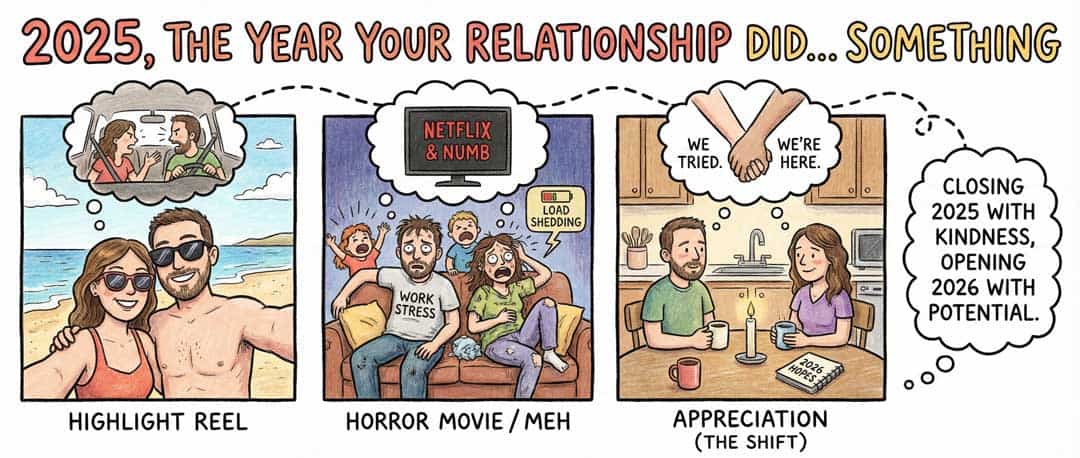
2025 Relationship Status: Highlight, Horror Movie, or “Meh”?
Let’s be honest about the three main relationship profiles of 2025:
The Highlight Reel Couple
You posted the photos. The beach days, the braai sunsets, the matching takkies. From the outside, you looked like relationship goals. But you know the truth: half those smiles were staged after arguments in the car. You’re not fake, you’re just selective about what you share. And that’s okay.
The Disaster-but-Still-Here Couple
Fights. Tears. “We need to talk” became your most-used phrase. You threatened to leave (or thought about it) at least once. Money stress, family drama, work pressure—it all landed in your relationship like a bomb. But here’s the thing: you’re still here. That counts for something.
The Numb-and-Netflix Couple
Nothing dramatic happened. That’s the problem. You’re roommates who occasionally have sex. Conversations dried up to logistics: “What’s for supper?” “Did you pay the wifi?” You’re not fighting, but you’re not really connecting either. Just… existing side by side.
None of these profiles make you a failed couple—they show what you were up against.
Here’s what matters: none of these profiles make you a failed couple. They show what you were up against this year. And that’s worth acknowledging.
You Weren’t Lazy, You Were Overloaded
Let’s name the real enemies of your relationship in 2025:
Work stress that followed you home every single night
Kids who needed everything, all the time
Financial pressure that kept you both awake at 3am
Load shedding that ruined plans and frayed nerves
WhatsApp groups that never stopped pinging
Family obligations that drained your weekends
Unresolved childhood stuff that kept showing up in your arguments
Exhaustion. Just bone-deep, relentless exhaustion.
Your nervous systems were running on fumes. Fight-or-flight became your default setting. You weren’t choosing to be irritable or distant or defensive—you were surviving.
So let’s reframe the narrative: Instead of “we sucked at this relationship,” try “we were stretched thin and still showed up in imperfect ways.”
You weren’t choosing to be difficult—you were surviving.
That’s closer to the truth.
“We Tried Our Best” – What That Actually Looked Like
Your “best effort” in 2025 probably didn’t look like the therapy books said it should. But it was real. Here’s what imperfect trying looked like:
Sending a peace-offering meme instead of starting another fight
Going to bed angry but still making tea in the morning
Agreeing to talk… then both chickening out… but at least not ghosting each other in the same house
Apologising three days late instead of never
Staying home together even when you wanted to run away
Holding hands during the worst of it, even when you couldn’t find words
Not saying the cruelest thing you thought of (even though you wanted to)
Showing up for boring domestic tasks when romance was dead
Choosing to stay instead of choosing to leave
Effort doesn’t always look wise or polished. Sometimes it’s clumsy survival. Sometimes it’s just not making things worse. And sometimes, that’s actually heroic.
Judgement: The Fastest Way to Ruin 2026 Before It Starts
Here’s how judgement sounds in relationships:
“You never change.”
“You’re impossible.”
“This relationship is a joke.”
“I can’t believe I’m still dealing with this.”
“You always do this.”
When your partner hears that tone—the one that says “you’re fundamentally flawed and I’ve given up”—something shuts down inside them.
The effects of feeling judged:
You stop trying (because why bother if you’re already a failure?)
You hide your real feelings (because vulnerability gets punished)
You play it safe and repeat the same patterns (because risk feels too dangerous)
You defend yourself instead of being honest
You return the judgement (because hurt people hurt people)
Feeling judged in 2025 trains you to fail again in 2026.
Here’s the clear line: Feeling judged in 2025 trains you to fail again in 2026.
If you want different results next year, you need a different approach. And that approach is appreciation.
Appreciation: Not Flattery, Just Honest Recognition
Appreciation is not the same as fake positivity. It’s not pretending everything was fine when it wasn’t.
It’s not saying: “You’re perfect.” “We’re amazing.” “This year was great.”
It’s more like: “You really did keep trying, even when it was messy.” “I see the effort you made, even when it didn’t work out perfectly.”
Here’s what real appreciation sounds like:
“Thank you for sticking it out when things were rough this year. I know you wanted to leave sometimes. I’m glad you stayed.”
“I noticed you tried to listen more, even when you were tired and overwhelmed. That didn’t go unnoticed.”
“We had some horrible fights this year, but we always came back to talk. That matters more than the fights themselves.”
“You showed up for me when I was falling apart, even though you were barely holding it together yourself.”
“We didn’t get it right most of the time, but we kept trying. That’s actually pretty brave.”
Appreciation does something powerful: it calms the nervous system. It signals safety. It says “you’re not on trial here.” And when people feel safe, they can actually change.
A Simple 2025 Relationship Debrief (Without Blaming Each Other)
Want to actually process this year together? Try this guided structure for a year-end chat. Set aside 30-45 minutes, put phones away, and work through these questions:
1. What was hard this year for us?
Stay on “we”, not “you”. Example: “It was hard for us when work took over and we stopped having real conversations.” Not: “You never made time for me.”
2. Where did we actually show effort?
Name small wins: conversations you forced yourselves to have, repairs you attempted, moments of humour that broke the tension, showing up even when you wanted to hide.
Example: “We showed effort when we agreed to stop arguing in front of the kids, even though it meant biting our tongues.” “We showed effort that time we both apologised the same day instead of dragging it out for a week.”
3. What did we learn about ourselves?
This is about self-awareness, not blame. Example: “I realised I shut down when I feel criticised.” “I realised I get loud when I feel ignored.” “I learned I need more sleep before I can handle difficult conversations.”
4. What do we want more of in 2026?
Be specific. Not “more happiness” (too vague). Try: “More honesty, even when it’s uncomfortable.” “More laughter—we used to be funny together.” “More date nights, even if they’re just pizza and a drive.” “More sleep so we’re not always running on empty.”
Sample sentences to help you start:
“One thing that was hard for us this year was…”
“I noticed we showed effort when…”
“Something I learned about myself in our relationship this year is…”
“In 2026, I’d like us to have more…”
Swapping Judgement for Appreciation in One Sentence
Sometimes all you need is a translation guide. Here’s how to turn judgement into appreciation:
From: “You’re so dramatic.” To: “You feel things deeply, and I can see it matters to you.”
From: “You never talk.” To: “I know talking is hard for you. I appreciate the times you push yourself to share with me.”
From: “We’re a mess.” To: “We’re messy and still here. That counts for something.”
From: “You always shut down.” To: “I can see you withdraw when things get intense. I’m learning that’s how you protect yourself.”
From: “This year was terrible for us.” To: “This year was hard, and we survived it together. That’s not nothing.”
Appreciation says: it’s safe to try again.
Notice the shift? You’re not denying reality. You’re just choosing to see effort alongside struggle.
How Appreciation Sets You Up for New Potential in 2026
Here’s the basic logic of why this matters:
Appreciation says: “It’s safe to try again.”
Safety leads to: More openness. More willingness to take risks. More honest conversations.
That’s where: New patterns can actually form.
Think about it this way:
Feeling judged = “I’m doomed to repeat 2025 because I’m fundamentally broken.”
Feeling appreciated = “I can grow. I can experiment. I can repair in new ways. There’s room here for me to be different.”
You don’t change when you feel attacked. You change when you feel seen, accepted, and given space to evolve.
So if you want 2026 to be different, stop punishing each other for 2025. Start appreciating the humans who did their messy best.
A Short Ritual to Close Off 2025 Together
Want to mark the end of this year in a meaningful way? Try this simple ritual:
The 2025 Relationship Close-Out
Sit together somewhere comfortable. Phones away. Maybe with a glass of wine or a cup of tea. Set aside 20-30 minutes.
Each person shares:
One thing that was hard for me this year in our relationship. Example: “It was hard for me when we stopped touching each other.”
One thing I appreciate about your effort this year. Example: “I appreciate that you kept coming back to talk, even after our worst fights.”
One thing I appreciate about us as a team. Example: “I appreciate that we still make each other laugh when we’re not fighting.”
One hope I have for us in 2026. Example: “I hope we can be more gentle with each other when we’re stressed.”
Optional humorous addition:
Light a candle and call it “The Drama of 2025.” Say thank you for the lessons it taught you. Acknowledge what was hard. Then blow it out together and say “Done.”
It’s silly, but it’s also symbolic. You’re marking a transition. You’re choosing to put 2025 behind you without carrying all its judgement into the new year.
Closing: You Don’t Need a Perfect Relationship, You Need an Honest One
2025 doesn’t need to be rewritten or denied. It needs to be acknowledged.
You don’t upgrade 2026 by punishing yourselves for 2025. You upgrade it by saying: “We were doing the best we could with what we knew… and now we’re ready to learn more.”
Perfect relationships don’t exist. But honest relationships—where two people can look at their mess and say “we’re still here, and we still choose this”—those are worth everything.
You made it through 2025. That matters. Maybe you fought too much. Maybe you disconnected for stretches. Maybe you hurt each other in ways you’re still repairing. But you showed up. You tried. And even when trying looked clumsy and desperate and inadequate, it was still something.
So here’s to appreciating the two imperfect humans who made it through 2025 together—and giving them a kinder, braver chance in 2026.
Every December, churches fill up. Candles are lit, carols echo, nativity scenes go up.
We celebrate the birth of Christ. We speak about Holy Love. God’s Love. We sing, “Love came down at Christmas.”
But here’s the hard question:
If you say you believe in God’s love, but the people closest to you experience you as distant, harsh, critical, or checked out… what is that belief worth in real life?
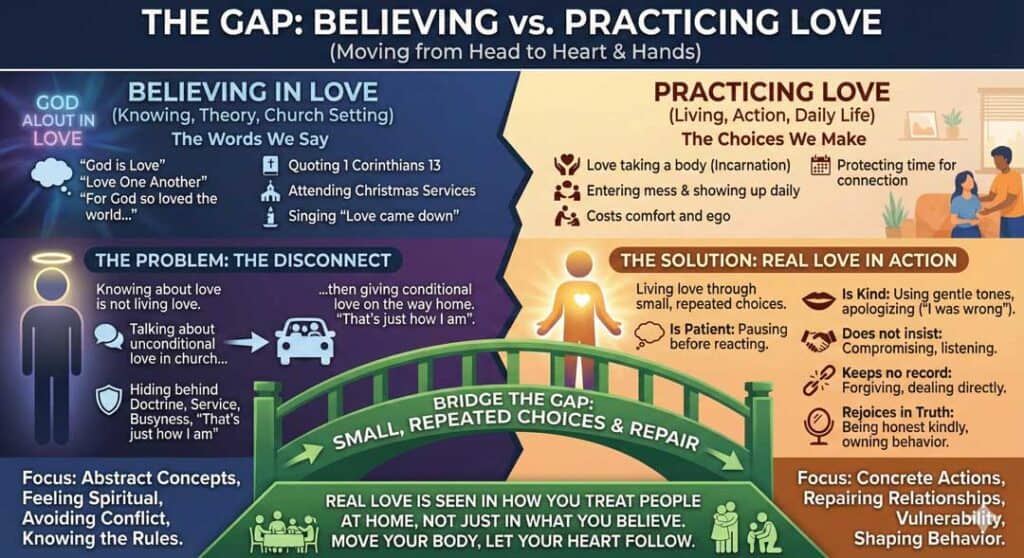
Knowing about love and living love are two different things.
This article is about that gap.
The Problem: We “Believe” in Love but Don’t Practice It
You know the words:
“God is love.”
“Love one another.”
“For God so loved the world…”
You might even be able to quote 1 Corinthians 13 from memory.
But:
You snap at your partner when you’re stressed.
You shut down when someone needs a real conversation.
You keep score instead of forgiving.
You stay silent when you should apologise.
You can sit in a Christmas service talking about unconditional love, then give your family very conditional love in the car on the way home.
You can sit in a Christmas service talking about unconditional love, then give your family very conditional love in the car on the way home.
The issue is not that you don’t know enough. The issue is that you don’t practice what you already know.
Christmas: Love That Took a Body
The central Christian claim at Christmas is simple: Love did not stay an idea. Love took a body.
God didn’t send a concept.
God didn’t send a rulebook.
God didn’t send “thoughts and prayers” from a distance.
God’s love moved into human life – with crying, feeding, waiting, growing, listening, walking, touching, healing.
If you say you honour that, but your love stays in your head or in your church building, you’ve missed the point.
Real love:
Enters mess.
Shows up in small daily moments.
Costs you comfort and ego.
Holy Love is not sentimental. It is concrete.
Holy Love is not sentimental. It is concrete.
From Knowing God’s Love to Living God’s Love
Think of it like this:
Knowing God’s love = “I’ve heard the story, I agree with it.”
Trusting God’s love = “I let it matter for me personally.”
Living God’s love = “I let it shape how I treat people.”
You move from “knowing” to “living” through small, repeated choices, not through one emotional church service.
Ask yourself:
If someone filmed you at home for a week, would they conclude: “This person believes in a God of love” based only on how you treat others?
If the answer is no, don’t defend yourself. Let it be a wake-up call.
What Real Love Looks Like in Daily Life
You don’t need to guess. Scripture already gives a clear picture (1 Corinthians 13). Translate that into daily behaviour:
Real love:
Is patient
You pause before reacting.
You give people time to finish their sentence.
Is kind
You use a gentle tone, especially with those closest to you.
You look for one small way to lighten someone’s load today.
Does not insist on its own way
You can say, “Let’s do it your way this time.”
You can compromise on plans, even when you’re convinced you’re right.
Keeps no record of wrongs
You stop bringing up that old mistake in every argument.
You deal with issues directly instead of storing them as ammunition.
Rejoices with the truth
You tell the truth kindly, instead of lying to keep the peace.
You face your own behaviour honestly, without excuses.
None of this is mystical. It is hard. It is simple. It is concrete.
None of this is mystical. It is hard. It is simple. It is concrete.
How We Dodge Real Love (Even While Talking About God)
Here are some common ways you avoid living love while pretending you’re still being “spiritual”:
Hiding behind doctrine
You debate theology but won’t apologise.
Hiding behind service
You help everyone at church, but your family gets your leftovers.
Hiding behind busyness
“I’m doing important things for God,” becomes an excuse for emotional absence.
Hiding behind “that’s just how I am”
You use personality as a shield against growth.
Every time you do this, you disconnect your faith from your relationships. You are “celebrating” God’s love while withholding your own.
Bringing Holy Love Into Your Relationships
If Christmas is about love taking on flesh, then your task is to let love take flesh in your body:
In your face
Softening your expression when your partner talks.
Really looking at your child when they show you something.
In your mouth
“I was wrong. I’m sorry.”
“I’m listening. Tell me more.”
“I appreciate you, even though we’re struggling.”
In your hands
Helping with the work nobody sees.
A gentle touch on the arm when someone is upset.
In your calendar
Protecting time for the people who matter.
Saying no to some “good things” so you can say yes to real connection.
You don’t need to fix everything at once. Choose one concrete way to let God’s love move through you today.
When You Fail (Because You Will)
You will lose your temper. You will withdraw. You will say something sharp and regret it.
Living love is not about perfection. It’s about repair.
When you fail:
Notice it – “I spoke harshly just now.”
Own it – “I’m sorry, that was unfair.” No excuses. No blaming.
Ask what the other person needs – “How did that land for you?” “What do you need from me now?”
Try again – Show, with your next action, that you’re serious.
This is how grace and Holy Love become visible in a relationship: not in never hurting each other, but in how you repair when you do.
A Christmas Prayer You Live, Not Just Say
If you want one simple way to realign this season, try this short daily prayer and back it up with action:
“God of Love, Show me one person I can love well today, and one concrete way to do it.”
Then:
Send the message.
Make the call.
Listen without defending.
Offer the hug.
Start the repair conversation.
Don’t wait to “feel spiritual”. Move your body in the direction of love, and let your heart follow.
Don’t wait to “feel spiritual”. Move your body in the direction of love, and let your heart follow.
Closing: If Love Doesn’t Change How You Treat People, It’s Still Theory
Celebrating the birth of Christ without changing how you treat people at home is like celebrating bread while never eating.
If God is love, your faith should make you more patient, not more arrogant.
More humble, not more defensive.
More present, not more absent.
Real love is not mainly seen in church services, candles, or carols. It is seen in the way you speak to your partner in the kitchen, your kids in the car, your family at the table.
Holy Love isn’t only something you sing about. It is something you practice, one relationship, one conversation, one awkward apology at a time.
Before your brain even boots up, the word is already out: “Busy.”
Your calendar is full. Your inbox never empties. Your phone pings constantly. You’re doing, achieving, managing, responding—always moving, always on.
And somewhere underneath all that motion, your heart is running on low battery.
Here’s the uncomfortable truth: Quality relationships need time and focus. Not the leftover scraps after work, family obligations, WhatsApp groups, and that thing you promised to do six weeks ago. Real time. Real attention.
But busyness? Busyness can be a socially approved way to avoid uncomfortable feelings. It looks productive. It feels important. And nobody questions it because everyone else is doing it too.
This holiday break can be the time you stop hiding behind your to-do list and start filling the space between you and your partner with real connection again.
If you’re brave enough.
Are You Busy… Or Busy Addicted?
Let’s get honest. Here’s a light checklist to poke some fun and provoke some truth:
You feel guilty if you sit down “for no reason” – Even watching TV requires justification: “I’m just unwinding after a long day.”
You reach for your phone the second there’s silence – Quiet makes you uncomfortable, so you fill it immediately.
Rest days make you edgy and irritable – When there’s nothing urgent to do, you don’t know who you are.
You secretly feel more important when you’re overwhelmed – Being busy makes you feel needed, valuable, like you matter.
“I’m so busy” has become your excuse for everything – Can’t call your mom, can’t see friends, can’t sit with your partner—you’re too busy.
Busyness isn’t just about getting things done—it’s a way of avoiding feelings.
If three or more of these sound familiar, you might not just be busy. You might be busy addicted.
And here’s the pattern: busyness isn’t just about “getting things done.” It’s a way of avoiding feelings. As long as you’re moving, you don’t have to feel. And that’s the real problem.
Childhood Messages: What Did You Learn About Rest and Fun?
Think back to your childhood. What were the spoken and unspoken rules about:
Relaxing
Having fun
Belonging in your family
Feeling wanted
Did you hear messages like:
“You must always be useful.”
“Fun is a reward, not a normal part of life.”
“If you’re not achieving, you’re lazy.”
“Don’t be a bother; fit in, keep quiet, don’t take up space.”
“Idle hands are the devil’s workshop.”
“Rest is for when you’re done—and you’re never really done.”
These messages didn’t disappear when you became an adult. They burrowed deep into your nervous system. Now:
You feel safe when you’re productive.
You feel anxious when you slow down.
You believe your worth is tied to your output.
You think resting means you’re weak, lazy, or selfish.
Your busyness isn’t a personality trait. It’s a learned survival strategy from a time when you needed to earn your place.
How Busyness Protects You From Old Pain
Let’s connect the dots in simple language:
If you never felt wanted as a child, you work yourself to exhaustion trying to become “valuable” enough that people won’t leave.
If you felt like the “too much” child (too loud, too needy, too emotional), you control yourself through work. You shrink your needs down to nothing and fill the void with productivity.
If you never truly belonged, you try to earn your place through performance. If you can just do enough, achieve enough, be useful enough—maybe then you’ll finally be wanted.
As long as you’re busy, you don’t have to feel how empty it sometimes is inside.
Work becomes a shield against old loneliness, shame, or feeling unwanted. And it works—for a while. As long as you’re busy, you don’t have to feel how empty it sometimes is inside.
But here’s the cost: the people who actually want you—your partner, your kids, your real life—can’t reach you through the wall of busyness you’ve built.
The Cost: Your Relationship Is Competing With Your To-Do List
Here’s how this looks at home:
Your partner talks to you. You half-listen while checking emails on your phone. You hear the words, but you’re not really there. They can feel it. They stop sharing the important stuff because what’s the point?
Your kids want attention. You say “Just now” for the 17th time. Eventually, they stop asking. They learn: Mom’s work is more important. Dad’s always busy. We’re not a priority.
Holidays turn into “mobile offices with snacks.” You’re physically at the beach or the family braai, but mentally you’re in seventeen WhatsApp groups and checking work emails “just quickly.” Nobody gets your real presence.
Here’s the consequence nobody wants to say out loud: Your loved ones start to experience themselves as less important than your work.
Emotional connection thins out. Conversations become transactional: “What’s for supper?” “Did you pay the wifi?” “Can you fetch the kids?”
Resentment grows quietly. And one day you look up and realize: you’re in the same house, but you’re strangers.
This Holiday: A Chance to Fill the Space Between You Again
Let’s reframe the holiday: it’s not a gap to fill with more tasks. It’s a space to fill with presence.
Here are practical, simple ideas to start:
One phone-free block of time each day
Start small: 30-60 minutes where phones go in another room. Not on silent. Not face-down on the table. Actually away. Use this time to be with your partner without the constant pull of notifications.
A daily “check-in” moment with your partner
Two simple questions:
“How are you really today?” (Not “fine” or “busy”—really.)
“What felt good between us today?” (Even small things count.)
One shared fun activity you both actually enjoy
Not what the kids want. Not what the in-laws expect. Something you two genuinely like: a walk, cooking together, watching the sunset with a cold drink, playing a game, listening to music.
Focused attention beats distracted hours together every single time.
Quality over quantity: focused attention beats distracted hours together every single time.
Taking Your Truth Back: Seeing What Your Busyness Is Really Doing
Here are some reflection questions to help you see clearly. Sit with them. Journal. Talk them through with your partner if you’re brave.
“What am I afraid I’ll feel if I slow down?”
Boredom? Loneliness? Worthlessness? Anxiety? Name it. That feeling is what you’re running from.
“What did I never get enough of as a child—and how am I still chasing that now?”
Attention? Approval? Feeling wanted? Belonging? Your busyness might be an adult attempt to finally get what you missed.
“How has my busyness protected me… and how is it hurting me and my partner now?”
Protection: It keeps you from feeling vulnerable, unwanted, or “lazy.” Hurt: It’s creating distance in the relationship that matters most.
The point here is understanding, not shaming yourself. You developed these patterns for good reasons. They helped you survive. But survival strategies that worked at age 8 don’t always serve you well at 38.
Making Time, Belonging, and Connection Non-Negotiable
Here’s the script flip: Instead of fitting your relationship into the leftovers of your life, you structure your life around what you say matters most.
That sounds nice in theory. Here’s what it looks like in practice:
Schedule “us time” first, then work
Put it in your calendar like a meeting. Protect it like you’d protect an important client call. Because your relationship is an important meeting.
Protect at least one recurring weekly connection ritual
A walk together. Coffee on Saturday morning. Date night at home after the kids sleep. Whatever works for you—but make it non-negotiable.
Start and end the day with real contact
Not “Hey” while scrolling. Real contact: a conversation, a hug, eye contact, appreciation. “I’m glad you’re here.” “I love you.” “Thank you for…”
This isn’t rocket science. It’s just intentionality. But intentionality is exactly what busyness erases.
Conscious Relating: Loving With Your Eyes Open
“Conscious relating” sounds fancy. It’s not. Here’s what it means in plain terms:
You notice your patterns instead of running on auto-pilot.
You name what’s happening between you instead of pretending you’re “fine.”
You take responsibility for your side rather than blaming work, emails, the economy, Eskom, everyone else.
Simple practices:
“Right now, I notice I want to escape into my phone instead of feeling irritated with you. Can we talk about what’s actually bothering me?”
“I’m tempted to open my laptop. But can we first have 15 minutes where I’m fully here with you?”
“I realized I’ve been using work to avoid feeling lonely. That’s not fair to you, and it’s not working for me either.”
Work will always take what you give it—this holiday, give your partner something you can’t get back later.
This kind of honesty feels vulnerable. But vulnerability is the price of real connection. You can’t have intimacy while hiding behind your to-do list.
A Holiday Experiment: 7 Days of “Less Busy, More Human”
Want to try something? Here’s a short, playful challenge for couples this holiday:
Day 1: One phone-free meal Breakfast, lunch, or dinner. Phones in another room. Just you two and actual conversation.
Day 2: 20-minute walk together, no work talk No discussing logistics, money stress, or what still needs to get done. Just walk and be.
Day 3: Share one childhood message about work/rest Tell each other one thing you learned growing up about productivity, rest, or being “good enough.” How does it still affect you?
Day 4: One small act of affection you usually “forget” A hug that lasts more than 3 seconds. Holding hands. A genuine compliment. Touch that says “I see you.”
Day 5: An hour with laptops off and curiosity on Ask each other real questions. “What do you actually want for 2026?” “What’s been hard for you lately?” “What makes you feel alive?”
Day 6: Appreciate three things about each other’s effort this year Not what they achieved. Their effort. “I appreciate that you kept showing up even when you were exhausted.”
Day 7: Plan one regular ritual you’ll keep in 2026 Pick something simple and commit to it. One thing that protects connection when life gets busy again.
Closing: Your Life Quality = Relationship Quality
If busyness runs your life, it will also run your relationship into the ground.
You can tell yourself you’re “doing it all for them”—working hard to provide, to build a better life, to make everything perfect. But if they never actually get you, what’s the point?
Your kids don’t need a more impressive house. They need a parent who’s present. Your partner doesn’t need more stuff. They need you to look at them like they matter more than your phone.
When you slow down enough to belong, connect, and love consciously, your quality of life shifts from “functioning” to actually living. From going through the motions to being genuinely alive in your own existence.
That’s not a luxury. That’s the whole point.
So here’s the challenge: Work will always take what you give it. There will always be one more email, one more task, one more urgent thing demanding your attention.
But this holiday, give your partner and yourself something you can’t get back later: your time and your full presence.
Not your distracted half-attention while you scroll. Not your exhausted leftovers at the end of the day. Your actual self—awake, alive, and here.
You’re in the same house, maybe the same room, sometimes even the same car for hours on the N1 or N2. Yet half the time the only thing really connecting you is the Wi-Fi password.
You sit on the couch while your partner scrolls. The kids game in their rooms. Conversations shrink to logistics: “What’s for supper?” “Did you pack the towels?”
This festive season can go by like that: bodies close, hearts far.
Real time with your loved ones is not about sharing a roof or a car seat. It’s about showing up with your attention. Looking up from the screen. Hearing the small sigh. Asking one more curious question. Laughing at the same silly thing at the braai.
This holiday can be the year you don’t only “survive” the family time. It can be the year you actually feel close again.
The Illusion of “Being Together”
Picture this: It’s 8pm on a Tuesday evening in December. The whole family is in the lounge. Dad’s on the recliner checking his work emails even though he’s officially on leave. Mom’s scrolling through TikTok recipes she’ll never make. The teenager is watching YouTube with earbuds in. The younger one is playing Roblox.
Everyone’s home. Everyone’s “together.”
And everyone is completely alone.
We tell ourselves, “At least we’re in the same room.” We convince ourselves that proximity equals connection. That as long as we’re under the same roof, in the same space, breathing the same air, we’re doing family time. We’re doing couple time.
Physical proximity without presence is a very fancy way of being alone.
But here’s the uncomfortable truth: Physical proximity without presence is a very fancy way of being alone.
You can sit next to your partner for three hours and never actually meet them. You can drive to Durban with your kids in the backseat and arrive having had zero meaningful conversations. You can spend the entire festive season “together” and feel more disconnected than ever.
The illusion is dangerous because it looks right from the outside. The Christmas card shows everyone smiling together. But the real experience? It’s a collection of separate people happening to occupy the same coordinates on Google Maps.
Why Your Presence Matters More Than Your Plans
Every December, we obsess over the plans. The perfect beach house booking. The right gifts. The Instagram-worthy festive spread. We spend hours comparing prices on Takealot and days stuck in Sandton City traffic.
But here’s what nobody tells you: Your loved ones won’t remember the thread count of the holiday accommodation sheets. They’ll remember how it felt to sit across from you at breakfast.
Connection isn’t built in grand gestures or expensive trips. It’s built in moments of focused attention. When you look up from your phone and really see your partner. When you ask your child about their day and actually listen to the answer instead of planning your response. When you’re fully there—mind, body, and heart—for the ordinary moments.
Research in neuroscience shows that when someone feels truly seen and heard, their nervous system regulates. Stress hormones decrease. The feeling of safety increases. This is why your presence is so powerful—it literally changes your loved one’s physiology.
Your loved one will forget what was on the table; they remember how they felt sitting across from you.
Couples and families don’t remember perfect itineraries. They remember moments of attention. The time you both laughed so hard at something ridiculous during load shedding. The conversation in the car where your teenager actually opened up. The morning your partner brought you coffee and sat down to drink theirs with you instead of rushing off.
These moments cost nothing. But they require everything—your full, undivided presence.
Sharing Space vs Sharing Attention
Let’s get clear on the difference, because it matters.
Sharing space looks like this:
Same house, but minds elsewhere
Same car trip, everyone on separate devices with headphones
Same braai, but half the people are on their phones photographing the food instead of enjoying the company
Same bed, scrolling through separate social media feeds before sleep
Sharing attention looks like this:
Eye contact when your partner speaks
Phones face-down and out of reach
Listening without immediately trying to fix or give advice
Responding to small bids for connection: “Come look at this sunset,” “Listen to this song,” “Taste this and tell me what you think”
Here’s a real example: Two families drive from Joburg to the coast for the holidays.
Family A: Everyone has headphones in. Dad’s listening to a podcast about crypto. Mom’s on a work call (yes, during leave). The kids are watching YouTube. They stop for petrol, grab a pie, and continue. Six hours pass. They arrive having barely spoken.
Family B: They make a playlist together before leaving. They play car games. They stop at a farm stall and actually walk around together, tasting things, laughing at the overpriced rusks. Someone starts a debate about which is better—Durban or Cape Town beaches. It gets heated and hilarious. Six hours pass. They arrive feeling like they’ve already had a holiday.
Same distance. Same amount of time. Completely different experience.
The Festive Trap: Busy, Full… and Emotionally Empty
The South African December is its own special brand of chaos, isn’t it?
There’s the last-minute shopping in overcrowded malls where parking is a contact sport. The bumper-to-bumper traffic leaving the cities. The work emails that keep coming even though you’re “officially off.” The family obligations—this side on Christmas, that side on New Year’s, somehow fitting in friends and neighbours too.
The kids are over-stimulated from too much screen time and too much sugar. The adults are exhausted from trying to create the “perfect” holiday experience while secretly counting down until January when normal life resumes.
Busyness gives you an excuse not to connect.
And here’s the trap: all this busyness gives you a convenient excuse not to actually connect. You can blame the chaos. “We’ll have proper time together after the holidays settle down.” “Once we get to the beach house, then we’ll relax.” “When things calm down in January, then we’ll talk.”
But what if they never really calm down? What if you keep postponing connection until “later,” and later never comes?
The cost shows up in small ways at first. Little irritabilities. Snapping at each other over nothing. Small fights about whose family to visit or how much to spend. That feeling of being “over” the holidays by the 26th of December.
But underneath, something more serious is happening: you’re drifting. You’re becoming strangers who share a surname and a bond payment. You’re losing the felt sense of “us.”
Small Daily Rituals That Turn Time into Connection
Okay, enough with the problem. Let’s talk solutions. The good news is that creating real connection doesn’t require a complete life overhaul. It requires small, consistent rituals that become your relationship’s anchors.
For Couples
The Evening Check-In (10-15 minutes)
Every evening, preferably after the immediate dinner chaos, sit down together and ask three questions:
“What drained you today?”
“What fed you today?”
“What do you need from me tomorrow?”
That’s it. No problem-solving. No debate. Just listening and being heard.
Morning Coffee or Evening Walk
Pick one. Make it sacred. Phones stay inside. Just you two and whatever conversation emerges. Some days it’ll be deep. Some days you’ll just complain about municipal potholes. Both are connection.
The No-Admin Conversation
Once a day, have one conversation that isn’t about logistics. Don’t discuss who’s fetching the kids or what’s for supper or whether the rates and taxes got paid. Talk about feelings, memories, dreams, observations. Remember when you used to just… talk?
For Parents and Kids
One-on-One Time
Each child gets 10-20 minutes of undivided attention. Not while you’re cooking or checking emails. Sit down, get on their level, and be fully there. Play what they want to play. Listen to what they want to tell you.
Simple Traditions
Pancake morning where everyone helps
Family TikTok dance (yes, even if you feel ridiculous)
Board game night where phones stay in another room
Sunset beach walk before dinner
Making silly videos together
The content matters less than the full presence.
For Extended Family
Story Circle
At a family gathering, go around and have each person share one favourite memory from the year. No interrupting. No phones. Just listening to each other’s stories.
Shared Activities
Instead of everyone splitting off to separate screens, do something together: cooking, beach walk, card games, even washing dishes while chatting. The activity provides an excuse to be together; the conversation is what actually matters.
Simple Presence Skills (So You Don’t Drift Back to Auto-Pilot)
Real presence requires practice. Here are concrete micro-skills you can use:
1. Phone Face-Down, Out of Reach Not just on silent. Not just flipped over on the table in front of you. Actually put it somewhere else. Your brain can’t fully relax if the phone is within sight.
2. Look at the Person While They Speak This sounds obvious, but when was the last time you maintained eye contact during an entire conversation with your partner? Try it. It’s more intimate than you remember.
3. Reflect Back What You Heard “So you felt frustrated when…” This simple Imago Dialogue technique shows you’re actually listening, not just waiting for your turn to talk.
4. Ask One Follow-Up Question Instead of immediately changing the topic to your own story, ask one more curious question about what they just shared. “Tell me more about that.” “What was that like for you?” “How did you handle it?”
These aren’t therapy techniques you need special training for. They’re basic presence skills we’ve all forgotten in the age of constant distraction.
Handling Awkwardness When You Try Something New
Let’s be honest: the first time you suggest, “Let’s put our phones away and actually talk,” your partner or kids might look at you like you’ve grown a second head.
That’s normal. Change feels weird. Especially when the change is toward more intimacy and vulnerability.
Here are some phrases that can help:
“I realized I don’t want this holiday to vanish in a blur. Can we try something different tonight?”
“I actually want to hear how you really are, not only what we still need to buy at Makro.”
“I miss us. Can we try something?”
What to do if they roll their eyes:
Don’t punish it. Don’t lecture. Don’t make a big deal. Just say something like, “Fair enough, no pressure. But I’m going to keep my phone away for a bit if you want to join me.”
Then do it yourself. Be present whether they join immediately or not. Often, once people experience real presence, they start craving it. But you can’t force it. You can only offer it.
A Simple Holiday Agreement for Your Household
Want to actually make this happen? Don’t just hope for the best. Make a simple agreement.
Sit down with your partner, your family, whoever you’re spending this festive season with, and propose a short “connection agreement.” Write it down. Put it on the fridge.
Here’s an example:
Our December Connection Agreement
One phone-free meal together every day (supper)
One slow activity per week with full attention (beach walk, board game, braai without devices)
A closing “gratitude moment” each night where each person shares one thing they appreciated about the day
Years from now, nobody will talk about the traffic or the specials; they’ll remember how it felt to be with you.
That’s it. Simple. Doable. Specific.
You’re not committing to becoming completely different people. You’re just committing to showing up a bit more fully for the people you love.
Don’t Let This Holiday Blur Past You
Years from now, nobody will talk about the Black Friday deals you scored or the traffic on the N3 or whether you got the right specials at Woolworths.
They’ll remember how it felt to be with you this December.
They’ll remember the conversation in the car. The laughter at the braai. The morning you sat together drinking coffee without rushing anywhere. The way you looked at them—really looked at them—and they felt seen.
The real gift you give your loved ones is your focused presence.
Not your exhausted, distracted, looking-at-your-phone-while-half-listening presence. Your full, eyes-up, heart-open, I’m-actually-here-with-you presence.
You can be at the most beautiful beach house in Plett, surrounded by your favourite people, with a cold drink in your hand and not a single work email demanding attention—and still be completely absent from your relationships.
Or you can be stuck in Joburg traffic on the way back from Checkers, holding hands in the car, really talking to each other, and be more connected than you’ve been all year.
The festive season will pass. The holidays will end. The decorations will come down. Work will start again.
But the habit of presence you build this December? That can change everything.
So put down your phone. Look at your partner. Really see your child. Notice the person sitting across from you.
And show up—fully, completely, courageously.
That’s the gift that keeps on giving long after the wrapping paper is binned and the new year has begun.