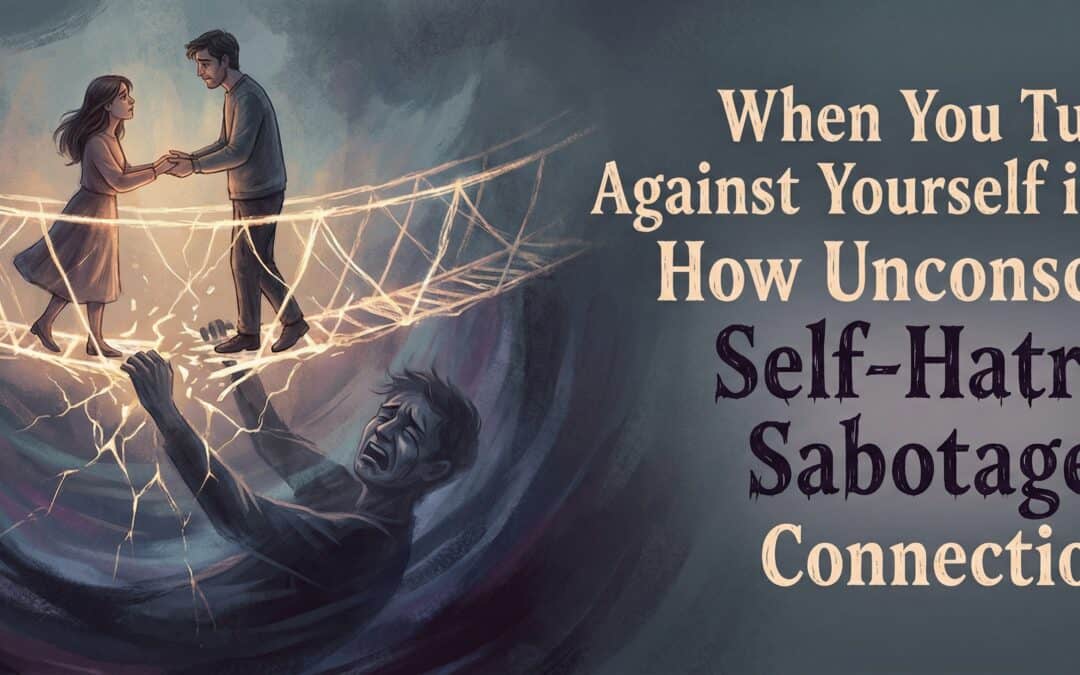
When You Turn Against Yourself in Love: How Unconscious Self-Hatred Sabotages Connection

When You Turn Against Yourself in Love: How Unconscious Self-Hatred Sabotages Connection

The Hidden Enemy Within

You’re lying in bed next to your partner, but you might as well be oceans apart. They reached for your hand earlier, and you pulled away—not because you don’t love them, but because some voice inside whispered, “You don’t deserve this.” Or perhaps you’ve spent the entire evening criticizing the way they loaded the dishwasher, knowing even as the words leave your mouth that this isn’t really about the dishes at all.

What if the most painful patterns in your relationship aren’t really about your partner? They’re about a quiet war you’re waging with yourself—one you often don’t even know you’re fighting.

Self-hatred rarely announces itself with clarity. It doesn’t wake you up declaring, “You’re worthless!” Instead, it operates in the shadows, disguised as perfectionism, self-sacrifice, or protective withdrawal. It’s the voice that says you need to earn love through constant giving, or that you should keep your needs small so you won’t be a burden, or that if your partner really knew you, they’d leave.

This unconscious self-rejection becomes the invisible third party in your relationship—the one calling the shots while you wonder why connection feels so difficult.

How Self-Hatred Sabotages Love

The Over-Giver’s Exhaustion

Sarah works full-time, manages most of the household, and always says yes when her partner asks for help with his projects. She prides herself on being supportive. But underneath, there’s a quiet belief: “If I stop giving, I’ll have nothing to offer. I’m only valuable for what I do.”

She resents her partner for not noticing her exhaustion, but she’s trained him not to see it. Every time she swallows her needs and pushes through, she reinforces her own unworthiness. The relationship becomes transactional—her service in exchange for the right to stay.

Over-giving isn’t generosity when it springs from the belief that you’re not enough as you are.

Over-giving isn’t generosity when it springs from the belief that you’re not enough as you are. It’s a form of self-abandonment, and eventually, it breeds resentment that corrodes intimacy from the inside out.

The Critic’s Shield

Marcus finds fault constantly. His partner leaves a towel on the floor, and he delivers a lecture on respect. She mentions feeling tired, and he points out that he’s tired too—why does she always need sympathy? The relationship has become a courtroom where he’s both judge and prosecutor.

But beneath the criticism lives terror. If he focuses on his partner’s flaws, he doesn’t have to face his own. If he stays vigilant about her imperfections, maybe she won’t notice his. Criticism becomes a wall against intimacy—because intimacy means being truly seen, and being seen feels dangerous when you believe that your true self is fundamentally unacceptable.

The Withdrawer’s Prison

Elena goes quiet when conflict arises. Her partner tries to talk about feeling disconnected, and she retreats into her phone or suddenly remembers urgent work. She tells herself she’s keeping the peace, avoiding drama. Really, she’s avoiding exposure.

The distance you create to protect yourself becomes the very thing that starves the relationship of oxygen.

Deep down, she believes that her feelings are too much, her needs are burdensome, her very presence might be unwelcome if she asks for anything real. So she makes herself small. She withdraws not just physically but emotionally, creating a buffer zone between her vulnerable self and the risk of rejection.

But this protective strategy backfires. The distance she creates to protect herself becomes the very thing that starves the relationship of oxygen. Her partner feels shut out, and Elena feels more alone than ever—trapped in a prison of her own making.


The Roots Beneath the Surface

These patterns don’t emerge from nowhere. They’re adaptations, learned long before your current relationship began.

Perhaps you grew up in a home where love felt conditional—available when you performed well, withdrawn when you didn’t. Maybe a parent was depressed or overwhelmed, and you learned that your needs were a burden. Or perhaps you faced criticism or neglect that taught you that something about you was fundamentally wrong.

Children are meaning-making creatures. When we experience pain or rejection, we rarely blame the limitations of the adults around us. Instead, we conclude: “There must be something wrong with me.” This belief gets wired into our nervous system, our sense of self, our understanding of how love works.

Then we grow up and bring these invisible contracts into our intimate relationships, unconsciously recreating familiar dynamics even as we consciously long for something different.

The Path Back to Yourself—and Each Other

Healing self-hatred isn’t about positive thinking or affirmations plastered over deep wounds. It requires something more honest: the willingness to turn toward yourself with curiosity instead of judgment, and to let your partner witness this journey.

Practice 1: Notice the Inner Narrative

Start by simply paying attention to the voice in your head, especially in moments of conflict or disconnection with your partner.

When you feel yourself pulling away, criticizing, or over-functioning, pause and ask: “What am I telling myself right now about who I am?” You might hear things like:

  • “I’m too needy.”
  • “I’m not doing enough.”
  • “If they knew the real me, they’d leave.”
  • “I always mess things up.”

Don’t try to change these thoughts yet. Just notice them. Write them down. The act of witnessing begins to loosen their grip.

Practice 2: Share the Discovery

This is where courage comes in. The next time you catch yourself in one of your protective patterns, try naming it out loud to your partner—not as confession but as invitation.

It might sound like:

  • “I notice I’m criticizing how you’re cooking dinner, but I think what’s really happening is I’m anxious about something at work and I don’t know how to ask for comfort.”
  • “I’m pulling away right now, and I realize it’s because I’m afraid that if I tell you what I really need, you’ll think I’m too much.”
  • “I keep saying yes to everything, but underneath I’m terrified that if I don’t keep giving, you won’t want me anymore.”
Real intimacy emerges when two people can see their wounds clearly and choose connection anyway.

This kind of vulnerability transforms the dynamic. Instead of your partner experiencing only the defensive behavior—the criticism, withdrawal, or exhausting over-functioning—they get to see the frightened, human part of you underneath. This creates space for connection instead of reaction.

Practice 3: The Dialogue of Self-Acceptance

This exercise helps partners witness and validate each other’s journey toward self-acceptance.

Step One: The Speaker Shares

Choose who will speak first. The speaker completes these sentences:

  • “One way I’ve been turning against myself in our relationship is…”
  • “The old message I’m carrying is…”
  • “What I’m really longing for is…”

For example: “One way I’ve been turning against myself is by withdrawing when I feel hurt instead of telling you. The old message I’m carrying is that my feelings are too much and will drive people away. What I’m really longing for is to feel safe being honest about what’s happening inside me.”

Step Two: The Listener Mirrors

The listener reflects back what they heard, word for word if possible: “So what I’m hearing you say is…” This isn’t about agreeing or fixing—just accurate listening.

Step Three: The Listener Validates

The listener says: “You make sense. I can understand how you might feel that way because…” This acknowledges the logic of the speaker’s experience, even if it’s based on old wounds rather than current reality.

Step Four: The Listener Empathizes

The listener imagines what this might feel like: “I imagine that when you carry this belief, you might feel…” (lonely, scared, exhausted, etc.)

Step Five: Switch Roles

Now the listener becomes the speaker and shares their own pattern of self-rejection.

This practice does something profound: it externalizes the internal conflict. The self-hatred that operated in isolation now has to reveal itself in the light of your partner’s compassionate witness. That changes everything.

Practice 4: Catch the Repetition

Once you’ve identified your pattern, you can begin catching it in real time—ideally before it fully unfolds.

Create a gentle signal with your partner. When you notice yourself starting to over-give, withdraw, or criticize from that defended place, you might say something like: “There it is—that’s the pattern we talked about. Can we pause?”

Then take a moment to reconnect with what you actually need or feel. Try completing this sentence: “What’s really true for me right now is…”

Maybe what’s really true is: “I’m scared. I need reassurance.” Or “I feel overwhelmed and I need help, but I’m afraid to ask.” Or “I’m judging myself harshly right now and I’m deflecting that onto you.”

Practice 5: Practice Receiving

For many people struggling with self-hatred, the hardest thing isn’t giving—it’s receiving. Compliments, help, affection, reassurance—all bounce off the armor of unworthiness.

You can be imperfect, needy, angry, scared—fully human—and still be loved.

Deliberately practice letting love in. When your partner expresses appreciation, affection, or offers support, pause. Notice the urge to deflect, minimize, or immediately reciprocate to balance the scales.

Instead, simply say: “Thank you. I’m going to let that in.” Then take a breath and actually feel it. You might feel vulnerable, uncomfortable, even tearful. That’s okay. You’re retraining your nervous system to recognize that you’re worthy of receiving, not just giving.

A Different Kind of Commitment

Healing self-hatred within a relationship requires something radical: the willingness to disappoint the inner critic that has been running the show. That critic promised to keep you safe by making you perfect, invisible, or indispensable. But safety purchased at the cost of authenticity isn’t safety—it’s a comfortable prison.

Real intimacy emerges when two people can stand before each other, see their own and each other’s wounds clearly, and choose connection anyway. Not because you’ve fixed yourself into lovability, but because you’ve recognized that you were always lovable—you just forgot.

Your partner can’t heal your self-hatred. But in the spaciousness of a relationship where both people are willing to bring their hidden rejections into the light, something remarkable becomes possible: you begin to internalize a different experience. You discover that you can be imperfect, needy, angry, scared—fully human—and still be loved. Not despite these qualities, but inclusive of them.

This is the deeper commitment underneath the commitment to stay together: the commitment to stop abandoning yourself in the name of love, and instead to bring your whole, complicated, beautiful self to the shared space between you.

The war you’ve been waging against yourself doesn’t have to continue. You can lay down your weapons—the criticism, the withdrawal, the exhausting over-giving. You can turn toward yourself with the same kindness you’d offer a frightened child.

And your relationship can become not just a place where two people coexist, but a sanctuary where two people practice, together, the revolutionary act of coming home to themselves and each other.

The journey from self-rejection to self-acceptance isn’t linear, and it’s rarely easy. But every moment you choose curiosity over criticism, vulnerability over withdrawal, and honest need over compulsive giving, you’re rewiring decades of conditioning. You’re teaching your nervous system that it’s safe to be real. And you’re creating the conditions for the kind of love you’ve always longed for—the kind that sees you completely and says, “Yes. You belong here. You always have.”

Choosing Each Other, Again and Again

Choosing Each Other, Again and Again

Choosing Each Other, Again and Again

Love, when it’s new, feels like a spark. But love that lasts is something else entirely—it’s a steady flame you tend, moment by moment. It’s quieter, less dramatic, but infinitely more powerful. It’s not about perfection; it’s about presence.

After every couple’s breakthrough comes the real work—turning the insight of connection into the daily practice of staying connected. That’s what it means to keep choosing each other, again and again.


The Return Home

After a deep season of relational work—therapy, retreat, or an honest reckoning at the kitchen table—many couples describe a similar experience. They return home feeling changed, but also aware that transformation is fragile. The real world tests it: alarm clocks, bills, dirty dishes, work deadlines.

The old patterns wait, patient and familiar. The challenge is not to erase them but to notice them. To remember, in those moments, that there’s a new way to respond—a way that honors the “space between.”

In Imago Relationship Therapy, this “space between” is not just metaphor. It’s the living field of energy between two people. What we fill that space with—curiosity or criticism, attention or avoidance—shapes our experience of love. When partners protect that space with safety and kindness, connection thrives.


From Fireworks to Steady Flame

The couples who make it beyond the breakthrough learn that love isn’t something that happens to them—it’s something they co-create. They move from chemistry to commitment, from intensity to intention.

They start to see that the true romance lies in everyday rituals. The morning coffee left on the counter. The text that says, “Thinking of you.” The courage to say, “I felt hurt,” instead of retreating behind silence.

Every act of repair becomes an act of renewal. Every time they soften after conflict, they are writing a new story: We can fight and still stay connected. We can get lost and still find our way back.


Completing, Not Canceling

For years, the planner and the free spirit drove each other crazy. She longed for spontaneity; he needed predictability. Every vacation became a small war between lists and last-minute whims.

Through their work, they discovered what every lasting couple eventually learns: difference isn’t the enemy; disconnection is.

When they learned to turn curiosity toward each other’s style, something shifted. Her spontaneity began to feel like oxygen to his structured world; his steadiness became the anchor that allowed her to fly.

They didn’t have to change each other—they had to listen long enough to see how each trait served the whole. He could hold the itinerary; she could hold the music. Together, they created balance.

This is the secret gift of difference: when held with respect, it completes what is missing in each of us.


Tiny Rituals, Deep Repair

In the language of Imago, safety is nonnegotiable. Without it, no healing can take root. With it, even the deepest wounds begin to close.

So couples build practices—not grand gestures, but steady habits that tend to the space between.
They do morning check-ins: “How’s your heart today?”
They exchange appreciations before bed: “One thing I loved about you today was…”
They practice “Zero Negativity,” noticing when criticism tries to sneak in and choosing curiosity instead.

When things go wrong (and they always do), they don’t aim for perfection—they aim for repair. A soft tone replaces a sharp one. A gentle touch says, “I want to be close again.” These micro-moments are where transformation lives.

Safety isn’t built once—it’s built daily, through reliability, kindness, and truth-telling.


Two Truths, One Unity

To choose each other again doesn’t mean merging into sameness. It means standing side by side, distinct and connected, like two trees whose roots intertwine underground.

Imago calls this a conscious partnership—a relationship where both partners understand that love is not the absence of tension but the presence of intention. They recognize that what happens between them shapes what lives within them. When the “space between” is safe, each person can grow freely.

Choosing each other again is an act of courage. It means forgiving often, listening deeply, and remembering that love is not a feeling—it’s a practice.

It’s the small pause before speaking in anger. The reaching out instead of turning away. The decision, every day, to nurture the flame.


The Warm Light of the Ordinary

When love matures, it doesn’t disappear—it deepens. The sparkle becomes a glow. The excitement of “you and me” becomes the peace of “we.”

On a quiet Sunday morning, one makes pancakes while the other sets the table. They exchange a smile that says: We made it through another week. We’re still here.

There’s no soundtrack, no applause—just the hum of something holy in the ordinary.

And that’s the miracle of love that lasts: not fireworks, but a steady light that warms the room.

It’s what happens when two imperfect people keep choosing to meet each other—with softness, honesty, and the promise to try again tomorrow.

Real love isn’t a constant high—it’s a deep, steady rhythm of showing up, listening, and softening toward each other.

In conscious partnership, differences stop being dangerous—they become doorways into deeper knowing

Love lasts not because we avoid rupture, but because we learn how to repair it.

Lasting love is built by honoring two truths at once: I am me, and we are us.

Why Your Partner Doesn’t Hear You (And It’s Not What You Think)

Why Your Partner Doesn’t Hear You (And It’s Not What You Think)

Why Your Partner Doesn’t Hear You (And It’s Not What You Think)

You’ve said it three times. Maybe four. Your voice gets a little louder, a little sharper. Your partner looks at you blankly, or worse—they’re scrolling through their phone. “Did you even hear what I just said?” The answer that crushes you isn’t the “no”—it’s the defensive “Yes, I heard you” that proves they didn’t hear you at all. They heard sounds. They didn’t hear *you*.

This is the most common complaint in couples therapy, more frequent than sex, money, or in-laws: “My partner doesn’t listen to me.” But here’s the truth that changes everything—your partner isn’t choosing not to hear you. Their brain literally can’t receive what you’re saying. And it has nothing to do with their ears.

The Invisible Wall Between You

When you feel unheard in your relationship, something biological is happening. Your partner’s nervous system has detected a threat—not a bear or a burglar, but something their unconscious brain has coded as dangerous: your emotional need, your vulnerability, or even just your intensity.

The reptilian brain, which operates 10 times faster than your thinking brain, makes a split-second decision: this conversation is unsafe. Maybe your tone reminded them of a critical parent. Maybe your need triggered their childhood fear of being inadequate. Maybe your emotion activated their family’s unspoken rule that feelings are dangerous.

Whatever the trigger, their brain does what it’s designed to do—it protects them. Blood flow moves away from the prefrontal cortex (where empathy and listening live) and floods the amygdala (where fight, flight, or freeze happen). Your partner might look like they’re listening, but neurologically, they’ve left the building.

You can’t think your way out of a hijacked nervous system. You can’t logic yourself into feeling safe. And this is why “communication skills” alone don’t work—you’re not actually having a communication problem. You’re having a safety problem.

Why “Just Listen!” Doesn’t Work

Most couples try to solve the listening problem by talking *more* or talking *differently*. Use “I statements.” Don’t be so emotional. Be more clear. Pick a better time. Use a softer tone.

These suggestions aren’t wrong, exactly. But they miss the point. When your nervous system is activated, you can’t access these skills. It’s like telling someone who’s drowning to “just swim better.” The problem isn’t technique—it’s that they’re underwater.

One husband described it perfectly: “When my wife starts talking about her feelings, I can feel my whole body tense up. It’s like static fills my brain. I know I should be listening, but I literally can’t process what she’s saying. I’m just waiting for it to be over.”

His wife wasn’t being unreasonable. He wasn’t being dismissive. They were two nervous systems that had learned, decades ago, that emotional conversation equals danger. His brain learned it when his depressed mother needed more than a child could give. Her brain learned it when her alcoholic father raged unpredictably.

They weren’t talking to each other. They were talking to ghosts.

The Imago Revolution: Mirroring

Imago Relationship Therapy discovered something remarkable: if you change *how* you have the conversation, you can override the nervous system’s panic response. The technique is disarmingly simple. It’s called mirroring, and it works like this:

One partner speaks in short sentences—one or two thoughts at a time. The other partner repeats back exactly what they heard: “What I hear you saying is…” Then they ask, “Is there more about that?”

That’s it. No responding. No defending. No fixing. Just reflecting back the exact words like a mirror reflects an image.

It sounds mechanical. It feels awkward at first. Couples often resist it: “This isn’t natural. We don’t talk like this. It feels like a script.”

Exactly. It’s supposed to feel unnatural. Because your “natural” way of talking—interrupting, defending, explaining, solving—is what created the problem. Your natural way triggers your partner’s nervous system. The structure is what makes it safe.

What Actually Happens in Your Brain

When your partner mirrors your words back without adding anything, something neurologically significant happens. Your amygdala (threat detector) starts to calm down. Why? Because you’re being *seen* without being *judged*.

Think about what usually happens. You say, “I feel lonely when you’re on your phone all evening.” Your partner immediately responds: “I’m not on my phone *all* evening” (defending). Or “You’re always criticizing me” (counterattacking). Or “I had a hard day, can’t you understand?” (explaining).

Each of those responses, no matter how reasonable, sends your nervous system a message: *Your experience is wrong. You’re the problem. I’m not safe to be vulnerable with.*

But when your partner simply says, “What I hear you saying is that you feel lonely when I’m on my phone in the evening. Is there more about that?”—everything changes.

Your nervous system registers: *They heard me. They didn’t attack. They didn’t defend. They want to hear more.* This is what safety feels like. And only in safety can real listening—and real change—happen.

The Three Steps That Transform Listening

Imago dialogue has three distinct steps, each building on the previous one:

Step 1: Mirroring – “Let me see if I got that. You’re saying… Did I get that? Is there more?”

This step alone reduces reactivity by 60-70%. When you know you’ll be accurately heard, your nervous system downshifts from emergency mode. When you have to listen carefully enough to repeat back exactly, you can’t simultaneously be crafting your defense.

Step 2: Validation – “You make sense. What makes sense to me is…”

This doesn’t mean you agree. It means you understand their logic from inside their experience. “You make sense” is different from “You’re right.” It says: “Given who you are and what you’ve experienced, I understand how you arrived at this feeling.”

One wife was astounded when her husband said, “It makes sense that you feel unimportant when I’m short with you, because you had that experience with your dad.” She said, “In 15 years, I’ve never felt like he understood. Not until this moment.”

Step 3: Empathy – “I imagine you might be feeling…”

This is where you step fully into your partner’s world. Not to fix it or change it, but to feel with them. “I imagine you might feel scared… or alone… or unimportant.”

When someone says “I imagine you feel…” and names your exact emotion, something almost magical happens. You feel seen at the deepest level. You feel less alone. And paradoxically, the intensity of the emotion often decreases simply because it’s been witnessed.

Why This Works When Nothing Else Does

Couples who learn Imago dialogue report something surprising: “It’s easier than we thought it would be.” Not easy—but easier than the decades of fighting, withdrawing, or silent resentment they’ve endured.

One husband put it this way: “I spent 20 years trying to prove I was right. This way, I just have to prove I was listening. That’s so much simpler.”

Here’s why it works:

It slows you down. You can’t interrupt when your job is to accurately repeat what was said. The structure forces you to actually hear before you respond.

It separates listening from agreeing. Most people won’t listen because they think listening means conceding. “If I validate her feelings, she’ll think she’s right and I’m wrong.” But validation isn’t agreement—it’s acknowledgment. You can understand someone’s experience without sharing it.

It reveals what’s really being said. Often, what someone is asking for isn’t what they first say. “You’re always on your phone” might really mean “I’m afraid I’m not important to you.” Mirroring and asking “Is there more?” lets the deeper truth emerge.

It rewires your emotional history. Every time your partner listens without defending, their brain gets new data: “I can be vulnerable and not be abandoned/criticized/shamed.” This is how childhood wounds heal—through new, corrective experiences with a safe partner.

The Resistance You’ll Feel (And Why It Matters)

Almost every couple resists the structure at first. “This feels robotic.” “We can’t talk like this all the time.” “What if there’s an emergency?”

These objections are your nervous system trying to maintain the status quo. Change feels dangerous, even when the status quo is painful. Your brain prefers the *familiar* painful to the *unfamiliar* potentially better.

But here’s the truth: you don’t have to use this structure all the time. You use it when it *matters*—when you’re discussing something important, when emotions are high, when you’re stuck in a pattern.

Think of it like a fire escape. You don’t use the fire escape to leave your apartment every morning. But when there’s a fire, you’re grateful it exists. Imago dialogue is your relational fire escape.

And something remarkable happens after you practice it for a while: the formal structure becomes less necessary. You internalize the *spirit* of it—curiosity instead of defensiveness, patience instead of reactivity, presence instead of preparing your rebuttal.

One woman described it: “We don’t do the full dialogue every time anymore. But something in me changed. When he talks now, I’m actually curious about what he’s going to say, instead of bracing for criticism. That shift happened because of the structure, but now it’s just who I am.”

What Happens to Couples Who Learn This

The research on Imago dialogue is compelling. Couples who use it regularly report:

  • 48% reduction in conflict frequency
  • 68% increase in feeling “understood”
  • Significant improvements in sexual intimacy
  • Greater ability to handle stress together
  • Increased warmth and affection

But the statistics don’t capture what couples actually experience. They describe it in words like: “relief,” “finally,” “hope,” “breakthrough,” “us again.”

One husband said, “For the first time in our marriage, I don’t dread important conversations. I actually look forward to them because I know we have a way to navigate them.”

Another wife: “I thought the problem was that we needed to talk more. Turns out the problem was how we were talking. When we changed the structure, everything else changed too.”

Your Brain on Connection

Here’s what’s happening neurologically when you’re truly heard:

Your amygdala stops firing distress signals. Your ventral vagal nerve (the safety/connection nerve) activates. Oxytocin releases, creating feelings of bonding and trust. Your prefrontal cortex comes back online, allowing you to think clearly and creatively about solutions.

In other words, being truly heard doesn’t just feel good emotionally—it creates measurable changes in your brain and body. You shift from a state of threat to a state of connection. And only in connection is growth possible.

This is why the quality of your primary relationship affects everything else in your life—your health, your work performance, your parenting, your immune function. Your nervous system is constantly scanning: “Am I safe? Am I alone? Can I be myself?” When your relationship provides a “yes” to these questions, your entire system relaxes. You have energy for creativity, generosity, playfulness, growth.

When your relationship provides a “no”—when you chronically feel unheard, unseen, or unsafe—your system stays in defensive mode. You’re surviving, not thriving. And no amount of meditation, vacation, or self-care can compensate for chronic relational unsafety.

Starting Tonight: The One Thing You Can Do

You don’t have to master the full Imago dialogue to start creating change. You can begin with this one practice:

The next time your partner is talking to you about something that matters to them, do not respond with your thoughts. Instead, simply say: “Let me make sure I understand. What I hear you saying is…” Then repeat back what they said as accurately as you can.

Then ask: “Did I get that right? Is there more?”

That’s it. Don’t add your perspective. Don’t explain your intention. Don’t defend or problem-solve. Just reflect back what you heard.

You will be amazed at what happens. Your partner will likely look surprised, then relieved, then they’ll share something deeper. Because you’ve created a moment of safety. And safety is the doorway to everything else you want in your relationship—passion, intimacy, partnership, joy.

The Truth About Being Heard

Your partner doesn’t fail to hear you because they don’t care. They fail to hear you because their nervous system has learned that emotional vulnerability is dangerous. This learning happened long before you met—probably before they could even speak.

But here’s the beautiful truth of neuroplasticity: the brain can learn new patterns at any age. Every time you create a safe conversation, you’re rewiring decades of defensiveness. Every time your partner mirrors you without judgment, they’re healing their own history while honoring yours.

This is the real work of relationship—not finding someone who instinctively knows how to love you, but becoming someone who can create safety for another nervous system to relax and open.

You are not broken because you don’t feel heard. Your relationship is not doomed because listening has been hard. You simply need a new structure—one that accounts for how humans are actually wired, not how we wish we were wired.

The question isn’t whether your partner loves you enough to listen. The question is: are you both willing to practice a new way of talking until it becomes natural? Are you willing to feel awkward in service of feeling connected?

Most couples, when given the choice between familiar suffering and awkward growth, choose familiar suffering. But you’re reading this, which means you’re different. You’re ready for the awkward growth.

Your partner is waiting to hear you. And you’re waiting to truly listen. The structure that makes both possible already exists. The only question is whether you’ll use it.

Start tonight. One conversation. One “Let me make sure I understand.” One moment of choosing connection over being right.

Everything can change from there.

Your partner isn’t choosing not to hear you—their brain literally can’t receive what you’re saying when their nervous system detects threat.

When your partner mirrors your words without adding anything, your amygdala calms down because you’re being seen without being judged.

Mirroring creates safety by proving you heard without defending, explaining, or fixing—and safety is the doorway to everything else you want.

Every time you create a safe conversation using this structure, you’re rewiring decades of defensiveness in both your brains.

From Breakdown to Breakthrough – Growing Together Through Every Stage of Marriage

From Breakdown to Breakthrough – Growing Together Through Every Stage of Marriage

In a growing marriage, when one layer of tension is resolved, the next layer that needs work often reveals itself

When Solving One Problem Leads to Another

Have you ever felt like as soon as you fix one issue in your marriage, a new one takes its place? You work hard to improve communication about finances, then suddenly you’re clashing over intimacy. You rebuild trust after a crisis, and next you’re arguing about family boundaries. It can be discouraging – like you’re playing whack-a-mole with relationship problems. You might even think, “Should it really be this hard? Are we just too different?”

Believe it or not, this cycle of new conflicts emerging is actually normal in a growing marriage. In fact, it can be a sign that you’re moving forward, not backward. Relationships aren’t static; they evolve through developmental stages, much like individuals do. When you resolve one layer of tension, it often reveals the next layer that needs work. The key is to recognize this as a growth process, not a sign of failure. Let’s explore how one couple discovered the power of embracing each stage of growth in their marriage, using dialogue and patience.

A Couple’s Story: One Step Forward, Two Steps Back?

Consider Rita and Skye, a couple together for 12 years. They cared deeply for each other, but their relationship felt like a roller coaster at times. Early on, they had a major struggle with trust – Skye felt Rita was emotionally distant and worried she couldn’t count on her commitment. With effort, they worked through that and rebuilt their trust. But a few months after that breakthrough, a new conflict erupted over decision-making and control.

Rita, a take-charge executive, was used to calling the shots. Skye, a free-spirited artist, felt stifled and unheard whenever Rita made decisions for both of them (about money, social plans, etc.) without consulting her. Now they were in a power struggle, even though trust was no longer an issue. It was bewildering – after all their progress, here they were fighting about something else. Both began to wonder if they were simply too incompatible to be happy.

They even separated for a short time at one point, only to come back together because they truly loved each other. By the time they sought help from a marriage counsellor, Rita and Skye were exhausted. “We fix one thing, and something else goes wrong,” they lamented. “Are we just not meant to be?”

The Imago Perspective: Every Conflict Is an Invitation to Grow

Their counsellor introduced them to a concept from Imago Relationship Therapy that immediately gave them hope. According to Imago theory, committed partners unconsciously come together to finish childhood – essentially, to help each other heal and grow past the unfinished developmental stages of early life. In other words, the deeper purpose of marriage is to drive personal growth. That means the conflicts you face aren’t random annoyances – they’re the curriculum of your relationship, guiding you toward wholeness.

She explained that relationships tend to move through developmental stages. In each stage, certain core needs emerge and old wounds can be triggered. For example, many couples first have to establish a secure base of connection and trust (Can I count on you and feel safe with you?). Once that’s solid, the next stage often brings up issues of autonomy and power (How can we be close without losing ourselves or feeling controlled?). Later stages might involve identity or self-esteem challenges between partners (Can I be fully myself and still be loved?). According to this view, when one stage’s challenges are resolved, the next stage’s challenges naturally arise. It’s not that you’re “back to square one” – it’s that your relationship is moving up to a new level of intimacy (with new lessons to learn).

This perspective was a revelation for Rita and Skye. They began to reframe their conflicts not as proof that they were wrong for each other, but as opportunities to tackle the next growth area in their relationship. Conflict wasn’t a sign of failure – it was an invitation to deeper understanding and maturity.

Dialogue as a Tool for Growth

Armed with this new mindset, Rita and Skye approached their latest power struggle differently. Instead of throwing up their hands, they got curious. In therapy, they used the Imago Dialogue process (taking turns speaking and truly listening without interrupting) to explore what was really underneath their fights about control. They discovered this stage was touching old childhood wounds for both of them.

For Rita, being in control had been her coping mechanism since childhood – she grew up in chaos and had to become responsible early. Her worst fear was feeling helpless or out of control. So in adult life, when things felt uncertain or chaotic, her reflex was to take charge (without realizing it sometimes shut out Skye’s input). Skye, on the other hand, grew up with very strict, controlling parents. Her core wound was feeling like her voice didn’t matter. So when Rita would “take over,” it struck that old nerve and made Skye shut down or push back to feel heard.

Through intentional dialogue, they truly heard each other’s deeper feelings. Rita finally understood that when she made all the decisions, it left Skye feeling insignificant – just as she had felt as a teenager under her parents’ strict rules. And Skye realized that when she disengaged or resisted everything, it triggered Rita’s fear of chaos – echoing the instability of Rita’s childhood. With this new understanding, they both sincerely apologized and acknowledged each other’s pain.

Next, the counsellor coached them to practice new behaviors to support each other’s growth. Rita worked on sharing power – consulting Skye on decisions and sometimes consciously stepping back to let Skye’s preferences lead, so she could learn that things wouldn’t “fall apart” if she wasn’t controlling them. Skye worked on stepping up – voicing her opinions and needs clearly (instead of quietly stewing) and taking initiative on plans, so she could experience being effective and heard. In short, they each stretched into a more developed version of themselves: Rita learned to relax her grip on control, and Skye learned to assert herself.

Breakthrough: Embracing the Journey

As Rita and Skye applied these changes, their “new” issue began to resolve – just as their earlier trust issue had. More importantly, they learned to view future conflicts with hope rather than dread. They knew there would be more bumps down the road (life always brings them), but now they saw those bumps as signs that they were entering a new growth phase, not that they were doomed.

Instead of seeing their relationship as constantly breaking down, they began to see it as continuously breaking through to deeper levels. Fights became less scary because they realized each one held a lesson for them. With each stage of growth they mastered, they felt more equipped for the next, and their marriage became a true partnership in growth.

Growing Up Together

The journey of marriage is often a journey of personal growth – and growth rarely happens in a straight line. It comes in stages, with spurts and plateaus. If you and your spouse find that new issues crop up just when you thought you had everything figured out, don’t panic. It doesn’t mean your marriage is broken; it may mean it’s evolving.

The key is to approach each new challenge with curiosity and commitment, rather than despair. Marriage counselling can provide valuable perspective and tools, as it did for Rita and Skye. A skilled counsellor can help you identify which developmental stage you’re in and what the real underlying tasks of that stage are. More importantly, they can guide you in using dialogue and empathy to grow through it together.

Remember, a thriving marriage isn’t one with zero conflict – it’s one where conflict leads to growth and deeper connection. Each time you “finish” one chapter and move to the next, you’re building a richer bond with your partner. When you both embrace the idea that you’re in this as growth partners, there’s much less dread when a new issue arises. Instead, you can say, “Alright, what is this trying to teach us, and how can we handle it side by side?”

So if it feels like you keep finding new mountains to climb in your relationship, take a moment to recognize how many you’ve already scaled together. See the pattern: each peak has made you stronger for the next. With that outlook – and perhaps the guidance of marriage counselling – you can face future stages hand in hand. In time, you’ll look back and realize that all those ups and downs molded you into a team with profound trust, flexibility, and love. That’s the beauty of growing up together in marriage: the challenges don’t break you apart; they shape you into a couple that can weather anything, together.

They realized each conflict was not the end, but a stepping stone to a deeper stage of intimacy.

The conflicts you face aren’t random annoyances – they’re the curriculum of your relationship..

“Instead of breaking down, they were breaking through to a stronger, more conscious love.