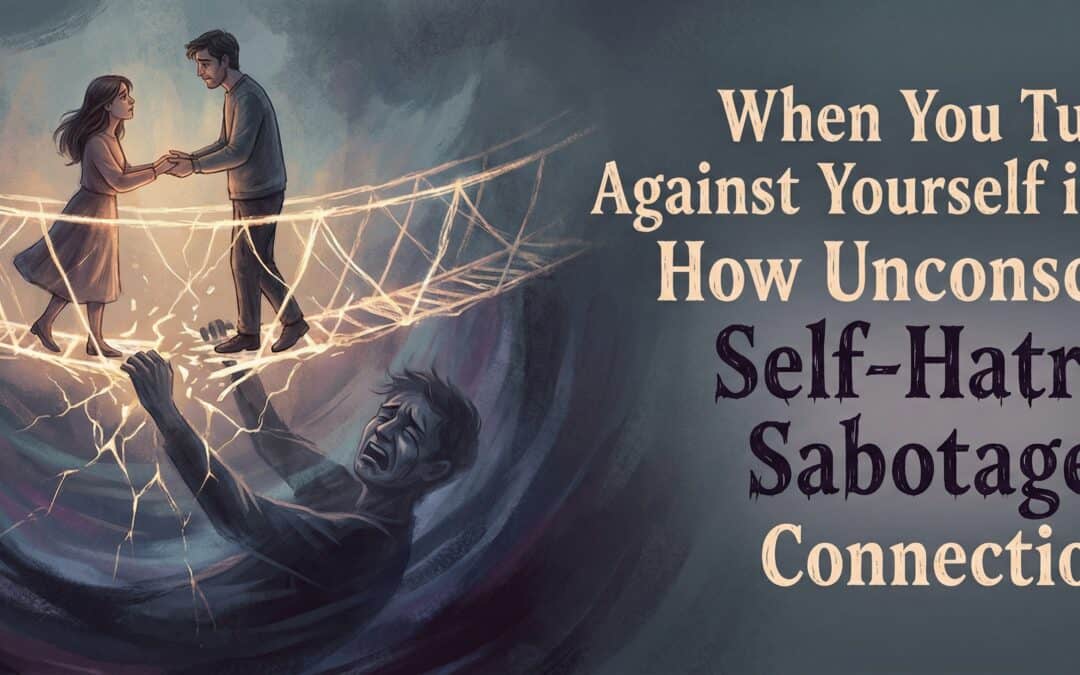
When You Turn Against Yourself in Love: How Unconscious Self-Hatred Sabotages Connection

When You Turn Against Yourself in Love: How Unconscious Self-Hatred Sabotages Connection

The Hidden Enemy Within

You’re lying in bed next to your partner, but you might as well be oceans apart. They reached for your hand earlier, and you pulled away—not because you don’t love them, but because some voice inside whispered, “You don’t deserve this.” Or perhaps you’ve spent the entire evening criticizing the way they loaded the dishwasher, knowing even as the words leave your mouth that this isn’t really about the dishes at all.

What if the most painful patterns in your relationship aren’t really about your partner? They’re about a quiet war you’re waging with yourself—one you often don’t even know you’re fighting.

Self-hatred rarely announces itself with clarity. It doesn’t wake you up declaring, “You’re worthless!” Instead, it operates in the shadows, disguised as perfectionism, self-sacrifice, or protective withdrawal. It’s the voice that says you need to earn love through constant giving, or that you should keep your needs small so you won’t be a burden, or that if your partner really knew you, they’d leave.

This unconscious self-rejection becomes the invisible third party in your relationship—the one calling the shots while you wonder why connection feels so difficult.

How Self-Hatred Sabotages Love

The Over-Giver’s Exhaustion

Sarah works full-time, manages most of the household, and always says yes when her partner asks for help with his projects. She prides herself on being supportive. But underneath, there’s a quiet belief: “If I stop giving, I’ll have nothing to offer. I’m only valuable for what I do.”

She resents her partner for not noticing her exhaustion, but she’s trained him not to see it. Every time she swallows her needs and pushes through, she reinforces her own unworthiness. The relationship becomes transactional—her service in exchange for the right to stay.

Over-giving isn’t generosity when it springs from the belief that you’re not enough as you are.

Over-giving isn’t generosity when it springs from the belief that you’re not enough as you are. It’s a form of self-abandonment, and eventually, it breeds resentment that corrodes intimacy from the inside out.

The Critic’s Shield

Marcus finds fault constantly. His partner leaves a towel on the floor, and he delivers a lecture on respect. She mentions feeling tired, and he points out that he’s tired too—why does she always need sympathy? The relationship has become a courtroom where he’s both judge and prosecutor.

But beneath the criticism lives terror. If he focuses on his partner’s flaws, he doesn’t have to face his own. If he stays vigilant about her imperfections, maybe she won’t notice his. Criticism becomes a wall against intimacy—because intimacy means being truly seen, and being seen feels dangerous when you believe that your true self is fundamentally unacceptable.

The Withdrawer’s Prison

Elena goes quiet when conflict arises. Her partner tries to talk about feeling disconnected, and she retreats into her phone or suddenly remembers urgent work. She tells herself she’s keeping the peace, avoiding drama. Really, she’s avoiding exposure.

The distance you create to protect yourself becomes the very thing that starves the relationship of oxygen.

Deep down, she believes that her feelings are too much, her needs are burdensome, her very presence might be unwelcome if she asks for anything real. So she makes herself small. She withdraws not just physically but emotionally, creating a buffer zone between her vulnerable self and the risk of rejection.

But this protective strategy backfires. The distance she creates to protect herself becomes the very thing that starves the relationship of oxygen. Her partner feels shut out, and Elena feels more alone than ever—trapped in a prison of her own making.


The Roots Beneath the Surface

These patterns don’t emerge from nowhere. They’re adaptations, learned long before your current relationship began.

Perhaps you grew up in a home where love felt conditional—available when you performed well, withdrawn when you didn’t. Maybe a parent was depressed or overwhelmed, and you learned that your needs were a burden. Or perhaps you faced criticism or neglect that taught you that something about you was fundamentally wrong.

Children are meaning-making creatures. When we experience pain or rejection, we rarely blame the limitations of the adults around us. Instead, we conclude: “There must be something wrong with me.” This belief gets wired into our nervous system, our sense of self, our understanding of how love works.

Then we grow up and bring these invisible contracts into our intimate relationships, unconsciously recreating familiar dynamics even as we consciously long for something different.

The Path Back to Yourself—and Each Other

Healing self-hatred isn’t about positive thinking or affirmations plastered over deep wounds. It requires something more honest: the willingness to turn toward yourself with curiosity instead of judgment, and to let your partner witness this journey.

Practice 1: Notice the Inner Narrative

Start by simply paying attention to the voice in your head, especially in moments of conflict or disconnection with your partner.

When you feel yourself pulling away, criticizing, or over-functioning, pause and ask: “What am I telling myself right now about who I am?” You might hear things like:

  • “I’m too needy.”
  • “I’m not doing enough.”
  • “If they knew the real me, they’d leave.”
  • “I always mess things up.”

Don’t try to change these thoughts yet. Just notice them. Write them down. The act of witnessing begins to loosen their grip.

Practice 2: Share the Discovery

This is where courage comes in. The next time you catch yourself in one of your protective patterns, try naming it out loud to your partner—not as confession but as invitation.

It might sound like:

  • “I notice I’m criticizing how you’re cooking dinner, but I think what’s really happening is I’m anxious about something at work and I don’t know how to ask for comfort.”
  • “I’m pulling away right now, and I realize it’s because I’m afraid that if I tell you what I really need, you’ll think I’m too much.”
  • “I keep saying yes to everything, but underneath I’m terrified that if I don’t keep giving, you won’t want me anymore.”
Real intimacy emerges when two people can see their wounds clearly and choose connection anyway.

This kind of vulnerability transforms the dynamic. Instead of your partner experiencing only the defensive behavior—the criticism, withdrawal, or exhausting over-functioning—they get to see the frightened, human part of you underneath. This creates space for connection instead of reaction.

Practice 3: The Dialogue of Self-Acceptance

This exercise helps partners witness and validate each other’s journey toward self-acceptance.

Step One: The Speaker Shares

Choose who will speak first. The speaker completes these sentences:

  • “One way I’ve been turning against myself in our relationship is…”
  • “The old message I’m carrying is…”
  • “What I’m really longing for is…”

For example: “One way I’ve been turning against myself is by withdrawing when I feel hurt instead of telling you. The old message I’m carrying is that my feelings are too much and will drive people away. What I’m really longing for is to feel safe being honest about what’s happening inside me.”

Step Two: The Listener Mirrors

The listener reflects back what they heard, word for word if possible: “So what I’m hearing you say is…” This isn’t about agreeing or fixing—just accurate listening.

Step Three: The Listener Validates

The listener says: “You make sense. I can understand how you might feel that way because…” This acknowledges the logic of the speaker’s experience, even if it’s based on old wounds rather than current reality.

Step Four: The Listener Empathizes

The listener imagines what this might feel like: “I imagine that when you carry this belief, you might feel…” (lonely, scared, exhausted, etc.)

Step Five: Switch Roles

Now the listener becomes the speaker and shares their own pattern of self-rejection.

This practice does something profound: it externalizes the internal conflict. The self-hatred that operated in isolation now has to reveal itself in the light of your partner’s compassionate witness. That changes everything.

Practice 4: Catch the Repetition

Once you’ve identified your pattern, you can begin catching it in real time—ideally before it fully unfolds.

Create a gentle signal with your partner. When you notice yourself starting to over-give, withdraw, or criticize from that defended place, you might say something like: “There it is—that’s the pattern we talked about. Can we pause?”

Then take a moment to reconnect with what you actually need or feel. Try completing this sentence: “What’s really true for me right now is…”

Maybe what’s really true is: “I’m scared. I need reassurance.” Or “I feel overwhelmed and I need help, but I’m afraid to ask.” Or “I’m judging myself harshly right now and I’m deflecting that onto you.”

Practice 5: Practice Receiving

For many people struggling with self-hatred, the hardest thing isn’t giving—it’s receiving. Compliments, help, affection, reassurance—all bounce off the armor of unworthiness.

You can be imperfect, needy, angry, scared—fully human—and still be loved.

Deliberately practice letting love in. When your partner expresses appreciation, affection, or offers support, pause. Notice the urge to deflect, minimize, or immediately reciprocate to balance the scales.

Instead, simply say: “Thank you. I’m going to let that in.” Then take a breath and actually feel it. You might feel vulnerable, uncomfortable, even tearful. That’s okay. You’re retraining your nervous system to recognize that you’re worthy of receiving, not just giving.

A Different Kind of Commitment

Healing self-hatred within a relationship requires something radical: the willingness to disappoint the inner critic that has been running the show. That critic promised to keep you safe by making you perfect, invisible, or indispensable. But safety purchased at the cost of authenticity isn’t safety—it’s a comfortable prison.

Real intimacy emerges when two people can stand before each other, see their own and each other’s wounds clearly, and choose connection anyway. Not because you’ve fixed yourself into lovability, but because you’ve recognized that you were always lovable—you just forgot.

Your partner can’t heal your self-hatred. But in the spaciousness of a relationship where both people are willing to bring their hidden rejections into the light, something remarkable becomes possible: you begin to internalize a different experience. You discover that you can be imperfect, needy, angry, scared—fully human—and still be loved. Not despite these qualities, but inclusive of them.

This is the deeper commitment underneath the commitment to stay together: the commitment to stop abandoning yourself in the name of love, and instead to bring your whole, complicated, beautiful self to the shared space between you.

The war you’ve been waging against yourself doesn’t have to continue. You can lay down your weapons—the criticism, the withdrawal, the exhausting over-giving. You can turn toward yourself with the same kindness you’d offer a frightened child.

And your relationship can become not just a place where two people coexist, but a sanctuary where two people practice, together, the revolutionary act of coming home to themselves and each other.

The journey from self-rejection to self-acceptance isn’t linear, and it’s rarely easy. But every moment you choose curiosity over criticism, vulnerability over withdrawal, and honest need over compulsive giving, you’re rewiring decades of conditioning. You’re teaching your nervous system that it’s safe to be real. And you’re creating the conditions for the kind of love you’ve always longed for—the kind that sees you completely and says, “Yes. You belong here. You always have.”

Choosing Each Other, Again and Again

Choosing Each Other, Again and Again

Choosing Each Other, Again and Again

Love, when it’s new, feels like a spark. But love that lasts is something else entirely—it’s a steady flame you tend, moment by moment. It’s quieter, less dramatic, but infinitely more powerful. It’s not about perfection; it’s about presence.

After every couple’s breakthrough comes the real work—turning the insight of connection into the daily practice of staying connected. That’s what it means to keep choosing each other, again and again.


The Return Home

After a deep season of relational work—therapy, retreat, or an honest reckoning at the kitchen table—many couples describe a similar experience. They return home feeling changed, but also aware that transformation is fragile. The real world tests it: alarm clocks, bills, dirty dishes, work deadlines.

The old patterns wait, patient and familiar. The challenge is not to erase them but to notice them. To remember, in those moments, that there’s a new way to respond—a way that honors the “space between.”

In Imago Relationship Therapy, this “space between” is not just metaphor. It’s the living field of energy between two people. What we fill that space with—curiosity or criticism, attention or avoidance—shapes our experience of love. When partners protect that space with safety and kindness, connection thrives.


From Fireworks to Steady Flame

The couples who make it beyond the breakthrough learn that love isn’t something that happens to them—it’s something they co-create. They move from chemistry to commitment, from intensity to intention.

They start to see that the true romance lies in everyday rituals. The morning coffee left on the counter. The text that says, “Thinking of you.” The courage to say, “I felt hurt,” instead of retreating behind silence.

Every act of repair becomes an act of renewal. Every time they soften after conflict, they are writing a new story: We can fight and still stay connected. We can get lost and still find our way back.


Completing, Not Canceling

For years, the planner and the free spirit drove each other crazy. She longed for spontaneity; he needed predictability. Every vacation became a small war between lists and last-minute whims.

Through their work, they discovered what every lasting couple eventually learns: difference isn’t the enemy; disconnection is.

When they learned to turn curiosity toward each other’s style, something shifted. Her spontaneity began to feel like oxygen to his structured world; his steadiness became the anchor that allowed her to fly.

They didn’t have to change each other—they had to listen long enough to see how each trait served the whole. He could hold the itinerary; she could hold the music. Together, they created balance.

This is the secret gift of difference: when held with respect, it completes what is missing in each of us.


Tiny Rituals, Deep Repair

In the language of Imago, safety is nonnegotiable. Without it, no healing can take root. With it, even the deepest wounds begin to close.

So couples build practices—not grand gestures, but steady habits that tend to the space between.
They do morning check-ins: “How’s your heart today?”
They exchange appreciations before bed: “One thing I loved about you today was…”
They practice “Zero Negativity,” noticing when criticism tries to sneak in and choosing curiosity instead.

When things go wrong (and they always do), they don’t aim for perfection—they aim for repair. A soft tone replaces a sharp one. A gentle touch says, “I want to be close again.” These micro-moments are where transformation lives.

Safety isn’t built once—it’s built daily, through reliability, kindness, and truth-telling.


Two Truths, One Unity

To choose each other again doesn’t mean merging into sameness. It means standing side by side, distinct and connected, like two trees whose roots intertwine underground.

Imago calls this a conscious partnership—a relationship where both partners understand that love is not the absence of tension but the presence of intention. They recognize that what happens between them shapes what lives within them. When the “space between” is safe, each person can grow freely.

Choosing each other again is an act of courage. It means forgiving often, listening deeply, and remembering that love is not a feeling—it’s a practice.

It’s the small pause before speaking in anger. The reaching out instead of turning away. The decision, every day, to nurture the flame.


The Warm Light of the Ordinary

When love matures, it doesn’t disappear—it deepens. The sparkle becomes a glow. The excitement of “you and me” becomes the peace of “we.”

On a quiet Sunday morning, one makes pancakes while the other sets the table. They exchange a smile that says: We made it through another week. We’re still here.

There’s no soundtrack, no applause—just the hum of something holy in the ordinary.

And that’s the miracle of love that lasts: not fireworks, but a steady light that warms the room.

It’s what happens when two imperfect people keep choosing to meet each other—with softness, honesty, and the promise to try again tomorrow.

Real love isn’t a constant high—it’s a deep, steady rhythm of showing up, listening, and softening toward each other.

In conscious partnership, differences stop being dangerous—they become doorways into deeper knowing

Love lasts not because we avoid rupture, but because we learn how to repair it.

Lasting love is built by honoring two truths at once: I am me, and we are us.

Every Argument Turns into a Blame Game – How Imago Dialogue Breaks the Cycle

Every Argument Turns into a Blame Game – How Imago Dialogue Breaks the Cycle

Blame might feel satisfying for a moment, but it drives a wedge between you and your partner.

Stuck in the Blame Game

Does this sound familiar? One of you says, “This is your fault,” and the other fires back with, “No, it’s yours!” Every argument becomes a tennis match of blame – and no one ever really wins. When conflicts always turn into pointing fingers, both partners walk away feeling hurt, misunderstood, and defensive. It’s natural to want to defend yourself when you feel attacked. Unfortunately, that instinct to blame or criticize back only fuels the fire. You end up in a loop where the original issue gets lost amid the accusations. The result? More distance, not resolution.

Living in a blame game is exhausting. You might dread bringing up issues because you know it will spiral into “who’s fault is it this time?” Instead of feeling like a team, you start to feel like opponents. Blame can even erode trust and safety in the relationship – after all, it’s hard to open up to someone if you fear they’ll just make you feel wrong. The tragedy is that beneath the blame, there’s usually pain and longing. You actually want to be heard and cared for, but it comes out as an attack. So how do you break this toxic cycle?

A No-Blame Approach with Imago Couples Dialogue

The Imago Couples Dialogue fundamentally changes the tone of your conversations by taking blame off the table. It creates a structured way to talk where criticism and shame are replaced with curiosity and respect. When you and your partner sit down for an Imago Dialogue, you both agree to certain ground rules that make blame virtually impossible. One rule is that the person speaking (the Sender) talks about their own feelings and experiences – not their partner’s faults. Instead of saying, “You never listen to me,” the Sender might say, “I feel lonely and unheard when I’m not listened to.” See the difference? The focus shifts from accusing your partner to sharing your inner experience.

The other partner’s role (the Receiver) is to listen and mirror back what they heard, without adding any commentary or defense. In Imago Dialogue, the Receiver isn’t allowed to say, “Well, here’s why that’s your fault,” or anything of the sort. They simply reflect the Sender’s words and feelings as accurately as possible, then validate (acknowledge that the Sender’s perspective makes sense) and offer empathy. This structure keeps the conversation safe. No one is blaming or judging; you’re each trying to understand the other. It might feel awkward at first to hold back your usual retorts, but that’s where the beauty lies – the usual blame game can’t take hold when you follow the dialogue process.

Breaking the Cycle and Healing Together

When you remove blame from your interactions, something amazing happens: both of you can finally lower your guard. If you’re not busy defending yourself from attack, you can actually listen. Imago Dialogue helps you see the hurt or concern behind your partner’s complaints, rather than focusing on the way it was delivered. For example, instead of hearing “it’s your fault” and bristling, you might hear “my partner is really hurting and needs my support.” That shift in perspective is everything. It turns an argument into an opportunity to care for each other.

As you practice communicating this way, you start to feel safer with each other. The defensive walls come down because you learn that it’s safe to express feelings – you won’t be blamed or shamed for how you feel. And when you’re the one listening, you realize that hearing your partner’s feelings doesn’t mean you’re a bad person; it just means they trust you enough to be vulnerable. Each dialogue you have without lapsing into blame builds a little more trust. Over time, that trust grows into a new norm: you both know you’re on the same side, tackling challenges together instead of attacking each other.

In fact, couples who commit to a blame-free dialogue often find that conflicts get resolved faster and more peacefully. When the negativity is out of the way, you can focus on solutions. You can say, “Okay, how do we fix this?” rather than “who caused this?” Imago Dialogue encourages you to also incorporate positive language – like appreciations and requests. Rather than criticizing what went wrong, you learn to ask for what you need in a loving way. Replacing negativity with positive intention doesn’t mean ignoring problems; it means addressing them with kindness instead of criticism. The difference in outcomes is huge: instead of lingering bitterness, you start feeling understood and supported.

From Blame to Empathy – Give It a Try

Escaping the blame game is one of the best things you can do for your relationship. It frees you from that exhausting cycle of attack and defend. Imago Couples Dialogue is the advanced tool that makes this possible, by giving you a step-by-step process to communicate with zero negativity. Imagine what it would be like to talk about a tough issue and actually feel closer afterward, rather than resentful. That’s the power of shifting from blame to empathy.

You can experience this shift for yourselves by trying the Imago Dialogue process. To make it easier, we offer a free online dialogue tool that guides you through it. It provides prompts so you can practice speaking and listening without blame or interruption. If every argument has been a blame game so far, it’s time for a new game plan. Try the free online Imago Couples Dialogue tool at https://imagorelationship.co.za/dialogue/. You’ll discover that when the blame stops, real understanding begins – and with it, a happier, stronger connection.

“Imago Dialogue replaces the blame game with a safe space where both of you can be heard without judgment.

When you stop blaming and start listening, you transform arguments into opportunities for understanding.

Removing negativity isn’t about ignoring problems – it’s about tackling them without attacking each other.

Counseling Felt Great… Until We Got Home – Making Progress Last with Imago Dialogue

Counseling Felt Great… Until We Got Home – Making Progress Last with Imago Dialogue

“Counseling felt great… until we got home.”

The After-Therapy Slump

Walking out of a counseling session, you feel hopeful. In the therapist’s office, you communicated better than you have in ages. You understood each other, maybe even held hands on the way to the car. But fast forward a few days (or even hours), and it’s like the session never happened. The same old argument flares up, or the silence falls back between you. It’s discouraging – how could things feel so right with the counselor, and so hard at home? This rollercoaster is common.

Therapy gave you a glimpse of how good things could be – Imago Dialogue helps you live that reality every day.

Many couples experience this whiplash. It doesn’t mean your therapy isn’t working or that you don’t care. It usually means that in day-to-day life, you lack the tools or environment that the counselor provided. Think of therapy like training wheels – it shows you what a balanced, healthy communication feels like. The goal is to eventually ride on your own. But if you just take the training wheels off without another support in place, you might wobble or fall over. That’s where Imago Couples Dialogue comes in.

Bringing the Therapy Room Home

Imago Couples Dialogue allows you to recreate, in your own living room, the kind of structured, respectful communication you experienced in counseling. In therapy, the counselor probably made sure each of you got to talk without interruption, encouraged you to listen to each other, and kept things safe and productive. Imago Dialogue gives you a format to do exactly that for yourselves.

Without a therapist’s guidance, old habits can creep back in. Imago Dialogue becomes your at-home guide for staying on track.

If an issue arises, instead of a shouting match or retreat into silence, one of you can say, “Can we do an Imago Dialogue about this?” That’s your cue to switch gears. You sit facing each other, and one speaks while the other mirrors and listens—no therapist needed. It might feel structured at first, but that structure is your safety net.

Making the Change Stick

When you consistently use Imago Dialogue at home, the growth from counseling doesn’t just stick—it compounds. You start to catch conflicts early. You reconnect faster. Over time, the dialogue becomes second nature. You’re no longer relying on your next counseling session to “fix” things—you’re staying connected daily.

The true test of any couples therapy is what happens at home. Dialogue gives you the tools to succeed where it really counts.

That doesn’t mean therapy isn’t valuable—it is. But think of Imago Dialogue as your daily workout, and your counselor as a coach you check in with. The real transformation comes from the practice, not just the insights. And this practice creates real, lasting change.

Your Relationship, Your Tools

Falling back into old patterns after a great session doesn’t mean you failed—it means you need a bridge. Imago Dialogue is that bridge. It lets you take the good feelings from therapy and turn them into a lifestyle of connection, empathy, and conscious love.

Why wait for the next counseling session to connect? Imago Dialogue empowers you to create healing conversations anytime you need.

Want to try it now? Use our free online tool to get started: https://imagorelationship.co.za/dialogue/. Don’t wait for the next crisis—use the Dialogue to build connection before the breakdown.